
John Roach, Esq. | October 7, 2026 | Car Accidents
Waymo Accident Lawyer in San Francisco: Who’s Liable When a Self-Driving Car Crashes?

Waymo robotaxis are now a normal part of getting around San Francisco, and in my view they’re among the safest ways to do it, though certainly not the cheapest. They don’t text, drive drunk, or run yellows to make a meeting. When a Waymo is involved in a collision, the self-driving car usually isn’t the cause.
Usually isn’t the same as never, though. Waymo can be responsible for an injury in a narrow set of situations, and when that happens, people often don’t know what to do. There’s no driver to exchange information with, no one at the scene to say what happened, and no license or insurance card to photograph.
California law handles these cases with the same questions it always asks: who acted unreasonably, and did that conduct cause the injury? The only difference is that the questions are aimed at a company instead of a person. This guide covers when Waymo may actually be liable and when it isn’t, the negligence theories that apply in those narrow cases, the evidence that decides them, and how to open a claim without damaging it. For a local example of how one of these incidents unfolded, see our breakdown of the Waymo crosswalk incident in Noe Valley.
No Human Driver Does Not Mean No Liable Party
California regulates autonomous vehicles under Vehicle Code section 38750 and the DMV regulations adopted under it. Waymo runs its driverless service under a DMV deployment permit and a California Public Utilities Commission (CPUC) permit to carry passengers. Neither framework leaves a gap where “the car did it” ends the inquiry. For ordinary negligence purposes, that is how these cases are being built: the autonomous driving system stands in the shoes of a human driver. The company that deploys it owes the same duty of reasonable care a human driver owes, and an injured person proves breach, causation, and damages the same way as in any San Francisco car accident case.
There is also real money behind that duty. Under CPUC Decision 20-11-046, a permitted driverless passenger carrier must carry at least $5 million in liability coverage. When a Waymo causes a crash, that policy is usually the answer to the first question every injured person asks: who pays?
Several legal theories typically overlap in an autonomous vehicle (AV) case:
- Negligence against the operator. The company answers for the vehicle’s driving decisions: following too closely, failing to yield, entering an intersection unsafely, or reacting erratically to a nearby cyclist or pedestrian.
- Negligence per se. Under Evidence Code section 669, violating a safety statute creates a presumption of negligence when the violation caused the kind of injury the statute was written to prevent. If the AV broke a specific traffic law, that violation can carry the breach element on its own.
- Product liability for a design defect. Separately from how the car behaved in the moment, an injured person can allege the self-driving software or sensor system was defectively designed, for example if it failed to detect a cyclist in close range. This is not automatic. California requires proof under either the consumer-expectations test or the risk-benefit test, plus proof that the defect caused the injury. These claims are expert-driven and lean heavily on the vehicle’s own data.
- A heightened duty to passengers. If you were riding in the Waymo, there is a strong argument that the company owes passengers the “utmost care and diligence” California demands of common carriers under Civil Code section 2100. How courts apply that standard to driverless ride services is still developing, but it is the same duty analysis that governs Muni and other transit carriers.
If you are trying to evaluate one of these cases, do not get distracted by the novelty of “no driver.” The core questions are the same ones you would ask about any at-fault driver: what did the vehicle do, was it unreasonable, and did it cause the injury? The difference is that the defendant is a well-funded technology company with its own engineers, insurers, and lawyers, much like the corporate defendants in Tesla Autopilot crash cases.
Common Negligence Theories in Self-Driving Car Collision Cases
Autonomous vehicle collisions tend to fall into a handful of recurring patterns. Identifying which one fits the facts early shapes how the claim gets investigated and argued.
- Failure to yield or an unsafe lane change. The same conduct that creates liability for a human driver applies directly to an AV’s decision-making.
- Blocking the box. Vehicle Code section 22526, California’s anti-gridlock law, prohibits entering an intersection or marked crosswalk unless there is enough space on the other side to clear it, even when the signal says go. An AV that enters without that clearance and ends up stopped in the path of cross traffic, pedestrians, or cyclists has committed a specific statutory violation that can support negligence per se.
- Erratic movement near cyclists and pedestrians. Sudden starts, stops, or lane shifts near someone navigating around the vehicle raise a straightforward duty-of-care argument on their own. These are the facts we see most often in bicycle accident claims and pedestrian accident claims involving AVs.
- Failure to detect a person or object. If the perception system failed to register someone in close proximity, that supports both a negligence theory and a design-defect theory, and it is proven almost entirely through the vehicle’s telemetry.
- Post-impact movement. Waymo’s own collision guidance says a vehicle may keep driving after a collision to reach a safe place to stop. That is designed behavior, but if the vehicle moved while a person was still in or near its path, the post-impact movement raises its own negligence question.
Whichever theory fits, the throughline is the same: who created the dangerous situation, and was the collision a foreseeable result of it? That framing, not just who physically made contact, should drive the early investigation. When more than one vehicle is involved, the analysis looks a lot like any multi-vehicle accident in San Francisco, with fault divided among every party who contributed.
What Changed on July 1, 2026: Police Can Now Write Up Robotaxis
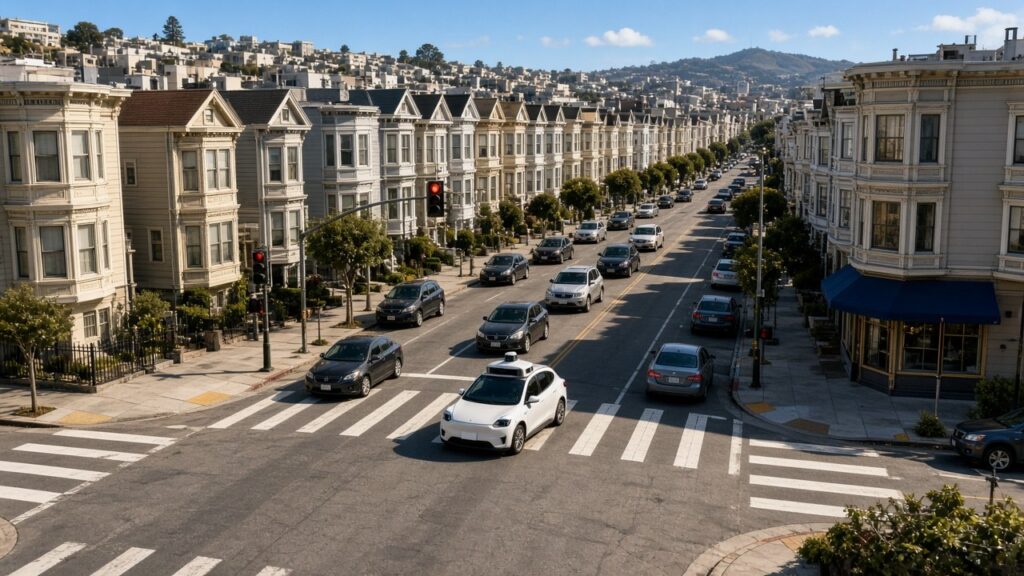
Until this year, a driverless car that ran a red light or blocked an intersection could not receive a traffic ticket because there was no driver to cite. Assembly Bill 1777 changed that. Since July 1, 2026, under Vehicle Code section 38752, a peace officer who observes a driverless AV violate the Vehicle Code or a local traffic ordinance while its autonomous technology is engaged can issue a Notice of Autonomous Vehicle Noncompliance. The notice goes to the manufacturer, not to a driver. The manufacturer has to get it to the DMV within 72 hours. That clock runs from issuance under the statute and from receipt under DMV guidance, and it drops to 24 hours if the officer marks the notice for priority review. AB 1777 also requires AV companies to staff a dedicated emergency response line and give first responders a way to talk to a remote operator at the scene.
Two cautions for anyone building a civil claim. First, this is not a conventional traffic citation. Section 38752(d) states expressly that a notice does not create a presumption the vehicle was unsafe, and the company remains free to contest it. Second, a notice is a lead, not proof. It documents what an officer observed, when, and where, which helps target subpoenas and depositions, but negligence still has to be established with evidence. The same is true of any police report, which is why it matters what you do when a police report gets the facts wrong.
Checklist: Building a Liability Case Against a Self-Driving Car
AV cases are won or lost on evidence that disappears fast: sensor logs, nearby camera footage, and fresh witness memory. Move on these as early as possible. Our free guide to the first 10 days after a car accident in San Francisco walks through the same timeline in more detail.
- Send Waymo a written evidence-preservation (litigation hold) letter immediately. Demand retention of all lidar, radar, camera, perception-system, and remote-assistance logs for that vehicle covering the incident window. This data is the case, and routine retention cycles can overwrite it.
- Ask the responding officer whether a Notice of Autonomous Vehicle Noncompliance was issued, and get the incident or report number before you leave. Call 911 and get a police response at the scene if at all possible.
- Flag any public-entity angle on day one. Signal timing, sightlines, missing “Do Not Block Intersection” markings, or a Muni vehicle in the sequence can bring the City or another public entity into the case, and that claim is due within six months, not two years (details below). The City’s own crash data on San Francisco’s most dangerous intersections is a useful starting point.
- Record the vehicle’s identifying details: the fleet ID and license plate on the exterior, exact location, direction of travel, and the time to the minute.
- Identify every bystander who stopped or saw the sequence. Robotaxi incidents draw crowds, and those people scatter quickly. Get names and phone numbers on the spot.
- Photograph the vehicle’s final resting position, the signal heads and their phase, any skid marks or debris, intersection markings, and the point of contact.
- Get a medical evaluation immediately, even if symptoms seem mild. Concussions and soft-tissue injuries often worsen over the following hours and days, and the medical record needs to start at the scene or the ER, not a week later.
- Canvass for third-party surveillance footage from storefronts, transit cameras, and parking garages before it is automatically deleted, often within 7 to 30 days.
- Write down or record your own account of the sequence while it is fresh, before any conversation with the company’s claims team.
- Assess comparative-fault exposure honestly and early so the file is built to answer the defense’s argument before it is made.
- Track damages from day one: ambulance and ER bills, imaging, follow-up care, lost wages, and property damage to a bike, vehicle, or personal items.
How to Open a Claim Against Waymo, Step by Step
- Report the collision to Waymo. Waymo accepts collision reports by phone at 1-844-263-9885, through its online collision form, by scanning the QR code on the vehicle’s front doors, or by email to insurance@waymo.com. According to Waymo, a member of its risk and insurance team reviews every reported collision.
- Get a reference number and the adjuster’s contact information before the first call ends, and confirm both in writing by email the same day.
- Send the evidence-preservation letter at the same time as the initial report, addressed to Waymo’s risk and insurance team. Do not wait for a claim number to make this demand.
- Check for the DMV collision report. AV manufacturers must report collisions involving property damage, bodily injury, or death to the DMV on form OL 316 within 10 days, and the DMV publishes those Autonomous Vehicle Collision Reports. The company’s own narrative of the crash is worth reading early.
- File an SR-1 if you were driving. If you were operating a vehicle in the collision and anyone was injured or killed, or property damage to any one person exceeded $1,000, the SR-1 must reach the DMV within 10 days. This applies to drivers. A pedestrian or cyclist generally does not file one, but should still request the police report.
- Avoid a recorded statement without counsel. Waymo’s guidance asks involved parties for photos and a description of what happened, which is reasonable for basic reporting. A detailed recorded statement before you have spoken with a lawyer can lock in language that gets used against the claim. The tactics insurance adjusters use do not change because the insured is a tech company.
- If you were a passenger, pull the app’s terms. Ride-service terms of service can include arbitration provisions, sometimes with a short opt-out window. Whether those terms reach an injury claim depends on their exact language and the facts, so have them reviewed before you file anywhere. Passenger claims raise many of the same issues as Uber and Lyft passenger injury cases.
- Document damages as they accrue: ER and ambulance records, imaging, specialist referrals, physical therapy, lost income, and repair or replacement costs. Daily-life impact matters too, and it is how you prove pain and suffering in California.
- Know the filing deadline. A California personal injury claim against a private company generally must be filed within two years of the injury under Code of Civil Procedure section 335.1. See our guide to the California statute of limitations. That sounds like a long runway, but sensor data and third-party footage can be gone within weeks. The deadline that usually matters first is the one for preserving evidence.
When the City Shares the Blame: The Six-Month Government Claim Deadline
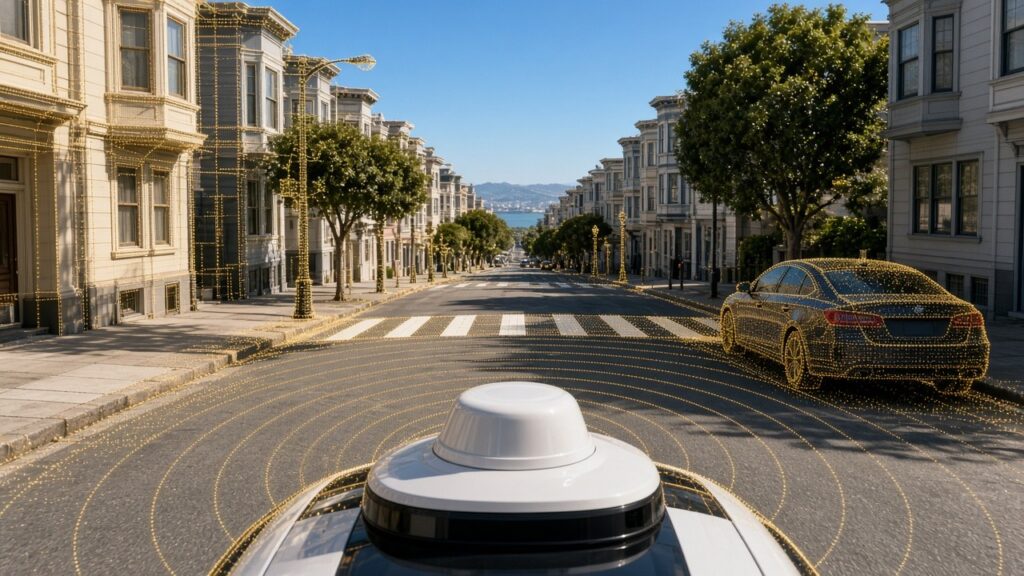
Not every AV collision is only the operator’s fault. A mistimed signal, a missing “Do Not Block Intersection” marking, sightlines blocked by city-controlled conditions, or a Muni vehicle in the chain of events can bring a public entity into the case. Public entities in California can be liable for a dangerous condition of public property under Government Code section 835.
Key deadline: A personal injury claim against the City and County of San Francisco, SFMTA, Caltrans, or another California public entity must generally be presented in writing within six months of the incident under Government Code section 911.2, before any lawsuit can be filed. The two-year statute of limitations that applies to Waymo does not protect a claim against the City. Miss the six-month window and the public-entity claim can be lost even while the case against the AV company is still open. Our guide to the six-month government claim deadline explains the process, and our government claims practice handles these filings directly.
Partial Fault Does Not Mean No Recovery
A common reason people never call a lawyer after one of these collisions is the assumption that being partly involved in how the contact happened means they have no case. California does not work that way. Under the pure comparative negligence rule the California Supreme Court adopted in Li v. Yellow Cab Co. (1975), a jury can find an injured person partly at fault without barring recovery. It simply reduces the award by that percentage. Someone found 20 percent at fault on a $100,000 claim still recovers $80,000.
The real question is never “was I partly responsible?” It is “how should responsibility be divided?” A company whose vehicle broke the rules of the road or behaved unpredictably near a vulnerable road user typically bears the larger share. Our deeper explainer on California comparative fault covers how insurers use this rule to discount claims and how to counter it.
Why the Lawyer You Choose Matters in a Waymo Case
A case against an autonomous vehicle company is a case against a sophisticated corporate defendant that controls the most important evidence. It calls for a lawyer who will send the preservation demand on day one, work with technical experts, and take the case to a jury if the company will not pay what it owes. John J. Roach has represented injured people in the Bay Area since 2009, holds a 9-for-9 trial record, and has recovered more than $25 million for clients, including a $6 million pedestrian brain injury settlement. You can review more case results or read about his approach to brain injury cases. Every case is handled directly by John, in English or Spanish, with no interpreters.
Frequently Asked Questions About Waymo Accidents
Yes. California treats the company that deploys an autonomous vehicle as responsible for how it drives. You can bring a negligence claim against the operator, and in some cases a product liability claim if the self-driving system was defectively designed. You still have to prove the vehicle acted unreasonably and caused your injuries, the same as in any car accident case.
If the Waymo was at fault, the operator’s liability insurance is the primary source of compensation for medical bills, lost wages, and pain and suffering. Under CPUC Decision 20-11-046, permitted driverless passenger carriers must carry at least $5 million in liability coverage. In the meantime, your own health insurance or medical payments coverage can pay bills as they come in, and those payers may assert a lien on the eventual recovery.
The vehicle’s own data: lidar, radar, camera footage, and perception and remote-assistance logs from the incident window. That data belongs to the company and can be overwritten under routine retention cycles, which is why a written preservation letter should go out immediately. Third-party surveillance video and witness contact information are close behind.
Since July 1, 2026, police can issue a Notice of Autonomous Vehicle Noncompliance under Vehicle Code section 38752 when a driverless car commits a traffic violation. The notice goes to the manufacturer, which must forward it to the DMV within 72 hours (24 hours if the officer requests priority review). It is not a conventional ticket and does not by itself prove the vehicle was unsafe, but it can be a valuable lead in a civil case.
Generally two years from the date of injury for a claim against a private company like Waymo. If a public entity such as the City of San Francisco or SFMTA shares responsibility, a written government claim must usually be filed within six months. Evidence can disappear in days, so the practical deadline is much shorter than either.
Reporting the collision and sharing basic facts and photos is fine. A detailed recorded statement is different. It is best to speak with a lawyer first, because statements given before you understand your injuries or the evidence are often used later to minimize the claim.
You can still recover. California follows pure comparative negligence, so your compensation is reduced by your percentage of fault rather than eliminated. If you were 20 percent at fault on a $100,000 claim, you would still recover $80,000.
No. The consultation is free, and personal injury cases are handled on a contingency fee, which means no fee unless there is a recovery. Call (415) 851-4557 to speak with John Roach directly, in English or Spanish.
Hurt by a Self-Driving Car? Talk to a Lawyer Before the Evidence Is Gone
If you or someone in your family was hurt in a collision with a Waymo or another autonomous vehicle anywhere in the Bay Area, call (415) 851-4557 or request your free consultation. The sensor data, camera footage, and witness memory that decide these cases start disappearing within days, and a preservation demand is the first thing we send.
¿Usted o un familiar resultó lesionado en un choque con un Waymo u otro vehículo sin conductor? Llame al (415) 851-4557. El abogado John Roach le atiende personalmente en español, sin intérpretes, y la consulta es gratuita. Su estatus migratorio no le impide presentar un reclamo por lesiones en California. Conozca más sobre nuestro abogado de lesiones personales en San Francisco o sobre los casos de accidentes de auto.