

This case resolved through a confidential settlement, which means I’m bound by more than my usual practice of protecting a client’s privacy — I’m bound by a signed agreement not to disclose the parties’ names or the details that would identify them. Everything below is told without names, without the specific intersection, and without the case number. The dollar figure and the injury type are already part of my public record of results; what follows is the fuller story behind that number, told in a way that keeps my client’s and the defendants’ identities out of it entirely.
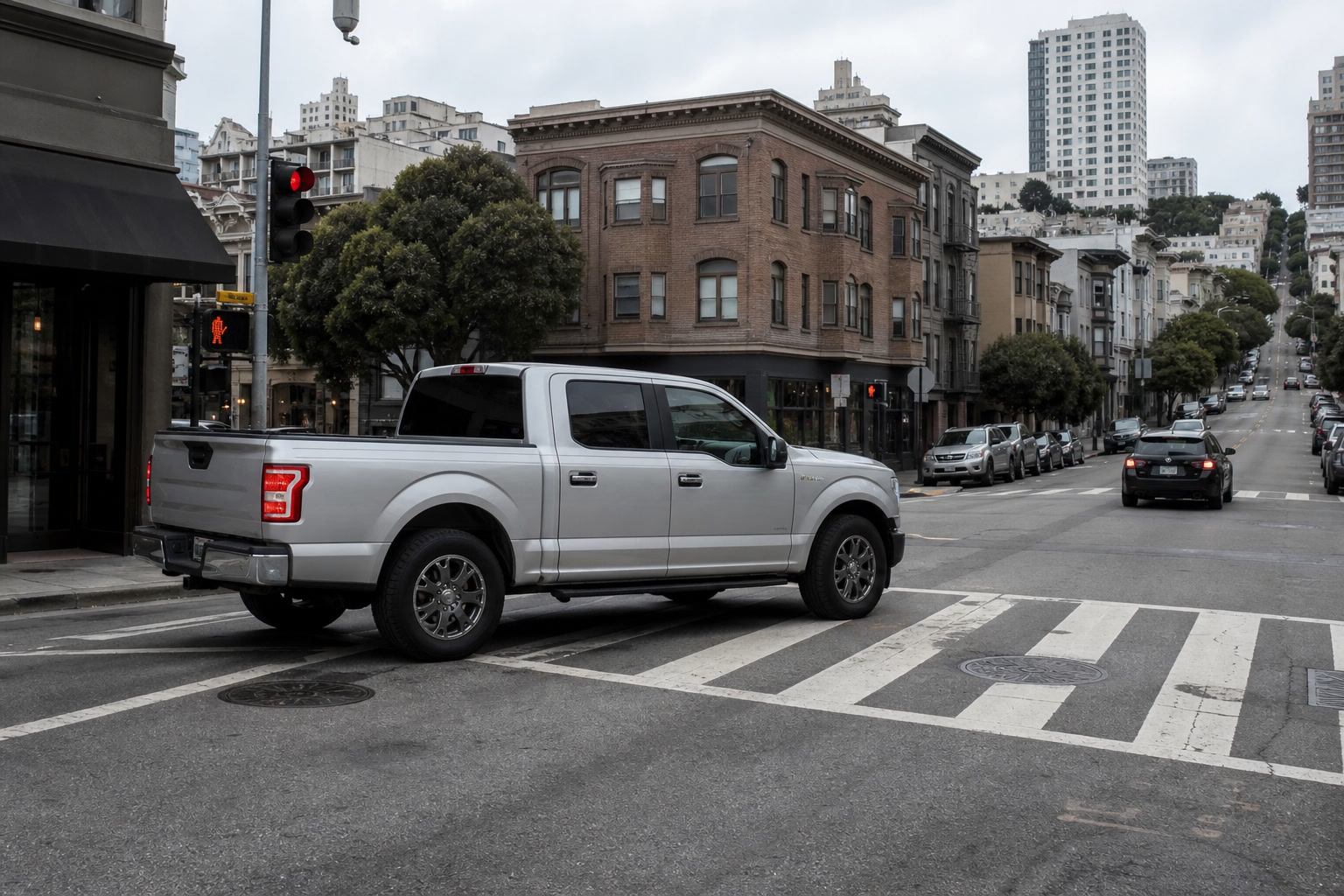
My client was crossing the street in a marked crosswalk, on a green light, when a Ford F-150 making a left turn struck him and kept going through the turn. He was thrown to the pavement and lay unconscious for several minutes before anyone could reach him. The driver was cited by police for failing to yield to a pedestrian and didn’t contest the ticket. At his deposition more than a year later, that same driver testified he wasn’t even one percent at fault, and suggested the fault was my client’s.
This is the story of how a case that started with a driver blaming the man he hit, and an insurer that wouldn’t move off a lowball number, ended with a $6,000,000 recovery for a brain injury that never fully healed.
Unconscious in the Street
First responders reached my client within about fifteen minutes. He’d been unconscious for roughly eight minutes after impact and was still confused when help arrived — able to give his name, not able to reliably answer much else. He was placed in full spinal precautions and taken to the hospital, where his condition over the next 24 hours made clear this was not a minor injury: a Glasgow Coma Scale score of 13 on arrival, nausea and vomiting, an altered mental state, and a CT scan showing bleeding on both sides of his brain.
He had fractured his skull in three places. He had bilateral subdural hematomas — bleeding between the brain and its outer covering, on both sides. He had fractured ribs and bleeding around one lung. He spent days in the ICU on seizure-precaution medication while doctors monitored whether the bleeding in his brain would stabilize on its own or require surgery. It stabilized, barely, without an operation. A repeat scan the next day still showed the bleeding expanding before it finally leveled off.
An Injury That Didn’t End When the Bleeding Stopped
A skull fracture and a subdural hematoma are the kind of injury an insurance company can’t easily argue is minor — the imaging alone tells that story. What a defense can still argue is that someone recovers. This driver’s insurer did.
The medical record over the following two years said otherwise. My client was left with chronic headaches, dizziness and balance problems significant enough that a treating neurologist documented a positive Romberg’s test — measurable unsteadiness that shows up on a basic physical exam. He lost his sense of smell and taste, a common and permanent consequence of the kind of frontal-lobe injury he’d sustained, and one that meant something as basic as knowing food had gone bad required someone else to check for him. He developed significant, well-documented deficits in memory, attention, and executive function — the mental skills involved in planning, organizing, and following through on a task. He experienced personality changes his own family reported under oath: a shorter temper, a lower threshold for frustration, reactions to ordinary stress that hadn’t been there before the crash. A treating neurologist rated his cognitive recovery using the Rancho Los Amigos scale, a standard clinical tool for measuring brain injury recovery, and found him still at a level marked by confusion with anything beyond simple, consistent instructions — more than a year after the collision.
A vocational rehabilitation expert evaluated him and concluded, based on standardized testing and a full functional interview, that he was not employable in his prior trade or in any other occupation in the competitive labor market. He had been a skilled tradesman before the crash, supporting his family with steady, physical, detail-oriented work. He has not been able to return to that work, or any work, since.
A Driver Who Wouldn’t Take Responsibility, an Insurer That Wouldn’t Move
What made this case harder to resolve than the medicine alone would suggest was the defense’s posture on fault. The traffic citation was undisputed — the driver never contested it. But at his own deposition, under oath, he testified he hadn’t seen my client before the impact and maintained he bore no responsibility at all for a collision serious enough to leave a pedestrian with skull fractures and bilateral brain bleeds in a crosswalk he had the legal right to be in.
That combination — a driver’s insurer defending a case where its own driver was cited and didn’t fight the ticket, while the driver himself denied any fault whatsoever under oath — meant liability had to be litigated as hard as damages. This case never came close to an early, easy resolution. More than fifteen depositions were taken before either side would seriously discuss numbers. A formal mediation, well into the litigation, went nowhere. A second settlement conference was put on the calendar and then called off entirely before it happened. At one point, with years of medical and vocational proof already in the record, I put a formal settlement offer in front of the defense at $1,000,000. It went unaccepted. The case ultimately resolved for six times that amount — the clearest evidence I can point to that walking away from that number, rather than negotiating down to meet it, was the right call.
Building the Damages Case
Proving what this injury was actually worth meant assembling a team that could speak to every part of what my client had lost: a treating neurologist who had followed him for years and could speak to the objective findings — the EEG abnormalities, the Romberg’s test, the Rancho Los Amigos rating; a neuropsychologist who had documented the specific cognitive deficits through standardized testing; a physician specializing in rehabilitation medicine who evaluated what his body and brain could and couldn’t do going forward; a vocational rehabilitation expert who could explain, in terms a jury could evaluate, exactly why those deficits meant permanent unemployability rather than a temporary setback; an economist who translated years of pre-injury wage records into a defensible present-value figure for everything my client would never earn again; and a certified life care planner, who built a detailed, itemized projection of the medical care, equipment, attendant care, and transportation my client will need for the rest of his life. A catastrophic brain injury doesn’t stop costing money the day a case settles, and a life care plan is how that ongoing cost gets put in terms a defense, a mediator, or a jury can actually evaluate rather than guess at.
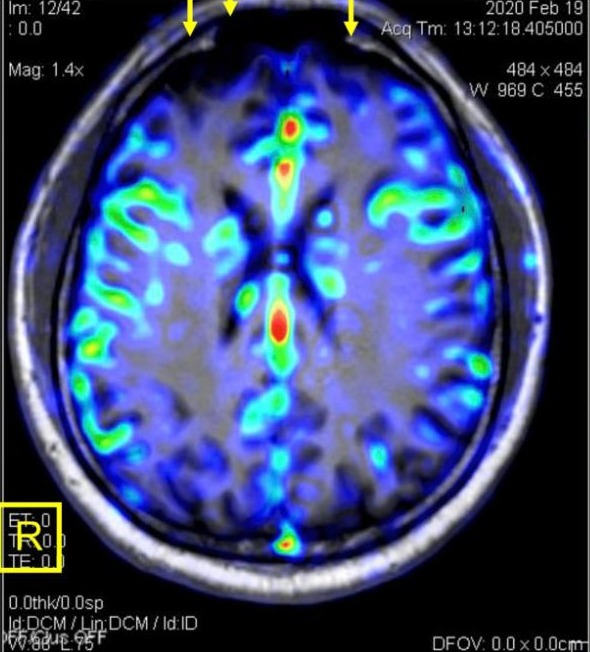
Behind all of it sat the imaging. A follow-up 3T MRI of his brain, read alongside advanced volumetric analysis, documented measurable tissue loss and abnormal blood flow in the frontal lobes — the part of the brain responsible for exactly the personality and executive-function changes his family had described. It is one thing to argue that a person seems different since a crash. It is another to show an arbitrator, a mediator, or a jury an image of measurably reduced blood flow to the specific region of the brain responsible for the symptoms being described, and to have a neuroradiologist explain what they’re looking at.
The Resolution
This case did not settle early, and it did not settle cheaply. It moved through years of litigation — more than fifteen depositions, a failed mediation, a second settlement conference that never even happened, and a rejected seven-figure offer from my side that the defense let expire — before resolving for $6,000,000, paid by the driver’s employer and its insurers.
That figure reflects what this kind of injury actually costs: not just the medical bills already incurred, but a working man’s permanently lost earning capacity, and the decades of ongoing care a severe traumatic brain injury like this one requires, itemized in detail by a certified life care planner rather than estimated. It’s also, I think, a number that reflects what happens when a defendant is cited by police, doesn’t contest it, spends a deposition denying any responsibility anyway, and then lets a reasonable settlement offer expire rather than test its luck against the record we’d built. Juries and the insurance companies trying to predict what juries will do don’t tend to reward that combination.
What This Case Is Really About
Every injury on this page is real to the person who lived it, but this one is a reminder of something particular: the person most affected by a catastrophic brain injury is often the last person able to advocate for himself. My client couldn’t testify to his own cognitive deficits with the clarity a jury needs — the injury itself stood in the way. Proving this case meant building an entirely independent record: family testimony under oath, standardized testing with hard numbers, imaging that could show what words couldn’t, a life care plan that turned decades of future need into something concrete, and a vocational expert who could translate “he’s not the same” into “he cannot work again, and here is why.”
That’s the work behind every number on this page. This one just required more of it than most — years of it, refused settlement offers on both sides of the table, and a defense that never stopped contesting fault even after its own driver accepted a citation for causing the crash.
Frequently Asked Questions
If a driver is cited by police for the crash, can they still deny fault in a lawsuit?
Yes, and it happens more often than people expect. A traffic citation is a separate proceeding from a civil injury claim, and a driver who doesn’t contest a ticket — often to avoid the cost or hassle of fighting it — can still deny fault entirely once a lawsuit is filed. It doesn’t mean the citation is irrelevant; it’s often powerful evidence. It does mean the case still has to be litigated and proven.
What is a life care plan, and why does it matter in a brain injury case?
It’s a detailed, itemized projection — usually built by a certified specialist — of the medical care, equipment, attendant care, and other support a person will need for the rest of their life because of a catastrophic injury. Rather than asking a jury or an insurer to guess at what decades of future care might cost, a life care plan turns that into a specific, defensible accounting, category by category.
Does a failed mediation mean a case is close to trial, or close to falling apart?
Neither, necessarily. A failed mediation just means the two sides haven’t yet agreed on a number — it says nothing about the strength of the underlying case. In this case, a failed mediation and a canceled second settlement conference were simply two more steps in a long process; the case kept moving forward on the strength of the medical and vocational record already being built.
Can a brain injury be real even if it’s not immediately obvious at the hospital?
Yes, though this case is actually the opposite scenario — the initial imaging showed serious, unmistakable injury from the start. What’s harder to establish is what a brain injury like this looks like two and five years later, after the acute bleeding has resolved but the cognitive and personality effects remain. That’s where ongoing neurological follow-up, neuropsychological testing, and specialized imaging become essential.
Why is this case anonymized when some others on this site use real names?
Because the case resolved through a confidential settlement, and that confidentiality is a term of the agreement itself — not just a courtesy I extend by default. I tell every case result as fully and honestly as I can within whatever constraints actually apply to it. Here, that means no names, no location, and no case number, but every fact about how the injury was proven and the case was won is real.
If you or a family member has suffered a traumatic brain injury as a pedestrian, cyclist, or in any collision — especially one where the insurance company is disputing fault or minimizing the long-term effects — call my office at (415) 851-4557 for a free consultation. I handle every significant case personally. Ofrecemos consultas gratuitas en español.
This case is one example from my broader record of results. For more on how brain injuries are proven and valued, see my guide to mild traumatic brain injuries and my page on pedestrian accident claims. Learn more about skull fracture injury claims in San Francisco. Past results do not guarantee a similar outcome in your case — read my full disclaimer.