

John Roach, Esq. | September 24, 2026 | California Law
When Is Muni Liable for a Bus Stabbing? A San Francisco Lawyer’s Analysis

On the afternoon of September 23, a man was stabbed on a Muni bus near 10th and Mission Streets. The San Francisco Chronicle reported, citing SFPD, that the stabbing happened around 1:41 p.m., that the man was stabbed by another passenger and left with life-threatening injuries, and that officers arrested a suspect that afternoon. Authorities did not specify which bus it was. SFMTA’s alert rerouted the inbound 14 and 14R lines around the police activity, and SFist, relying on video from the scene, identified it as a 14 Mission bus. That video shows the man conscious and being treated for what appears to be a neck wound. As of this reporting, nothing is public about what led up to the attack or what the operator did.
This was not the first stabbing on a Muni bus this year. In March, two riders were stabbed on two different buses on the same day, both after arguments with other passengers, as CBS San Francisco also reported. Each time, the same question hangs over everyone who rides: when something like this happens on a public bus, is the city legally responsible?
I have practiced as a San Francisco personal injury attorney since 2009, and I have sued Muni. This is not about any one person’s case. I do not represent anyone involved in this incident, and the injured man is intentionally not identified here. It is an analysis of how California law treats violence on public transit, where the real legal lines are, and what would make riders safer. It is general information, not legal advice about any particular situation.
What the Law Requires of a Carrier: A Lawyer’s Framework
Muni is a common carrier, and California Civil Code section 2100 requires carriers to use “the utmost care and diligence” for their passengers’ safe carriage. That is a higher standard than the ordinary reasonable care a private driver owes. But a carrier is not an insurer of passenger safety, and it is not automatically liable each time one rider hurts another.

The California Supreme Court set the test for passenger-on-passenger violence in Lopez v. Southern California Rapid Transit District (1985) 40 Cal.3d 780. A carrier is liable only where, in the exercise of the required care, it “has or should have knowledge from which it may reasonably be apprehended that an assault on a passenger may occur, and has the ability in the exercise of that degree of care to prevent the injury.” Two elements do the work: foreseeability and the ability to prevent. A public agency is liable for its employees’ negligence within the scope of their work under Government Code section 815.2, which is how an operator’s failure becomes the agency’s liability.
Did Lopez Involve a Stabbing or Shooting?
No. Lopez was not a stabbing or a shooting case. As the Court described the allegations, a group of juveniles began harassing other passengers on an RTD bus, a “violent argument” ensued, and it escalated into a “violent physical fight” in which five plaintiffs were injured. The opinion mentions no weapon. The plaintiffs alleged that the driver was notified of the “altercation,” took no precautionary measures, and kept driving, and that RTD knew violent incidents occurred daily or weekly on its buses, including on that route. A shooting does appear in the opinion, but as another case the Court discussed: in Hernandez v. Southern California Rapid Transit District (1983) 142 Cal.App.3d 1063, a bus passenger was shot and killed by a fellow passenger after a loud argument, and the Court of Appeal upheld the sustaining of a demurrer. The Supreme Court disapproved Hernandez to the extent it held there is no special relationship between a public carrier and its passengers.
Two details matter for anyone drawing lessons from it. First, Lopez was decided on a demurrer. The trial court threw the case out at the pleading stage, and the Supreme Court reversed, holding that the plaintiffs were entitled to try to prove their allegations. The opinion is not a verdict and does not say the plaintiffs won. Second, the Court rejected the agency’s immunity arguments. Government Code section 845, the police-protection immunity, did not apply because the claim was not about failing to hire police. It was that a driver, already on the scene and aware of the violence, “did absolutely nothing.” Section 820.2, discretionary-act immunity, did not apply either, because a driver simply continuing to drive is not a considered policy decision that balanced risks and advantages. The Court stressed that its holding was “a limited one.” It did not decide that RTD breached its duty, or that sections 845 and 820.2 would necessarily be inapplicable as the facts developed.
What Could the Driver Have Done?
The Court answered that directly, with a caveat that protects operators. Subject “to reasonable concern for his own safety,” a driver might warn the unruly passengers to quiet down or get off the bus, alert the police and summon their assistance, or, if necessary, eject them. The Court also pointed to what the carrier itself could provide: radio communication between drivers and police or headquarters, alarm lights to alert nearby police or carrier personnel, and training for drivers, especially on routes with a history of criminal activity, to recognize and defuse volatile situations.
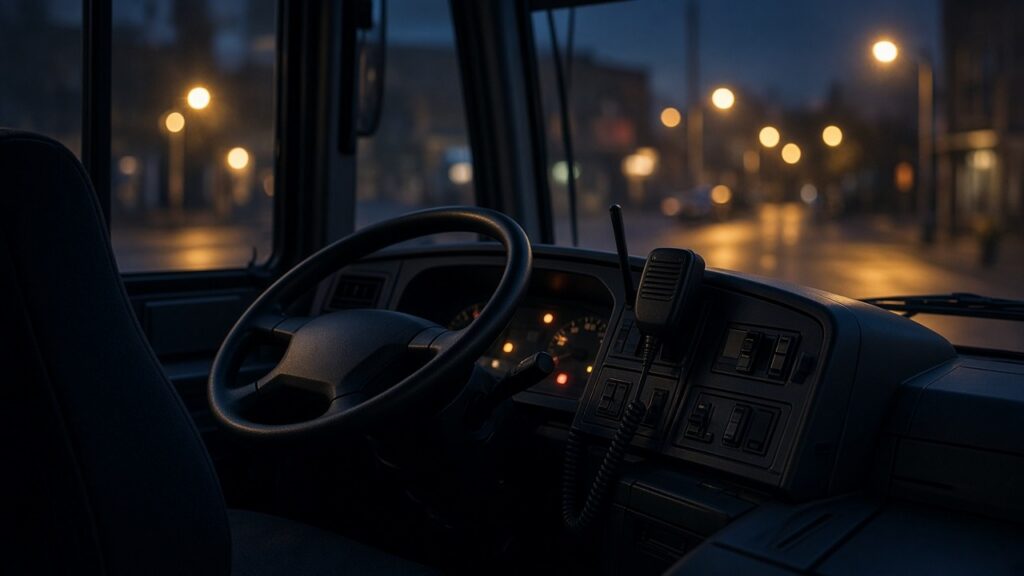
Notice what is not on that list. Nobody expects a bus operator to physically confront someone with a knife. The duty is about low-risk, common-sense steps. Translated to a modern Muni bus, those steps would look like this (my translation, not the Court’s list): a silent alarm or radio call to dispatch, a 911 call, a public announcement, stopping in a safe place and opening the doors so riders can get away, and asking the aggressor to leave before a confrontation escalates. Whether an operator did any of that is one of the first facts that would matter in a case like this. The Court explained why the duty is so demanding: bus passengers are “sealed in a moving steel cocoon” (language it drew from the Court of Appeal) and, if trouble arises, “wholly dependent upon the bus driver to summon help or provide a means of escape.”
Should Muni Have Armed Guards? Is That the Highest Standard of Care?
Legally, no, and Lopez says so in terms. RTD argued that “nothing short of an armed security force” could curb violence on its buses. The Court answered that the cost and feasibility of an armed force “is not the issue,” and that finding a duty under section 2100 “is not the functional equivalent of finding a duty to provide an armed security guard on every bus.” A carrier has a number of options short of that which, in a given case, might be sufficient.

The “utmost care” standard is easy to misread. The Court, drawing on an earlier case, described it as requiring carriers “to do all that human care, vigilance, and foresight reasonably can do under the circumstances,” while stressing that carriers are not insurers and that the care required is only what can reasonably be exercised given the practical operation of the carrier’s business. It is a very high standard measured against the risk the carrier knows about. The more specific and predictable the danger, the more the carrier is expected to do. A route with a documented pattern of violence calls for more than a route with none. But no version of the standard requires a guard with a gun on every vehicle. One concurring justice would have gone further: adopting the Court of Appeal’s opinion, the concurrence said a jury might find the duty required a security guard on buses on the route. That was a minority view, and the majority left the question alone.
There is also a structural obstacle to any claim built on “there should have been more security.” Government Code section 845 provides that a public entity is not liable “for failure to establish a police department or otherwise to provide police protection service or, if police protection service is provided, for failure to provide sufficient police protection service.” The Legislature’s rationale, as the Law Revision Commission put it, is that whether and how much police protection to provide are “political decisions” for policymakers, not juries. Footnote 8 of Lopez says the Court did not decide whether section 845 immunizes a carrier from a claim that it breached section 2100 by failing to provide security guards on its buses, because the plaintiffs had not made that claim. As far as I found, no published opinion has squarely resolved that question, but it is less open than the footnote suggests. In Zelig v. County of Los Angeles (2002) 27 Cal.4th 1112, 1145, a courthouse shooting case in which the Supreme Court held the claims against the county were properly dismissed, the Court described Lopez as not questioning that the transit district would be immune had it been alleged that the district “fail[ed] to provide police personnel or armed guards on board its buses.” Read together, the cases point one way: a claim that boils down to “there should have been more guards or officers” faces a steep climb, while a claim about what the operator on the scene did or failed to do does not.
That is why I would separate two questions that often get blended together. Is Muni legally required to post armed guards? Almost certainly not. Should Muni put visible, armed officers on the lines where violence keeps happening? That is a policy judgment for the SFMTA Board, the Mayor, the Board of Supervisors, and SFPD, and reasonable people can favor it on public-safety grounds without the law compelling it. One more legal point cuts in favor of acting: under Evidence Code section 1151, safety measures taken after an incident generally cannot be used to prove the agency was negligent before it. Muni does not have to fear that adding patrols is an admission. A stabbing on a bus, on top of the March incidents, may become one more data point in whatever notice picture develops for future incidents on these routes, though City and County of San Francisco v. Superior Court (Colbert), discussed below, is a reminder that a route’s history alone has rarely been enough to establish foreseeability for a sudden, unprovoked attack.
When Would Muni Be Liable on Facts Like These?
Nobody outside the investigation knows yet what happened before the attack, so the honest answer depends on facts that are not public. Here is how the law would sort the possibilities:
- A sudden attack with no warning. If the attacker pulled a weapon without any prior sign of trouble, it is very hard to show the operator had knowledge from which an assault could be apprehended, or any ability to prevent it. A carrier is not an insurer. This is the scenario where the agency wins.
- An escalating confrontation the operator saw or heard. If riders were arguing, threats were being made, or a weapon was displayed while the operator was present and did nothing, that is the Lopez fact pattern. This is where liability is realistic.
- A known aggressor. If the operator, a fare inspector, or an ambassador had already dealt with this person on the same vehicle, or he had been removed and allowed back on, foreseeability is much stronger.
- A failure of the response system. Silent alarms that did not reach dispatch, a call that went unanswered, or long delays in getting help or medical aid after the attack, if any of that made the outcome worse.
- Notice of a pattern, without adaptation. Prior assaults on the same line, at the same stops, and at the same hours, followed by no change in training, protocols, or deployment. This is the weakest of the five standing alone: California courts have rejected the argument that a route’s history of prior assaults, by itself, makes a later sudden attack foreseeable. The two March stabbings happened on buses on or near Mission Street and involved arguments between passengers, which is at least the same corridor and dynamic, but that similarity would still need to connect to something the operator on this bus could see or anticipate, not just a route-wide statistic. This theory runs into immunity most directly, and works best, if at all, when framed around a specific, repeated failure in operator training or response protocols rather than staffing levels or a general crime rate.
The case most on point is City and County of San Francisco v. Superior Court (Colbert) (1994) 31 Cal.App.4th 45, and it should temper any assumption that a stabbing automatically means a viable claim. A passenger was stabbed by a man who sat down behind her, pulled a knife, and attacked her within about five seconds, with no warning. The trial court had pointed to two prior assaults on the same bus line within the preceding year as notice; the Court of Appeal rejected that, holding that prior assaults on a route do not impose liability for what was, on these facts, a sudden and unheralded attack, and it directed that summary judgment be entered for the City. Colbert is the sharpest illustration of the “sudden attack with no warning” scenario above, and it is the reason the “pattern of notice” theory is the hardest of the five to win on: a route’s history has to translate into something the operator could see or expect in the moments before this specific attack, not just a statistical pattern after the fact.
Even in the best case, a plaintiff would have to prove causation: that the precaution the agency skipped would actually have prevented or reduced this injury. If the attack took seconds, that can be the hardest element. The evidence that decides these cases is the onboard video, dispatch and radio logs, the operator’s training and protocols, and Muni’s own incident data for the route.
The same fight is playing out in other transit litigation. In Dandan v. BART (San Francisco Superior Court, CGC-25-621614), the family of Corazon Dandan, a 74-year-old woman pushed into a train at Powell Street Station on July 1, 2024, and killed, sued BART, alleging among other things dangerous conditions on public property and a shortfall in safety staffing. In June 2025, ABC7 reported that the judge allowed three claims to go forward: dangerous condition of public property, wrongful death, and a survival action. That was a pleading-stage ruling in a case that remains pending. It is not a decision on the merits and not appellate authority, but it shows these claims can survive a challenge. My earlier write-up on wrongful death after a Bay Area public transit accident covers related ground.
The Six-Month Clock: What Anyone Hurt on Muni Should Know
Because SFMTA is a public entity, the ordinary two-year injury deadline does not apply. This is the procedural fact that ends more valid claims than any defense on the merits:

- Present a government claim within six months of the injury (Government Code section 911.2).
- The City has 45 days to respond, unless the parties agree in writing to extend that period. Silence counts as a rejection on the last day of the period (section 912.4).
- File suit within six months after written notice of rejection is given (section 945.6(a)(1)). If the City never gives written notice, the outer limit is two years from the injury (section 945.6(a)(2)).
- If the six-month window was missed, a late-claim application may be possible within one year of the incident (section 911.4), but it is discretionary.
I cover the mechanics in my guides to Muni bus accident claims and the six-month deadline that kills cases, and the same rules apply to cable car injuries and operator fatigue cases. My page on filing a government claim against a public entity in California walks through the full process in more depth.
A Call for More Visible Policing and Safety Presence on Muni
Whatever your politics, riders share one interest: nobody should have to weigh their commute against their safety. Muni riders include workers, students, seniors, and families who cannot skip the bus. More visible policing and safety staffing on transit, meaning uniformed officers and trained safety personnel on the routes and at the hours where violence keeps recurring, plus a faster and more reliable response when an operator calls for help, is a public-safety goal, not a partisan one.
The legal system will rarely deliver that. Immunity doctrines mean courts are cautious about ordering a public agency to deploy more officers, and litigation comes after someone is already hurt. So the practical levers are civic. If you agree, tell SFMTA and your district supervisor which lines and stops need more coverage. Public comment at SFMTA Board meetings goes into the record. Report incidents even when no one is injured, because a documented pattern is what puts an agency on notice. Beyond patrols, the fixes that hold up under the Lopez analysis are unglamorous: clear operator protocols for when to stop, alarm, and call for help; regular scenario training, especially on high-incident routes; alarms and live-camera access that put eyes on a situation early; and public reporting of where assaults occur so deployment follows the data.
How to Lower Your Risk on Muni: Practical Tips from a Lawyer Who Has Sued the Agency
No tip guarantees safety, and an attack is never the victim’s fault. These habits reduce exposure:

- Stay aware. Keep one earbud out and your phone down when someone new boards or the bus is crowded.
- Sit or stand near the operator and the cameras. The front of the bus is typically the best-monitored area, and the operator is your fastest route to dispatch.
- Move early. If someone seems agitated, is arguing with other riders, or is fixated on a passenger, change seats, move toward the operator, or get off at the next stop and wait for another bus.
- Do not engage. Skip the argument, the stare-down, and the confrontation. Create distance instead.
- Tell the operator immediately. An operator who knows can stop the bus, call dispatch, and document it. Your report also creates a record that the agency was on notice.
- Call 911 for any weapon or threat. Do not wait to see whether it escalates.
- Avoid late-night or empty-vehicle rides when you can. Another rider nearby, or a different route, is worth the extra minutes.
- If something happens, document it. Note the route, bus number, direction, time, and stop, collect witness contact information, photograph injuries, and remember that legal deadlines against a public agency are measured in months.
Hurt on Muni?
If you or someone you love was hurt in an assault on Muni or another public transit line, the facts of what the operator saw and did in the moments before the attack will decide whether a claim is viable, and the deadline to act is six months, not two years. Call the Law Office of John J. Roach at (415) 851-4557 for a free consultation. I\u2019ll look at what happened and tell you plainly where your case stands.
Reporting Cited
- Muni rider suffers life-threatening stab wound in SoMa, police say — San Francisco Chronicle
- Suspect Arrested After Stabbing On 14-Mission Bus In SoMa — SFist
- Two Stabbed On Two Different Buses Following Arguments With Other Passengers — SFist
- 2 San Francisco Muni bus passengers stabbed in separate incidents — CBS San Francisco
- Lopez v. Southern California Rapid Transit District (1985) 40 Cal.3d 780 — Justia
- City and County of San Francisco v. Superior Court (Colbert) (1994) 31 Cal.App.4th 45 — Justia
- Zelig v. County of Los Angeles (2002) 27 Cal.4th 1112 — Justia
- Corazon Dandan: Judge moves forward with wrongful death lawsuit against BART — ABC7 San Francisco
- Government Code and Evidence Code sections cited — California Legislative Information
Frequently Asked Questions
No. The opinion describes juveniles harassing passengers on a bus, a violent argument, and a violent physical fight that injured five plaintiffs. It mentions no weapon. A fatal shooting was at issue in Hernandez v. SCRTD, a Court of Appeal case the Supreme Court discussed and disapproved in part. The case was decided on a demurrer, so the Supreme Court held only that the plaintiffs could try to prove their claims.
No. As a common carrier, Muni owes passengers the utmost care and diligence under Civil Code section 2100, but it is not an insurer. Under Lopez, liability requires that the carrier had or should have had knowledge from which an assault could reasonably be apprehended, and the ability to prevent the injury.
Lopez lists warning unruly passengers, alerting police, and ejecting them, all subject to the driver’s reasonable concern for his own safety. It also points to radio communication, alarm lights, and driver training on routes with a history of crime. Today that includes silent alarms, 911, announcements, and stopping in a safe spot with the doors open.
The California Supreme Court said finding a duty under section 2100 is not the equivalent of requiring an armed guard on every bus. In footnote 8 it left open whether Government Code section 845 bars a claim based on failing to provide security guards, but in Zelig v. County of Los Angeles (2002) the Court later described Lopez as not questioning that the district would be immune from a claim that it failed to provide police personnel or armed guards.
Not entirely. Operators are not expected to confront an attacker. But a policy does not excuse failing to take basic low-risk steps like calling for help, and Lopez rejected the argument that a driver’s inaction was an immune policy decision absent a considered balancing of risks.
Then a claim is difficult. If there was no prior sign of trouble, it is hard to show the carrier had knowledge from which an assault could be apprehended, or any ability to prevent it. Prior incidents on the route and how the agency responded to them can change the analysis.
A Muni passenger was stabbed by a man who sat down behind her and, without warning, pulled a knife and attacked her within about five seconds. The trial court pointed to two prior assaults on the same bus line as notice; the Court of Appeal disagreed, holding that prior assaults on a route do not, by themselves, make a later sudden attack foreseeable, and ordered summary judgment for the City. It is the closest reported case to a Muni stabbing, and it is a reminder that a route\u2019s history of violence is not, on its own, enough to establish liability for an attack that came without warning.
Potentially. Notice of repeated violence strengthens foreseeability. But claims that boil down to inadequate police or security staffing run into Government Code section 845, so these cases tend to focus on operator training, protocols, and response systems.
Six months from the injury to present a government claim under Government Code section 911.2. The City has 45 days to act, unless extended in writing, and silence counts as a rejection. You then generally have six months from written notice of rejection to file suit under section 945.6, or up to two years from the injury if no written notice is given. A late-claim application may be possible within one year of the injury.