

John Roach, Esq. | October 8, 2026 | Car Accidents
The Black Box Data That Wins Truck Accident Cases: What a San Francisco Lawyer Preserves in the First 72 Hours

Most people who’ve been hit by a commercial truck assume the crash report will settle the question of what happened. It won’t. The report captures what the officer saw after the fact — skid marks, final resting positions, statements taken while everyone was still shaken. What actually proves fault in a serious truck case is sitting inside the truck itself, in a set of electronic systems most injured people have never heard of — and in a lot of cases, that data is gone within days if nobody moves to preserve it.
I wrote about who can be held liable in a truck crash — the driver, the carrier, and sometimes the broker — in my last post on truck accident liability. This post goes deeper into the evidence itself: what a truck’s “black box” actually records, why it disappears so fast, and what has to happen in the first 72 hours to keep it from being lost for good.
“Black Box” Is a Nickname — Here’s What It Actually Is
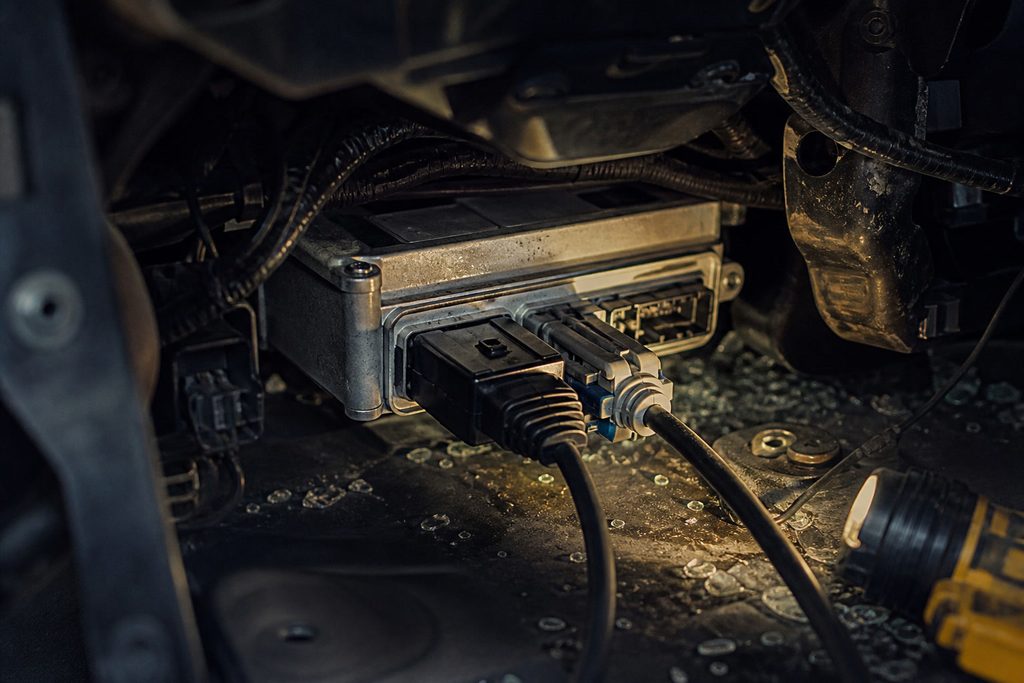
Commercial trucks don’t have a single black box the way an airplane does. What they have is a small collection of electronic systems, and knowing the difference between them matters because each one gets requested, preserved, and used differently.
The Electronic Control Module (ECM) is built into the engine itself and continuously monitors vehicle performance — speed, RPM, throttle position, and braking activity. Most ECMs retain a rolling window of recent operating data, and many will capture a “hard brake” or “hard event” log automatically triggered by sudden deceleration, which is often the single most valuable data point in a crash reconstruction.
The Event Data Recorder (EDR), where equipped, is closer to what most people picture when they hear “black box.” An EDR captures a short, frozen snapshot of specific data points — speed, brake application, steering input, seatbelt status — in the seconds immediately before, during, and after a triggering event like a hard collision. Not every commercial truck has a standalone EDR the way passenger vehicles increasingly do, but many newer trucks integrate EDR-equivalent functions into the ECM or a separate telematics control unit.
The Electronic Logging Device (ELD) is a different system entirely, and it doesn’t record how the truck was driven — it records how long the driver had been driving. Federal law requires most commercial drivers to use an ELD that automatically logs duty status: driving, on-duty not driving, sleeper berth, and off-duty. This is the system that exposes hours-of-service violations, and it’s often the clearest, hardest-to-dispute evidence of driver fatigue in a serious crash.
None of these systems are optional extras — they exist because federal regulation requires them on most commercial vehicles. But federal law does not require the carrier to hand this data over voluntarily, or even to preserve it once it’s no longer “needed” by the company’s own internal standards. That gap is exactly where cases are won or lost.
The Hours-of-Service Numbers That Matter
FMCSA’s hours-of-service rules set specific limits: a property-carrying driver generally cannot drive after 11 cumulative hours of driving time, cannot drive beyond the 14th consecutive hour after coming on duty, and must take a 30-minute break after 8 cumulative hours of driving. A driver who crashes at hour 12, or who never logged the required break, has generated a federal paper trail that speaks for itself — an ELD printout showing a duty-status pattern that violates these limits is difficult for a defense expert to explain away, because the driver’s own federally mandated device created it in real time, not after the fact.
This is also where ELD data and ECM data work together. A driver who was legally within hours-of-service limits on paper can still have been drowsy, distracted, or driving too fast for conditions — and that’s where the ECM’s speed and braking data fills in what the duty log alone can’t show.
Telematics and Dashcams: The Window Closes Fastest Here
Beyond the engine-level systems, many commercial fleets run third-party telematics platforms layered on top — GPS tracking, driver-behavior scoring, and increasingly, dual-facing dashcams that record both the road ahead and the cab interior. Where these exist, they can be the single most persuasive piece of evidence in the entire case: a jury doesn’t have to interpret a data printout when there’s footage of the actual collision.
The problem is retention. Telematics platforms and dashcam systems are typically built to manage storage costs, not to serve as permanent evidence archives — footage is commonly retained for a matter of days to a few weeks before the system automatically overwrites it to make room for new recordings. Unlike the ECM’s hard-brake event log, which is often flagged and held separately once triggered, routine dashcam footage rolls over on its own schedule regardless of whether a serious crash just happened. If nobody formally demands preservation immediately, footage that could have settled every disputed fact in the case simply ceases to exist — and no one did anything intentionally wrong to lose it. That’s the trap.
Why Carriers “Lose” This Data — and When That Stops Being Innocent
In the ordinary course of business, a trucking company has no reason to hang onto months of ECM logs or weeks of dashcam footage from a truck that didn’t crash. Systems are built to cycle. When a serious crash happens, that routine cycling doesn’t pause itself — someone has to affirmatively stop it.
That’s the purpose of a spoliation letter: formal written notice to the carrier, sent as soon as possible after the crash, specifically identifying the categories of evidence that must be preserved — ECM/EDR data, ELD records, dashcam and telematics footage, maintenance and inspection logs, driver qualification files, and dispatch communications — and putting the carrier on legal notice that destroying any of it, even through routine automated processes, can expose the company to serious consequences.
Once a carrier has received that notice, the calculus changes completely. Data that disappears afterward isn’t a routine overwrite anymore — it can be spoliation, and California courts have real tools to address it: an adverse inference instruction telling the jury it may assume the destroyed evidence would have been unfavorable to the party that destroyed it, monetary sanctions, and in egregious cases, evidentiary or terminating sanctions against the carrier’s defense. Carriers and their insurers know this, which is exactly why a fast, specific, well-documented preservation letter changes how seriously they treat a claim from day one — it’s often the first signal a carrier gets that they’re dealing with a lawyer who knows how these cases are actually won, not just a claimant filling out a form.
How This Evidence Actually Wins a Case
Data alone doesn’t win a case — it wins a case when it’s tied directly to a liability theory. A few examples from how this plays out in practice:
An ECM hard-brake log showing the truck was traveling well above the posted speed when the driver finally braked doesn’t just corroborate a witness’s estimate — it replaces the need to rely on estimates at all. An ELD record showing the driver had been on duty for 13 hours and 40 minutes at the moment of impact turns a general “the driver seemed tired” allegation into a documented federal hours-of-service violation. Dashcam footage showing the driver looking down at a phone in the seconds before impact removes any argument about sudden, unavoidable circumstances. And maintenance logs showing a brake defect was flagged on a pre-trip inspection three weeks before the crash and never repaired connects the carrier’s own negligent-maintenance decisions — the kind I described in my truck accident liability post — directly to the mechanism of the crash.
This is also why insurance carriers negotiate differently once this evidence is locked down. A demand letter built on an adjuster’s guess about what probably happened gets a lowball response. A demand letter built on the truck’s own data, preserved before it could be destroyed, is much harder to argue with.
Evidence Preservation Checklist: The First 72 Hours

If you or a family member was hurt by a commercial truck, these are the categories that need to be identified and formally preserved as soon as possible — ideally before the truck returns to service:
- ECM / EDR data — speed, braking, throttle, and hard-event logs from the engine control module and event data recorder
- ELD hours-of-service records — the driver’s duty-status log for the days leading up to the crash
- Dashcam and telematics footage — both road-facing and cab-facing, if equipped, before automatic overwrite
- GPS and route data — timestamped location history from the carrier’s fleet-management system
- Driver qualification file — hiring records, prior violations, medical certification, training history
- Maintenance and pre-trip inspection logs — especially any noted, unresolved defects
- The truck and trailer themselves — vehicle inspection before repair or disposal, if damage or a mechanical defect is at issue
The single most important thing to understand about this list: every item on it can legally disappear through nothing more than a company’s routine data-retention cycle. A formal preservation letter is what interrupts that cycle — and the sooner it goes out, the more of this list survives to actually be used.
When the Roadway Itself Is Part of the Evidence
Some truck crashes involve a public roadway defect alongside the data above — a poorly designed on-ramp, an obscured truck-route sign, a malfunctioning signal at an intersection trucks aren’t built to navigate safely. If a public entity’s roadway condition contributed to your crash, California Government Code §911.2 requires a government claim within six months — far shorter than the two-year window for claims against the driver and carrier. I cover this deadline, and how it interacts with a trucking case, in more detail in my truck accident liability post.
Why This Can’t Wait
Every category of evidence above has a clock running on it the moment a truck accident happens, and nobody on the other side of the case is going to slow that clock down for you. I’ve represented injured clients since 2009, with extensive trial experience building truck accident cases around exactly this kind of evidence — because a case built on preserved data, not on what an adjuster is willing to assume, is the difference between a fair settlement and a lowball one.
If you or someone you love was hurt in a crash with a commercial truck, don’t wait to find out what the trucking company’s insurer says first. Call the Law Office of John J. Roach at (415) 851-4557 for a free consultation — se habla español.
Frequently Asked Questions
The ECM (Electronic Control Module) continuously monitors engine performance — speed, RPM, braking — and often logs a hard-braking event automatically. An EDR (Event Data Recorder) captures a short, specific snapshot of data around a triggering collision event. Many trucks combine these functions rather than running them as fully separate systems, but both can be critical evidence.
As soon as possible — ideally within days, not weeks. Dashcam footage and telematics data are often retained for only a matter of days before automatic overwrite, and the sooner a carrier receives formal notice, the harder it is for data to disappear through “routine” processes without legal consequences.
You can ask, but a trucking company and its insurer have no obligation to respond to an informal request from an injured person, and they generally won’t volunteer data that could hurt their case. A formal spoliation letter from an attorney carries legal weight that an individual’s request does not.
That can constitute spoliation of evidence. California courts can respond with an adverse inference instruction — telling the jury it may assume the destroyed evidence was unfavorable to the party that destroyed it — along with monetary or, in serious cases, evidentiary sanctions against the carrier.
No. Dashcam use varies significantly by carrier and fleet size. Where they exist, footage is one of the most valuable pieces of evidence available, but the absence of a dashcam doesn’t mean there’s no usable data — ECM, ELD, and telematics records are still generated independently.
It’s typically analyzed by an accident reconstruction expert, who ties the raw data — speed, braking, timing — to the mechanics of the crash and, where relevant, to a driver’s or carrier’s specific acts of negligence. Objective data-driven evidence is often more persuasive to a jury or an adjuster than testimony alone, because it doesn’t depend on anyone’s memory or credibility.
It can complicate things, but it’s rarely fatal to a claim. Contact a lawyer as soon as possible so the statement can be reviewed against the physical and electronic evidence before the insurer builds its position around it.
Generally two years from the date of the crash for claims against the driver, carrier, or broker. If a government entity’s roadway condition contributed to the crash, that separate claim carries a six-month deadline instead.