

John Roach, Esq. | September 10, 2026 | Brain Injuries \ California Law \ Car Accidents
Motorcycle Accident Brain Injury Lawyer in San Francisco: When the Helmet Isn’t Enough

You did everything right. You wore a DOT-approved helmet, you rode sober and alert, and a driver still turned left across your lane or drifted into you on the 101. The helmet did its job — you’re alive, your skull is intact. But in the weeks since the crash, something is off: headaches that won’t quit, a fuse shorter than you’ve ever had, words that won’t come, a job that suddenly feels harder than it should. The emergency room said your scans were clean.
Here is what nobody explained in the ER: a helmet is designed to stop your skull from breaking. It is far less able to stop your brain from being injured inside that skull. As a San Francisco motorcycle accident lawyer who has handled catastrophic traumatic brain injury cases since 2009, I’ve represented riders who did everything right and still came away with life-changing brain injuries — and then had to fight an insurance industry that assumes every rider is reckless. This post explains the injury, the law, and the fight.

The Helmet Paradox: What Helmets Do — and Don’t — Protect Against
Motorcycle helmets are engineered primarily against linear impact: the direct blow that fractures a skull or drives debris into it. At that job they are outstanding, and the data on lives saved is overwhelming. Wear one, always.
But most motorcycle crashes don’t deliver a single clean, straight-line blow. They deliver rotational force — the violent twisting and whipping of the head as a rider is thrown, tumbles, or strikes at an angle. Inside the skull, the brain is soft tissue floating in fluid. When the head rotates violently, the brain lags, twists, and shears against itself. The result is diffuse axonal injury: microscopic tearing of the connections between brain cells, spread across the brain rather than concentrated at one impact point.
No helmet fully prevents rotational injury, because the force acts on the brain’s own inertia, not on the surface of the head. That is the helmet paradox: a rider can walk away with an intact skull, a helmet that “did its job,” and a serious brain injury — from a shear injury with no visible wound at all, to bleeding inside the skull such as a subdural hematoma that can develop over hours or days after the rider felt “fine.”
California’s Helmet Law Works in Your Favor
California Vehicle Code § 27803 requires every rider and passenger to wear a compliant helmet — one of the strictest universal helmet laws in the country. If you were wearing yours, that fact does real legal work for you:
- It removes the comparative-fault argument. In states with weaker helmet laws, insurers argue the rider’s own choice caused the head injury. A helmeted California rider takes that argument off the table entirely.
- It reframes the injury. When a rider suffers a brain injury through a compliant helmet, that is evidence of how violent the crash was — not evidence that the injury can’t be real.
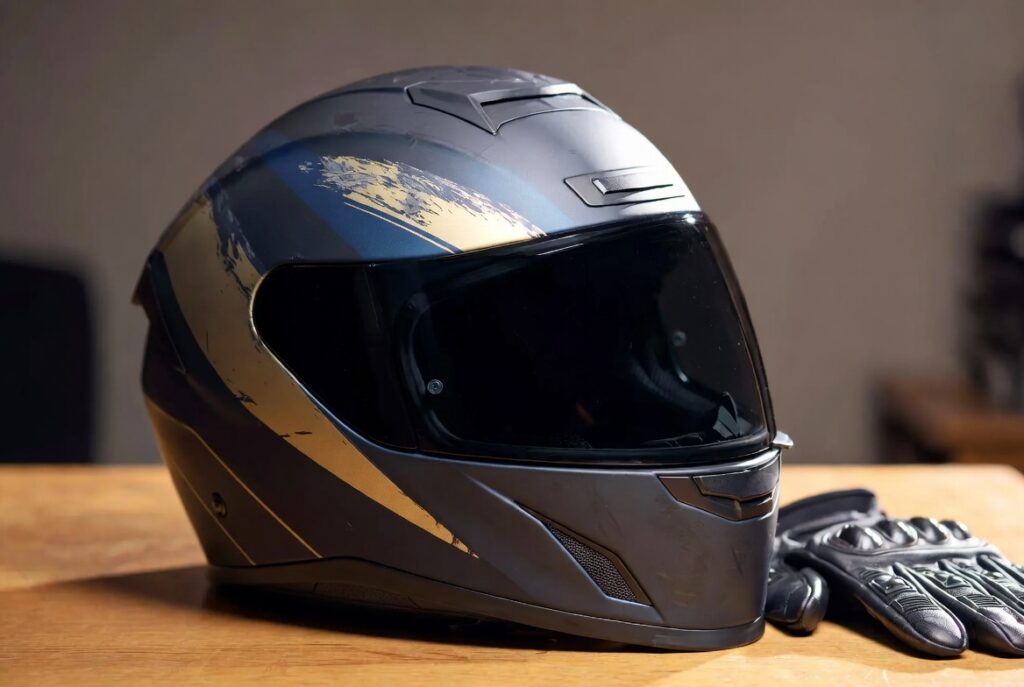
- The helmet itself becomes evidence. Scrapes, gouges, and crush patterns on the shell document where the head hit and at what angle — often the single best physical proof of the rotational forces involved. Which is why one of the most important things you can do after a crash is preserve the helmet, unwashed and unrepaired.
Don’t let an adjuster run the argument in reverse — “you wore a helmet, so you can’t have a brain injury.” That is medically false, and the science on rotational injury says exactly the opposite.
“Your Scans Were Normal”: The Misconception That Undervalues Rider TBIs
Emergency room CT scans detect the emergencies that kill tonight: skull fractures, large bleeds, dangerous swelling. They do not detect diffuse axonal injury, because microscopic shearing is invisible on a standard CT and often on a routine MRI. A rider can have a genuinely serious brain injury and a genuinely normal scan — both at once.
What the scan misses, life reveals: concussion symptoms after a crash that persist — headaches, light and noise sensitivity, memory gaps, word-finding problems, personality change, crushing fatigue. Family members often see it before the rider does. Proving it is a matter of building the right record: neuropsychological testing, specialists in brain injury medicine rather than just the ER, before-and-after testimony from family and coworkers, and work records showing the decline. That is the core of my TBI representation, and it’s the fight insurers least want to have with a firm that tries cases.
Insurance Bias Against Riders — and How I Beat It
Every motorcyclist knows the assumption: the rider must have been speeding, weaving, splitting recklessly. Adjusters price claims on that bias, and defense lawyers try cases on it.
The facts usually point the other way. In the classic San Francisco motorcycle crash, a driver turns left across the rider’s right of way, changes lanes into him, or rear-ends him at a light — the same rear-end collision fact pattern I litigate in car cases, with far worse consequences for the human being on the bike. And lane splitting is legal in California (Vehicle Code § 21658.1) — a lane-splitting accident does not mean a rider at fault, no matter how confidently an adjuster implies it.
Beating the bias takes evidence, not indignation: scene photography and reconstruction, the helmet and gear as physical proof, downloaded vehicle data from the car that hit you, and witnesses locked in early. It also takes a credible threat of trial. As a trial-tested attorney with a 9-for-9 verdict record — work I’ve also published in Plaintiff Magazine — I prepare rider cases to be tried, which is exactly why most of them settle well.
When the Road Itself Caused the Crash: Tracks, Potholes, and the Six-Month Trap
Some of the worst motorcycle crashes in San Francisco involve no other vehicle at all. Streetcar and light-rail tracks that catch a front wheel at the wrong angle. Potholes and pavement lips that would be a jolt for a car and a launch ramp for a bike. Steel construction plates left unramped or slick in fog. Faded markings and missing warnings on a curve.
When a road defect caused or contributed to your crash, the responsible party may be a public entity — the City, the SFMTA, Caltrans on state routes — and that changes everything about your deadlines. Before you can sue a California public entity, you must file a formal government claim, generally within six months of the crash under Government Code § 911.2. Miss it and the case can die no matter how badly the road was maintained. These “dangerous condition of public property” cases also demand fast evidence work: the pothole gets patched and the plate gets moved within days of an injury report. My guide to transit-related claims covers the deadline machinery in detail — and if your crash involves any government-maintained roadway, treat the six-month clock as running from day one.
What a Motorcycle Brain Injury Case Is Really Worth
Brain injury cases are not medical-bills cases. They are future cases: the earning capacity of a tradesperson or professional whose concentration and stamina never fully return; years of cognitive rehabilitation and therapy; the household help and life-care needs nobody prices in the first month; the spouse who becomes a caregiver. When a spinal cord injury rides along with the TBI — common in motorcycle ejections — the life-care numbers compound.
I’ve recovered more than $25 million for Bay Area clients, including a $2.185 million brain injury recovery and a $6 million settlement for a pedestrian with a traumatic brain injury. The difference between a claim priced on the ER bill and one priced on a life-care plan is routinely seven figures in this category — and riders, who face bias on top of injury, leave the most on the table when they settle early without counsel.
What to Do After a Motorcycle Crash in San Francisco
- Preserve your helmet and gear — unwashed, unrepaired. The impact patterns are evidence of the forces on your brain. Do not sell the bike or authorize repairs until it’s documented.
- Get medical care immediately and report every symptom, including the “small” cognitive ones. Brain injury symptoms surface late; documentation gaps become the insurer’s argument.
- Photograph everything — the scene, skid marks, the road surface defect if there was one, the other vehicle, your injuries.
- Identify witnesses fast. Riders rarely can at the scene; a family member or friend should follow up within days.
- Give no recorded statement to any insurer before speaking with an attorney — especially with rider bias in play.
- Check the road, not just the driver. If tracks, potholes, plates, or missing signage played any role, the six-month government claim clock may already be running.
Talk to a San Francisco Motorcycle Brain Injury Lawyer — Free
If a motorcycle crash left you or someone you love with brain injury symptoms — even with a “normal” scan, even with a helmet that did its job — get an evaluation from a lawyer who has proven these injuries against skeptical insurers since 2009. I handle rider cases the same way I handle my collisions with cars and trucks across San Francisco and cyclist injury representation: built for trial from day one. Consultations are free, you pay nothing unless I recover for you, and my frequently asked questions page covers the basics — schedule a free case review or call (415) 851-4557. I offer bilingual representation in English and Spanish, directly with me.
¿Se lesionó usted o un ser querido en un accidente de motocicleta? Atiendo a la comunidad hispana directamente en español, sin intérpretes. Las lesiones cerebrales pueden ser graves aunque los exámenes salgan normales y aunque usted haya usado casco. Llame al (415) 851-4557 para una consulta gratuita y confidencial — su estatus migratorio no afecta su derecho a compensación.
Frequently Asked Questions About Motorcycle Brain Injuries
Can I have a brain injury even though I wore a helmet?
Yes. Helmets are excellent at preventing skull fractures and penetrating injuries, but they cannot fully prevent rotational forces — the violent twisting of the head that shears the brain’s internal connections. Riders regularly suffer serious brain injuries through fully compliant helmets.
Does wearing a helmet help my injury claim?
Significantly. California requires helmets (Vehicle Code § 27803), so compliance removes any comparative-fault argument about your head injury — and a brain injury suffered through a compliant helmet is evidence of how violent the crash was.
Is lane splitting legal in California?
Yes. Vehicle Code § 21658.1 recognizes lane splitting, and doing it does not make a crash your fault. Insurers often imply otherwise; the actual question is whether each driver acted reasonably under the circumstances.
My CT scan was normal. Do I still have a case?
Potentially, yes. Standard CT scans cannot detect diffuse axonal injury — the microscopic shearing behind most crash-related brain injuries. Persistent symptoms with normal scans are a recognized medical reality, proven through neuropsychological testing, specialist care, and before-and-after witness testimony.
What if road conditions caused my crash — tracks, potholes, or steel plates?
A public entity may be liable for a dangerous condition of public property, but California generally requires a formal government claim within six months of the crash. That deadline is far shorter than the standard two-year limit, and road defects get repaired fast — contact an attorney immediately.
What should I do with my helmet after the crash?
Keep it, exactly as it is — don’t clean it, repair it, or throw it away. The impact patterns on the shell are often the best physical evidence of where your head hit and the rotational forces involved.
What is a motorcycle brain injury case worth?
These cases are valued on the future, not the ER bill: lost earning capacity, cognitive rehabilitation, life-care needs, and the injury’s effect on your family. Results in this category are routinely seven figures when the injury is fully documented — which is why early, uncounseled settlements cost riders the most.
How much does it cost to hire a motorcycle accident attorney?
Nothing up front. I handle these cases on contingency — no fees unless I recover compensation for you — and the initial consultation is free, in English or Spanish.