

If you were rear-ended in San Francisco or anywhere in the Bay Area, call (415) 851-4557 for a free, confidential consultation.

I’m John J. Roach, and I’ve represented Bay Area drivers and passengers in rear-end collision cases since 2009. Insurance companies treat rear-end cases as low-value because they assume “minor damage equals minor injury.” That assumption costs accident victims real money — unless they have an attorney who has tried these cases, knows exactly what defense will argue, and has the trial experience required to back it up.
You pay nothing unless I recover compensation for you. Representation is available in English or Spanish — I am a bilingual personal injury lawyer and conduct full representation in either language without an interpreter.
Why Rear-End Collision Cases Are Different
Rear-end collisions are the most common type of motor vehicle accident in California, but they aren’t the simple cases insurance companies pretend they are.
Liability is usually clear, but not always. Under California Vehicle Code §21703, drivers may not follow more closely than is reasonable and prudent. Under §22350, drivers must operate at speeds reasonable for traffic, weather, and visibility. Combined, these statutes create a strong presumption that the rear driver is at fault when a rear-end collision occurs. But defenses exist — sudden mechanical failure, multi-car chain collisions where the middle car was hit twice, deliberate brake-checking by the front driver, and comparative negligence arguments where both drivers contributed to the crash. A skilled defense attorney will pursue every one of these theories.
The “low-impact, high-injury” problem. This is where most rear-end cases are won or lost. Adjusters look at photos of the vehicles, see modest cosmetic damage, and assume the occupants couldn’t have been seriously hurt. The medical reality is the opposite: low-speed rear-end impacts produce some of the most common serious injury patterns in personal injury practice — whiplash, cervical and thoracic disc herniations, concussions even without head contact, shoulder labrum tears from seatbelt restraint, and lumbar disc injuries. None of these show on photographs of bumpers.
Adjusters know this. They count on injured victims accepting early lowball settlements before the full extent of injuries becomes apparent.
Common Injuries in Bay Area Rear-End Collisions
Rear-end collisions produce predictable injury patterns that an experienced personal injury attorney recognizes immediately:
Whiplash and cervical strain — the rapid forward-and-back head motion stretches and tears cervical soft tissue. Symptoms often don’t peak for 24-72 hours, which is why same-day medical documentation is critical.
Cervical and thoracic disc herniations — the same forces that cause whiplash can cause disc material to herniate, compressing nerves and producing radiating pain into the arms and shoulders.
Concussion and mild traumatic brain injury — the brain doesn’t need to hit the skull to be injured. The acceleration-deceleration forces in a rear-end collision can cause diffuse axonal injury, post-concussive syndrome, and lasting cognitive symptoms.
Lumbar injuries — the seated, bent-forward position at impact transfers significant force into the lower back, producing disc herniations, facet joint injuries, and sciatica.
Shoulder injuries — the seatbelt restrains the body but transfers impact force to the shoulder, producing rotator cuff tears, labrum tears, and AC joint separations.
For more on traumatic brain and spinal injuries from rear-end impacts, see my pages on San Francisco Brain Injury cases and Spinal Injury cases.
Bay Area Locations Where Rear-End Collisions Are Most Common
Bay Area traffic patterns produce predictable rear-end hot spots:
- US-101 stop-and-go traffic — particularly the SoMa, downtown, and Marin approach segments
- I-280 and I-580 commute corridors — heavy congestion produces frequent low-speed rear-ends
- I-880 East Bay traffic — Oakland and Hayward stretches, particularly during commute hours
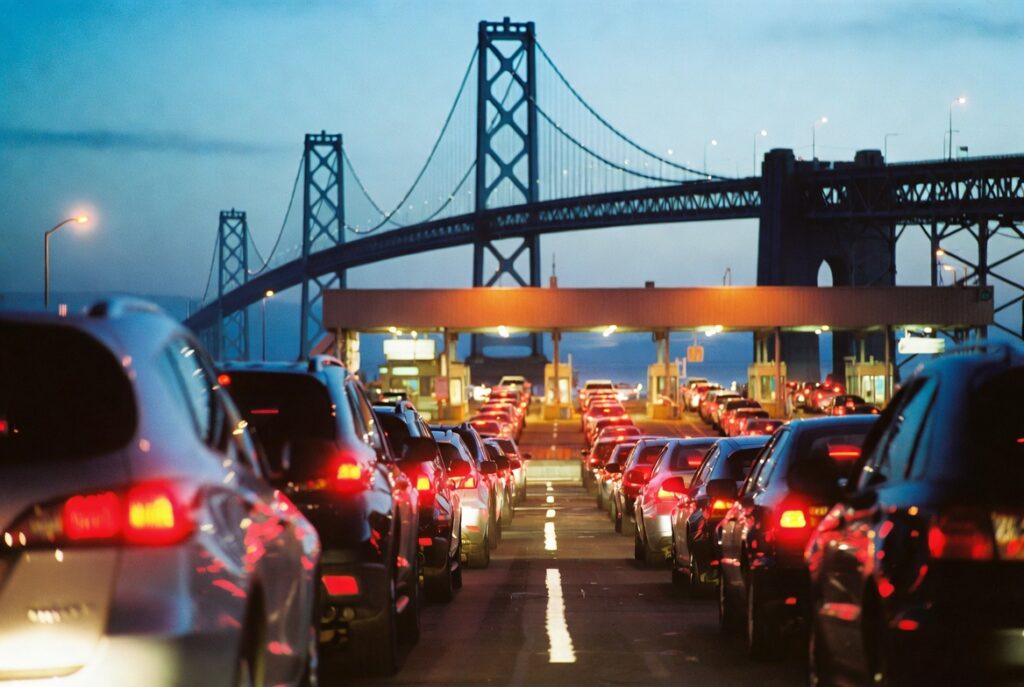
- Bay Bridge approach — the merge from 80 East and the toll plaza queue
- Doyle Drive and Golden Gate Bridge approach
- Signalized intersections in SoMa, Mission, and the Financial District — where stoplight backups produce frequent rear-end impacts
- Hill-stop scenarios — Pacific Heights, Russian Hill, Twin Peaks, and other steep grade intersections
If your rear-end collision happened on a Bay Area freeway, the case may also involve trucking carriers, rideshare drivers, or commercial fleet vehicles — each of which carries different insurance coverage and case strategy implications.
What Insurance Companies Will Argue Against Your Rear-End Case
Having tried and arbitrated these cases for over fifteen years, I can tell you what the defense playbook looks like. It’s remarkably consistent across cases, defense firms, and insurance carriers.
The “minor damage equals minor injury” argument. Defense will lead with photographs of your vehicle and the at-fault driver’s vehicle. They will hire a biomechanical engineer to calculate Delta-V — the change in velocity at impact — and argue that the forces involved could not have caused the injuries you claim. The medical literature contradicts this position; soft tissue injuries, disc herniations, and concussions occur regularly at impact speeds well under 10 mph. But the argument is effective because it appeals to lay intuition. Bumpers look fine, so people couldn’t have been seriously hurt — that’s the framing defense wants the arbitrator or jury to absorb before they ever see the medical records.
The “subjective versus objective findings” attack. If your initial CT scan or MRI didn’t show acute findings — and many concussions and soft tissue injuries don’t — defense will argue that the absence of imaging findings means the injury didn’t occur. They will simultaneously point to any age-related or degenerative findings on your imaging and argue that those explain your symptoms, not the collision.
The “attorney-driven diagnosis” narrative. Defense will create a timeline showing exactly when you retained counsel and when each diagnosis was made. If your treating physicians initially called your symptoms “post-concussive” and a specialist later diagnosed traumatic brain injury after you retained an attorney, defense will tell the arbitrator or jury that the diagnosis was manufactured for litigation. The way to defeat this is contemporaneous documentation of symptoms from day one — every visit, every complaint, every functional limitation, recorded in the medical records before any attorney is involved.
The treatment gap and compliance attack. Every missed appointment, every gap in treatment, every recommended referral you did not pursue, every prescription you stopped — defense will document all of it. Their narrative: if you were really hurt, you would have followed through with treatment. Real life with serious injury is messy. Insurance approval delays, pain that comes and goes, conflicting medical advice, work obligations, family responsibilities — all of these create gaps. But your case is stronger when those gaps are fewer and shorter.
Alternative causation. Defense will look hard at your life for anything else that might explain your symptoms — pre-existing conditions, family stressors, financial pressures, aging, other medical issues, prior injuries. California’s eggshell plaintiff rule means defendants take you as they find you, including any pre-existing vulnerabilities. But defense will still argue that those other factors, not the collision, are responsible for your current condition. In one of my recent rear-end cases, defense pursued this theory aggressively, arguing that marital stress and family issues — not the rear-end collision — caused my client’s anxiety and cognitive symptoms.
The functional capacity counter-narrative. If you continued working, traveling, exercising, parenting, or otherwise functioning at a high level after the collision, defense will use that to argue you were not really impaired. Photographs from social media, calendar entries, business records, and travel itineraries become defense exhibits. Conversely, defense may argue that any limitations you have were imposed by your family or chosen for non-medical reasons, not caused by the injury itself.
Expert testimony battles. In serious rear-end cases, defense will retain biomechanical engineers, neurologists, neuropsychologists, and economists. The biomechanical engineer will testify about peak head acceleration and argue it was insufficient to cause traumatic brain injury. The neuropsychologist will reinterpret your test results to argue that scores within normal range mean no cognitive deficit. The neurologist will testify that mild concussion symptoms typically resolve within eight to twelve weeks, so any persistent symptoms must have a different cause. Your case requires equally credentialed experts who can hold up under cross-examination.
Damages calculation challenges. Even when liability and causation are conceded, defense will challenge how damages should be calculated. For lost income, they may argue replacement-worker cost — what it would have cost to hire someone to do your job — rather than your actual lost personal income. For future medical expenses, they will call any treatment protocol speculative, proprietary, or unsupported by FDA-approved dosages. In Underinsured Motorist arbitration specifically, defense may argue that the collateral source rule does not apply in first-party contract claims, citing Plut v. Fireman’s Fund Ins. Co. and Bramalea California, Inc. v. Reliable Interiors, Inc., to limit recovery for medical expenses already covered by your health insurance.
The reason I have recovered substantial verdicts and arbitration awards in rear-end cases is that I prepare for every one of these arguments from the first client meeting. The defense plays a known playbook. The cases that succeed are the ones where plaintiff’s counsel has anticipated each play and built the record to defeat it.
Recent Rear-End Collision Results
The cases I’ve handled for Bay Area rear-end victims include:
- $750,000 binding underinsured motorist arbitration award
- $700,000 settlement
- $659,000 arbitration award
- $650,000 settlement for a lumbar spine injury affecting work capacity
- $495,000 settlement
- $140,000 jury verdict in a case where the defense’s top pretrial offer was $50,000
- $100,000 jury verdict in a case where the defense’s top pretrial offer was $21,000
Each of these results was obtained against the defense playbook described above. The two arbitration awards in particular — at $750,000 and $659,000 — involved sophisticated defense firms running coordinated attacks on causation, treatment compliance, alternative explanations, biomechanical force analysis, and damages calculation. The two jury verdicts at the end of the list deserve specific emphasis: the defense believed each of those cases was worth a small fraction of what the jury ultimately awarded. The willingness — and the trial-credible record — to take a rear-end case to a jury changes the math for adjusters from the moment representation is established.
Results are from prior cases handled by the firm and do not guarantee future outcomes. Every case is evaluated on its own facts.
What to Do After a Rear-End Collision in San Francisco
The first 48 hours after a rear-end collision determine much of what’s possible later in the case. The defense playbook described above is built almost entirely on what does or doesn’t happen in the early days and weeks. Each of the following actions exists for a reason — it counters a specific defense argument you will eventually face.
Get medical care the same day. Even if you feel fine. Soft tissue injuries often don’t peak for 24-72 hours. Same-day medical documentation establishes the connection between the collision and any injury that develops. The defense argument that “you didn’t complain of pain at the scene, so your injuries can’t be real” is defeated by same-day emergency room or urgent care records.
Document symptoms contemporaneously. When new symptoms develop — neck pain on day two, headaches on day three, dizziness on day five — tell your doctor that day and make sure each symptom is in the medical record. Do not wait until your attorney consult to surface symptoms you’ve been experiencing for weeks. The “attorney-driven diagnosis” narrative depends on a gap between when symptoms started and when they were documented. Close that gap.
Follow through on every referral. If your primary care physician refers you to neurology, go. If neurology refers you to physical therapy, go. If physical therapy is not working and your doctor suggests pain management, go. Every gap and missed referral becomes defense ammunition. Insurance and scheduling will sometimes create unavoidable delays — document those delays in your medical records when they occur, so the gap has a non-litigation explanation on the record.
Document the scene before you leave. Photograph both vehicles from multiple angles, including the interior of your vehicle and the position of headrests and seats. Photograph any visible debris pattern. Get witness names and phone numbers.
Do not give a recorded statement to the at-fault driver’s insurance. They will call within days, often within hours. Politely decline and refer them to your attorney. Anything you say will be used to minimize your claim — and any inconsistency between your initial statement and later medical complaints will be highlighted at deposition or trial.
Do not accept a quick settlement offer. Early offers exist for one reason: to close the case before injuries become fully apparent. Once you sign a release, the case is over.
Be careful with social media. Defense investigators routinely review social media accounts for the months and years following a collision. Photographs of you on a hike, at a wedding, golfing, or otherwise functioning at a high level become defense exhibits. You don’t need to disappear from social media, but understand that anything you post may be reframed as evidence you weren’t really hurt.
Call an attorney within the first week. Evidence preservation, defendant identification, and insurance notification all benefit from early legal involvement.
Why My Practice Fits These Cases
Rear-end cases are won by attorneys willing to take them to trial or to binding arbitration. I have tried nine personal injury cases to verdict in my career and won all nine. I have also obtained six- and seven-figure arbitration awards in cases the defense valued at a fraction of what the arbitrator awarded. That trial and arbitration readiness is the single biggest factor that changes how adjusters evaluate a case from the moment they learn who represents the plaintiff.
I work as a solo practitioner — every client speaks directly with me, not with a paralegal or junior associate. That direct attorney access matters most in cases like rear-end collisions, where the difference between a $20,000 settlement and a $200,000 verdict often comes down to medical-evidence development and litigation strategy decisions made in the first 90 days.
I am bilingual in English and Spanish and offer all consultations and case representation in either language at no additional cost.
Other Practice Areas I Handle
- Car Accidents — General Bay Area car accident representation
- Brain Injuries — TBI cases including post-concussive syndrome from rear-end impacts
- Spinal Injuries — Cervical, thoracic, and lumbar injuries from rear-end collisions
- Uber & Lyft Accidents — Rideshare-specific rear-end cases
- All Practice Areas
Frequently Asked Questions
Almost always, but not absolutely. California Vehicle Code §21703 prohibits following too closely, and §22350 requires reasonable speed for traffic conditions. Combined, these statutes create a strong presumption against the rear driver. But defenses exist — sudden mechanical failure, multi-car chain collisions, and comparative fault arguments based on the front driver’s conduct. The presumption is strong enough that most rear-end cases proceed on damages rather than liability, but each case requires individual analysis.
No. Delayed-onset pain is normal in rear-end collisions — soft tissue injuries often don’t peak for 24-72 hours, and disc injuries can take longer. Get medical care now, document the connection between the collision and your symptoms, and contact an attorney. The earlier you start the documentation trail, the stronger your case will be.
Almost certainly not. Quick settlement offers in rear-end cases are designed to close the case before injuries become fully apparent. Once you sign a release, the case is over — even if you discover serious injuries weeks or months later. Have any settlement offer reviewed by an attorney before signing anything.
California follows the eggshell plaintiff rule: defendants take the victim as they find them, including any pre-existing vulnerabilities. The fact that you had a prior condition doesn’t bar recovery — it changes the analysis to focus on whether the collision aggravated, accelerated, or worsened that condition. Comprehensive pre-accident medical records become important evidence.
Case value depends on the specific facts: severity of injuries, medical treatment required, lost income, future treatment needs, insurance coverage available, and dozens of other factors. I do not provide case value estimates without reviewing the medical records and accident facts. If anyone offers you a number based on a brief description, be skeptical — accurate case valuation requires real investigation.
You may still recover through your own insurance under Uninsured Motorist (UM) or Underinsured Motorist (UIM) coverage if you have it. UIM cases often go to binding arbitration rather than jury trial, and they require specific procedural steps that differ from third-party liability cases. One of my recent rear-end results — the $750,000 award — came through binding UIM arbitration.
Free Consultation
If you were rear-ended anywhere in the Bay Area, call (415) 851-4557 for a free, confidential consultation. There is no fee unless I recover compensation for you. I am bilingual in English and Spanish.
Disclaimer: This page is for informational purposes only and does not constitute legal advice. Consult a licensed attorney for advice specific to your situation. Results mentioned are from prior cases handled by the firm and do not guarantee future outcomes.