

John Roach, Esq. | June 8, 2026 | California Law \ Car Accidents
I-280 Car Accidents in San Francisco: Common Causes, Severe Injuries, and Why Highway Cases Are Different

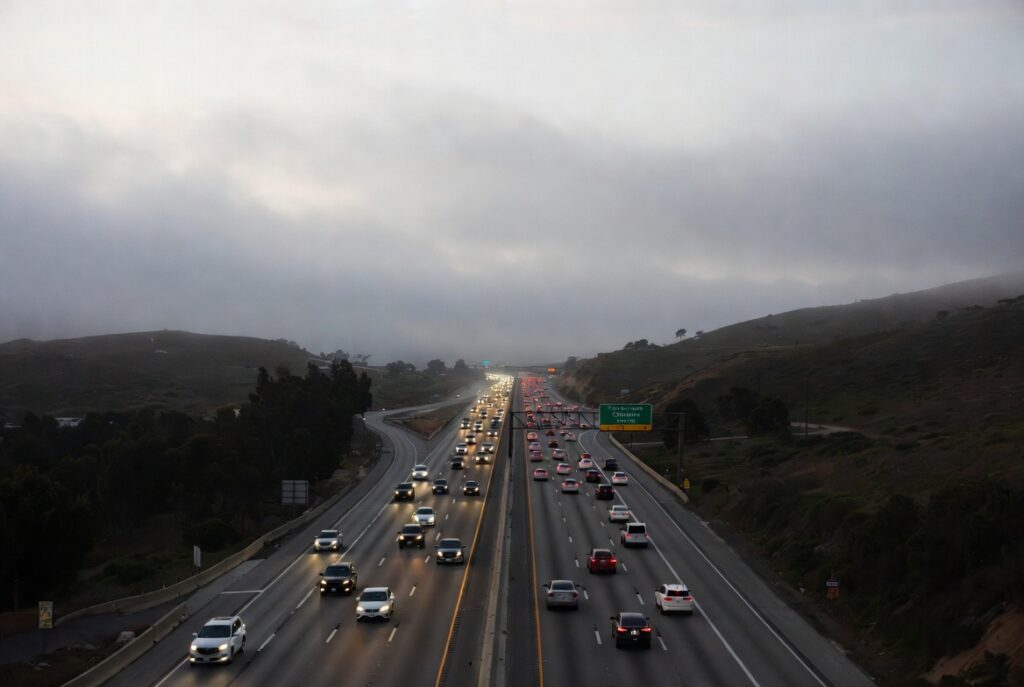
Interstate 280 cuts through the San Francisco Peninsula at speeds and grades that turn ordinary driver mistakes into catastrophic injury cases. A momentary lane drift on Highway 101 becomes a sideswipe. The same drift on I-280 — at 75 miles per hour, on a downhill curve, in the canyon-fog the corridor is famous for — becomes a multi-vehicle pile-up with severe traumatic brain injuries, spinal cord damage, and sometimes fatalities.
I represent injury victims across San Francisco and the Bay Area, and I have handled hundreds of car accident claims since 2009, including a substantial share involving the I-280 corridor between the city, Daly City, and the mid-Peninsula. Highway crashes here are not just bigger versions of city-street accidents. They follow different physics, generate different injuries, and require a different legal playbook.
This post explains why I-280 cases are different, the corridor segments where crashes cluster, the injuries that recur, and the case-building decisions a trial-tested attorney makes in the days and weeks after a serious highway crash.
Why I-280 Crashes Are Different from Surface-Street Car Accidents
Three factors make I-280 collisions distinct from the urban crashes that fill most San Francisco police reports.
Higher kinetic energy. Kinetic energy scales with the square of speed. A crash at 70 mph carries roughly five times the destructive force of a crash at 30 mph. Bumpers that absorb city-speed impacts disintegrate at highway speed. Airbags that protect occupants in fender-benders become inadequate against the full force of a 4,000-pound vehicle hitting a stopped car at speed. The injuries that follow are correspondingly more severe — severe traumatic brain injury, spinal cord damage, multiple fractures, internal organ injury.
Multi-vehicle complexity. On a city street, a typical crash involves two cars. On I-280, secondary impacts are common — a rear-end collision triggers a chain reaction. Three, four, or more vehicles end up involved. Identifying the actual sequence of impacts, the point of first contact, and each driver’s contribution to the chain becomes a forensic exercise requiring accident reconstruction. Comparative-fault arguments multiply with every additional vehicle in the chain.
Government and contractor defendants. I-280 is a Caltrans-maintained roadway. When roadway design, signage, drainage, lane striping, or guardrail condition contributes to a crash, the State of California becomes a potential defendant. So do private contractors who performed maintenance or construction work on the corridor. These claims have shorter deadlines (six-month government tort claim under California Government Code § 911.2) and tougher procedural requirements than claims against private drivers — but they can unlock the resources needed to fully compensate catastrophic injuries when the at-fault driver alone carries minimal coverage.
Common Causes of I-280 Crashes in the San Francisco Area
Most I-280 crashes I see fall into recurring patterns.
- Following too closely at speed. California Vehicle Code § 21703 prohibits following another vehicle more closely than is reasonable and prudent. At 70 mph, the reasonable following distance is much greater than most drivers maintain. When traffic abruptly slows — a common occurrence on I-280 near the 101 split and the John Daly approach — drivers who were following too closely cannot stop in time.
- Lane changes without adequate gap. Aggressive lane changes are common between the 280/101 split and the merges into and out of San Francisco. A car that cuts in and immediately brakes turns a manageable highway situation into a crash.
- Driver fatigue. I-280 carries heavy long-distance traffic in both directions — Peninsula commuters in the mornings, Silicon Valley returns in the evenings, weekend trips between San Francisco and Santa Clara County. Fatigue-related crashes spike on long-distance corridors.
- Distracted driving. Phone use behind the wheel at highway speeds is a leading cause. The few seconds a driver spends looking at a navigation app or a text message translate to hundreds of feet of unmonitored road at 70 mph.
- Weather and visibility. The canyon segments of I-280 through the Peninsula see some of the densest fog in the Bay Area. Visibility drops abruptly. Drivers who do not slow appropriately rear-end vehicles that have slowed for the conditions ahead.
- Commercial truck involvement. I-280 carries substantial commercial truck traffic. Truck crashes cause disproportionate damage because of weight differential and the longer stopping distances big rigs require. When the at-fault driver is a commercial truck operator, federal FMCSA regulations apply, hours-of-service records become evidence, and the available liability insurance is often a $1 million commercial policy rather than a state-minimum auto policy.
- Motorcycle and rideshare involvement. Motorcyclists on I-280 face elevated risk in lane-change collisions; rideshare drivers working long shifts and watching app screens are involved in a growing share of corridor crashes.
Dangerous Segments of I-280 in and Near San Francisco
Crashes do not happen evenly along the I-280 corridor. Certain segments produce a disproportionate share of serious-injury cases.
The 280/101 split (Northbound). Where I-280 splits from US-101 just south of San Francisco, last-second lane changes and merge confusion cause regular sideswipes and chain-reaction rear-ends. This area is also one of the foggiest stretches in the Bay Area, compounding visibility issues.
The Cesar Chavez and Mariposa exits. The exits into Bernal Heights and the southern edge of Noe Valley funnel high-speed traffic into surface streets quickly. Drivers who do not adjust speed in time rear-end stopped or slowing vehicles waiting at the bottom of the off-ramp.
The Daly City interchange. Where I-280 transitions out of San Francisco into Daly City, traffic patterns change as commuters merge from Highway 1 and the John Daly Boulevard exits. Multi-vehicle pile-ups in this segment are common during morning and evening peak hours.
The Crystal Springs and Canyon segments. South of San Francisco proper, between San Mateo County exits and the Santa Clara County line, I-280 winds through scenic but technical terrain — sweeping curves, varying grades, persistent fog. Drivers who maintain freeway speed through these segments without adjusting for the conditions cause some of the most serious single-vehicle and lane-departure crashes the corridor sees.
Severe Injuries Common in I-280 Highway Crashes
Highway-speed crashes produce injury patterns that rarely appear in lower-speed urban accidents. The catastrophic end of the spectrum is overrepresented.
- Severe traumatic brain injury. Even with airbags and helmets, the rotational and translational forces in a high-speed impact can cause diffuse axonal injury and subdural hematomas that produce permanent cognitive deficits. My practice has reached $6 million for a pedestrian traumatic brain injury settlement and $2.185 million for a separate brain injury matter — and many I-280 crashes generate similar severity.
- Spinal cord injury. Spinal cord damage from highway crashes can produce partial or complete paralysis. Lifetime care costs for a severe spinal cord injury frequently exceed $5 million.
- Mild and moderate concussions. Concussion and mild TBI frequently present hours or days after a high-speed crash. Insurance companies aggressively minimize these cases despite well-documented long-term cognitive and emotional consequences.
- Multiple orthopedic fractures, including pelvic, femoral, and rib fractures from the seatbelt or steering column.
- Internal organ injury, including splenic and hepatic lacerations from belt loading.
- Fatal outcomes. Highway-speed crashes are among the most common contexts for wrongful death claims in California.
How Insurance Companies Fight I-280 Crash Claims
Highway crashes are higher-value cases, and insurance carriers fight them harder. The recurring tactics:
Disputed comparative fault. In multi-vehicle pile-ups, every insurer’s incentive is to argue their insured was less at fault and someone else was more. California’s pure comparative negligence rule under Li v. Yellow Cab Co. (1975) means even a 20% fault assignment reduces a plaintiff’s recovery by 20%. Insurers will press hard on lane positioning, following distance, speed, and reaction time — all of which require accident reconstruction expertise to counter.
“The crash wasn’t survivable for someone uninjured.” This argument is the inverse of the low-impact defense familiar from city-street cases. When an I-280 crash is severe enough that occupants were almost certain to be seriously hurt, insurers will sometimes argue that any specific injury must therefore have been pre-existing or fabricated because the impact was not unique to the plaintiff’s claimed condition. Defeating this requires careful medical-records work documenting the specific mechanism of each injury.
Caltrans procedural defenses. When roadway condition or design contributes to a crash, Caltrans counsel will raise design immunity, discretionary immunity, lack of notice, and missed-deadline defenses. The six-month government tort claim under California Government Code § 911.2 is the first procedural battleground — miss it, and the entire roadway-condition theory is barred regardless of merit.
Commercial truck driver-and-employer defenses. When a commercial truck driver is at fault, the trucking company will argue the driver was outside the scope of employment, was an independent contractor, or was not at fault despite the evidence. Federal Motor Carrier Safety Regulations and electronic logging device data — both of which have to be preserved through prompt litigation hold letters — are usually the key evidence to defeat these defenses.
What to Do After an I-280 Car Accident
The general action plan after any San Francisco car crash applies on the highway too — call 911, get medical care, document the scene, do not give recorded statements, preserve evidence. I have walked through that plan in detail in a separate post you can read here: What to Do After a Car Accident in San Francisco.
Three highway-specific points are worth adding.
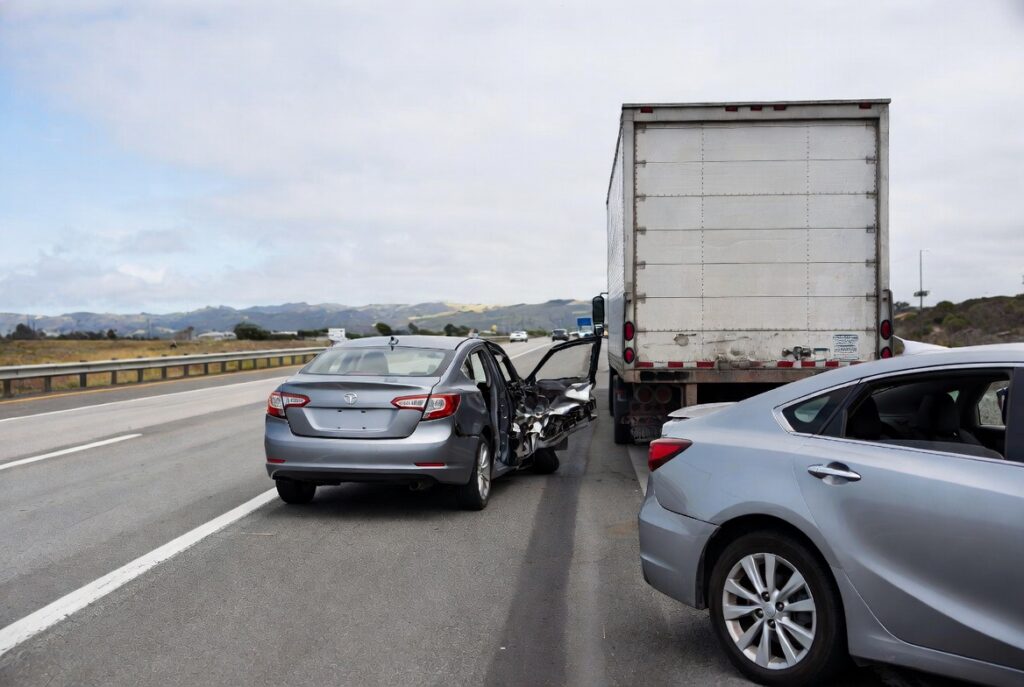
Stay in the vehicle if traffic is moving. Secondary collisions — being struck after exiting your car — are a leading cause of injury escalation on highway crashes. If the vehicle is operable and the shoulder is reachable, move to the shoulder before getting out. If not, stay belted in until law enforcement arrives or traffic stops.
Preserve commercial vehicle evidence immediately. If a commercial truck was involved, the truck’s electronic logging device, the driver’s logs, the company’s pre-trip inspection records, and the truck’s black-box data are evidence with very short retention windows. A preservation letter from an attorney within days — not weeks — can mean the difference between a clear liability case and a credibility contest.
Watch the 6-month deadline if Caltrans or road condition may be involved. If poor signage, defective guardrails, drainage issues, design flaws, or maintenance failures may have contributed, the six-month government tort claim deadline applies to any claim against the State. This deadline is hard, not advisory.
Frequently Asked Questions
Highway speeds produce roughly five times the kinetic energy of city-street crashes, which translates to more severe injuries — traumatic brain injury, spinal cord damage, multiple fractures, and fatalities are overrepresented in I-280 cases. Multi-vehicle pile-ups, commercial truck involvement, and Caltrans roadway-condition issues also make these cases legally more complex.
Depending on the facts: the at-fault driver, multiple at-fault drivers in a chain-reaction crash, a commercial trucking company under federal regulations, a rideshare or delivery company if a gig driver was involved, Caltrans if roadway design or maintenance contributed, and contractors who performed work on the highway. Catastrophic-injury cases often require pursuing multiple defendants to access enough insurance coverage to fully compensate the harm.
Two years from the date of the crash for claims against private drivers, under California Code of Civil Procedure § 335.1. Six months for any claim against Caltrans, the State of California, or a government contractor under Government Code § 911.2. The six-month deadline is the more dangerous one — it runs fast, and missing it bars the entire government-defendant claim.
California’s state-minimum policy is far below what most highway-crash injuries are worth. When the at-fault driver is underinsured, your own underinsured motorist (UIM) coverage can fill the gap. I have recovered $750,000 in a UIM arbitration for a rear-end client whose at-fault driver carried a state-minimum policy. Additional layers of coverage may also be available if a commercial vehicle, rideshare driver, or government defendant is involved.
No. Commercial trucking insurers send adjusters and rapid-response investigators to crash scenes within hours — sometimes before injured drivers are out of the hospital. Their job is to limit the company’s exposure. You are not legally required to give a recorded statement, and anything you say will be used against you. Talk to an attorney before any contact with the trucking company’s insurer.
You can still recover. California follows pure comparative negligence under Li v. Yellow Cab Co. (1975) — even a driver found 70% at fault can recover 30% of their damages. The defense will work to assign as much fault to you as possible. An attorney’s job is to push back with accident reconstruction, witness testimony, and forensic evidence.
Surveillance cameras at nearby businesses, gas stations, and highway-adjacent properties typically overwrite footage within 7 to 30 days. Caltrans traffic cameras have similarly short retention windows. Commercial truck black-box and electronic logging device data can be wiped or overwritten if not preserved by formal letter. The window for preserving this evidence is very narrow — days, not weeks.
Talk to a San Francisco Highway Accident Lawyer About Your I-280 Case
If you or a loved one was injured in an I-280 crash, you need representation that understands highway-specific evidence preservation, multi-defendant liability, and Caltrans procedural deadlines. I offer free consultations and handle every case personally — no associate handoffs. With $25 million+ recovered for Bay Area clients across catastrophic-injury matters, I have the experience and the resources to fight for full compensation. Call (415) 851-4557 or email john@representmyinjury.com to discuss what happened.