

John Roach, Esq. | June 5, 2026 | California Law \ Car Accidents
What to Do After a Car Accident in San Francisco: Step-by-Step Action Plan from a Trial Lawyer

The hours and days after a car accident in San Francisco are the most important part of your case — and almost everyone makes mistakes during them. Insurance companies count on it. Adjusters will be calling within 24 hours, your own carrier will be asking for recorded statements, and well-meaning friends will be giving you contradictory advice. Meanwhile, evidence is disappearing, witnesses are forgetting details, and symptoms you do not yet feel are about to surface.
I represent injury victims across San Francisco and the Bay Area, and I have handled hundreds of car accident claims since 2009 — everything from rear-end collisions on the 101 to catastrophic traumatic brain injury cases involving pedestrians. The pattern I see most often is good people making decisions in the first 72 hours that quietly cost them five-figure or six-figure compensation later.
This post is the action plan I give every client and every friend who has ever been in a crash. Eight steps, in order, plus the special situations that apply in San Francisco specifically. Follow it, and you protect your case before you ever speak with an attorney.
Want this as a printable checklist? I’ve packaged these steps into a free PDF guide, The First 10 Days After a Car Accident in San Francisco, including the DMV filing deadline most guides skip.
Step 1 — Make Sure You and Anyone Else Is Safe
Before anything else, check yourself, your passengers, and anyone else involved for injuries. If the vehicles can be moved and traffic is creating a danger, move them to the shoulder or the nearest safe spot. If they cannot be moved or you suspect serious injury, leave everything in place and stay put.
Turn on hazard lights. If it is dark or visibility is poor — especially on San Francisco’s foggy corridors near Ocean Beach, the Presidio, or the bridge approaches — flares or warning triangles can prevent secondary collisions. Most rental cars and many newer vehicles carry these in the trunk.
Do not get out into traffic unless you are certain it is safe. Secondary crashes — being struck after exiting your vehicle — happen frequently on the 101 corridor and the I-280 merges.
Step 2 — Call 911 and Request a Police Report
Call 911 even for what seems like a minor crash. There are three reasons this matters.
First, a police report creates an official, contemporaneous record of what happened — who was driving where, who admitted what at the scene, what the conditions were. Without it, you are in a he-said-she-said situation later when the other driver’s story changes.
Second, paramedics on scene can document injuries you may not realize you have. Adrenaline masks pain. Shock masks neurological symptoms. Having medical professionals look at you at the scene creates a baseline record that is hard to challenge later.
Third, if the other driver was impaired, distracted, or fleeing the scene, only law enforcement can document and pursue that. DUI accidents are some of the most valuable cases in my practice because the at-fault driver’s conduct opens the door to punitive damages — but only when the impairment is documented at the scene.
For collisions involving MUNI buses or other government vehicles, the police report is doubly important — the deadline to file a government tort claim is six months under California Government Code §§ 911 and 945.4, far shorter than the standard two-year statute of limitations.
Step 3 — Document the Scene Thoroughly
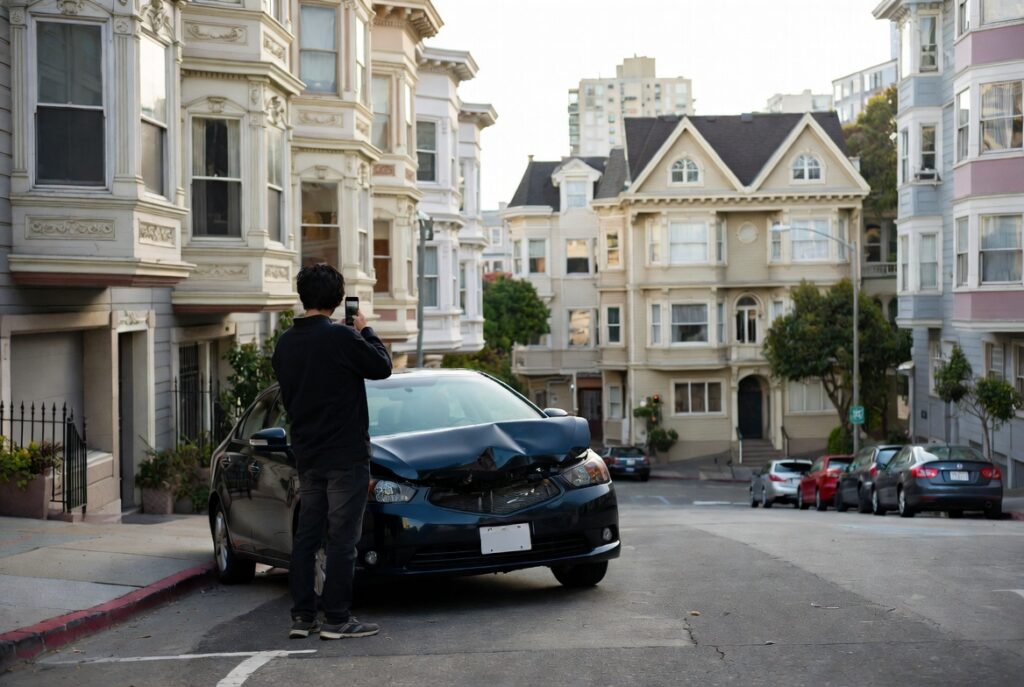
Your phone is the most important piece of legal equipment you carry. Use it.
- Photograph all vehicles — close-ups of damage, and wide shots showing the full position of every car
- Photograph the scene — skid marks, debris, traffic signs, signal lights, intersection geometry
- Photograph any visible injuries — yours and your passengers’
- Photograph the other driver’s license, insurance card, and license plate
- Get names and phone numbers of all witnesses — even brief ones who saw it happen
- If there are nearby businesses with security cameras, write down their addresses
Video is even better than still photos when possible. A 30-second walk-around video captures details that photos miss. Surveillance footage from nearby businesses has short retention windows — usually 7 to 30 days — and recovering it after the fact requires a preservation letter from a lawyer. The names you write down at the scene make that preservation letter possible.
Step 4 — Get Medical Care Immediately, Even If You “Feel Fine”
This is where most cases are won or lost. Adrenaline and shock can mask serious injuries for 24 to 72 hours. By the time symptoms emerge, the insurance adjuster’s argument writes itself: “If you were really hurt, you would have gone to the hospital.”
Some injuries are particularly common to develop late after a crash. Concussion and mild traumatic brain injury frequently present hours or days after impact, often without the person ever striking their head — the brain moves inside the skull during the acceleration-deceleration cycle. Cervical and lumbar disc injuries can be asymptomatic for a week, then progressively worsen as inflammation develops. Subdural hematomas — bleeding between the brain and its outer membrane — can develop slowly and become life-threatening days later.
Go to the emergency room the same day if there is any question. For non-emergency symptoms in the days that follow, see your primary care doctor or an urgent care clinic and tell them clearly: “I was in a car accident on [date].” That single sentence connects every subsequent symptom and treatment to the crash in your medical record.
Step 5 — Do Not Talk to the Other Driver’s Insurance Company
Within 24 to 48 hours, you will get a call from the at-fault driver’s insurance company. The adjuster will sound friendly and helpful. They will ask if it is okay to record the conversation “for accuracy.” They will ask how you are feeling, what happened, and whether you have any injuries.
You are not required to give a recorded statement to the other driver’s insurance company. You should not. Anything you say can and will be used to discount your claim later. “I’m okay” said in shock at the scene becomes evidence you were not injured. “It happened so fast” becomes evidence you cannot reliably describe what occurred. “I didn’t see them coming” becomes evidence you were not paying attention.
The correct response: “I’m not going to give a recorded statement at this time. Please put any requests in writing.” Then end the call. If you have counsel, refer the adjuster to your attorney.
Step 6 — Notify Your Own Insurance, but Be Careful What You Say
Your own insurance policy almost certainly requires you to notify them promptly after a crash — usually within 30 days, sometimes sooner. Failing to do so can void coverage you need. Make the call.
But the conversation with your own carrier is more delicate than people realize. Your insurance company has financial interests that do not perfectly align with yours, particularly if you may need to make an uninsured motorist (UM) or underinsured motorist (UIM) claim against your own policy. Stick to facts: when, where, what happened, who else was involved. Do not speculate about fault. Do not minimize injuries. Do not promise anything.
UM/UIM coverage is critical when the at-fault driver has minimal or no insurance. California’s state-minimum liability coverage is well below what most serious-injury cases are worth. I have recovered six- and seven-figure UIM arbitration awards for clients whose at-fault drivers carried state-minimum policies.
Step 7 — Preserve Evidence and Track Everything
From the day of the crash forward, document every cost and every consequence. Keep a single folder — physical or digital — with:
- All medical records, bills, and prescription receipts
- Pay stubs and any documentation of missed work
- Receipts for transportation to medical appointments
- Repair estimates and rental car receipts
- A daily journal of pain levels, symptoms, and limitations — even short notes
- Any photos of bruising, swelling, or recovery as it develops
The journal is more powerful than people expect. Memory fades. By the time a case settles or goes to trial, you will not remember which week you could not sleep through the night or which month you stopped being able to lift your daughter. Contemporaneous notes are some of the strongest evidence of pain and suffering damages.
Also preserve digital evidence. Dashcam footage. Phone GPS data showing your route. Text messages with witnesses. Email confirmations of medical appointments. Anything that can be wiped, overwritten, or lost — back it up.
Step 8 — Talk to a San Francisco Car Accident Lawyer Before You Sign Anything
Most San Francisco personal injury attorneys — including my office — offer free consultations and work on a pure contingency-fee basis. You pay nothing unless I win. There is no financial reason to delay calling.
There are several legal reasons to call sooner rather than later. Evidence has short retention windows. Witnesses become harder to find. Insurance carriers calibrate their initial offers based on whether a claimant has counsel. Statutes of limitations run — and run faster than people expect, particularly for any claim involving a government vehicle, agency, or roadway condition.
Most importantly, decisions made before consulting an attorney cannot always be undone. Recorded statements cannot be retracted. Quick settlement offers, once signed, end your right to seek further compensation even if your condition gets dramatically worse. I have seen clients sign a $5,000 settlement in the first week of a crash and then find out three months later they need surgery for a herniated disc — at which point the release has already closed the door.
What NOT to Do After a Car Accident in San Francisco
If steps one through eight are what to do, here is the matched list of what to avoid.
- Do not apologize at the scene, even reflexively. “I’m sorry” is the most damaging phrase you can say. Even if you mean it as sympathy, it will be used as an admission of fault.
- Do not admit fault or assign blame. You do not have the full picture. Save your description for the police, your doctor, and your lawyer.
- Do not give a recorded statement to the other driver’s insurance — see Step 5.
- Do not sign anything an adjuster sends you in the early weeks. Releases, medical authorizations, and “property damage only” settlements can have hidden language that affects your personal injury claim.
- Do not accept an early lowball offer. Soft tissue injuries, disc injuries, and concussions can take months to fully reveal themselves. Quick settlement offers are calculated to close the file before you know what you actually have.
- Do not post about the accident on social media. Insurance defense firms monitor social accounts during open claims. A photo of you smiling at a birthday party becomes evidence you were not in pain. Set accounts to private and stay off them for the duration of the claim.
- Do not skip or delay medical treatment. Gaps in treatment are one of the most common defenses used to discount injury claims.
Special Situations in San Francisco
Some types of car accidents have additional rules or strategic considerations specific to San Francisco. The following situations all carry case-specific complications worth understanding.
Rear-end collisions. California Vehicle Code § 21703 creates a rebuttable presumption that the rear driver was at fault. Rear-end cases in San Francisco are usually fought on damages, not fault — particularly the “low-impact” defense where insurers argue minor property damage means minor injury.
Pedestrian accidents. Pedestrians account for nearly 40% of serious-injury collisions in the city. Pedestrian accident cases often involve catastrophic injuries — I obtained a $6 million settlement for a pedestrian with traumatic brain injury. Catastrophic cases require expert-driven life-care planning from day one.
Bicycle and motorcycle crashes. Cyclists and motorcyclists have rights under the Vehicle Code that motorists do not always respect. Bicycle accident claims and motorcycle accident claims each have specific evidentiary patterns — lane positioning, helmet use, lane-splitting law under CVC § 21658.1 — that affect comparative-fault arguments.
Uber, Lyft, and delivery driver collisions. When the at-fault driver is operating in the course of rideshare or delivery work — Uber, Lyft, DoorDash, Uber Eats, Amazon Flex — there is potentially a $1 million commercial policy available. Rideshare cases turn on the driver’s app status at the time of the crash, which determines which insurance layer applies.
Commercial truck crashes. Big-rig and commercial vehicle trucking accidents involve federal FMCSA regulations, hours-of-service records, and electronic logging device data that have to be preserved immediately or they disappear. These cases are higher-value but require fast action.
Fatal crashes. If a family member was killed in a car accident, California Code of Civil Procedure § 377.60 governs who may bring a wrongful death claim. The damages include not only the family’s economic loss but the loss of love, comfort, society, and care.
Prefer to watch? Here’s a quick walkthrough of these same steps, so you know exactly what to do at the scene before you call a lawyer.
California Deadlines You Cannot Miss
Three deadlines matter most after a San Francisco car accident.
Two-year statute of limitations. California Code of Civil Procedure § 335.1 generally gives you two years from the date of the crash to file a personal injury lawsuit. After that, your claim is permanently barred — no exceptions for not knowing your rights.
Six-month government tort claim deadline. If your crash involves any government vehicle, government employee, or government-controlled roadway condition — MUNI, BART, City of San Francisco, Caltrans, a police vehicle, a school bus — the deadline to file an administrative claim under California Government Code § 911.2 is just six months. Miss this and the entire claim is forfeited regardless of how strong it would have been.
Insurance reporting deadlines. Your own policy specifies when you must notify your insurer of the accident, often within 30 days. Some UM/UIM provisions impose even shorter notice requirements. Check your policy.
These deadlines are why hesitation costs people their cases. Even if you do not yet know whether you want to pursue a claim, talk to an attorney early so the deadlines are not what decides for you.

Frequently Asked Questions
Generally two years from the date of the accident under California Code of Civil Procedure § 335.1. Claims involving any government entity — including MUNI buses, BART vehicles, or city-owned property — require a government tort claim filed within six months under Government Code § 911.2. Waiting until the deadline approaches is risky: evidence is harder to obtain, witnesses become harder to find, and insurance carriers know time pressure favors them.
Yes. A police report creates an official, contemporaneous record that protects you when the other driver’s story changes later. It also documents impairment, distraction, or fleeing-the-scene conduct that may matter to your case. Even a fender-bender benefits from having law enforcement on the record.
Get medical care anyway. Adrenaline and shock mask injuries for 24 to 72 hours. Soft tissue injuries, concussions, and disc injuries frequently develop hours or days after a crash. See a doctor the same day and tell them you were in a car accident — that single fact connects every later symptom to the crash in your medical record.
No. You are not legally required to give a recorded statement to the at-fault driver’s insurance company, and anything you say can be used against you later. Insurance adjusters are trained to elicit statements that limit the carrier’s exposure. Speak with an attorney before any recorded contact with the other side’s insurance.
Your own uninsured motorist (UM) or underinsured motorist (UIM) coverage can fill the gap. California’s state-minimum liability coverage is well below what most serious-injury cases are worth, so UM/UIM coverage is critical even when the at-fault driver is technically insured. UM/UIM claims are pursued against your own insurance carrier and often require arbitration.
It depends on whether anyone was injured and how the insurance companies are behaving. For property-damage-only crashes with no injuries, you may not need representation. For any crash with injuries — including injuries that develop in the days following — a free consultation costs nothing and protects you against signing away rights you do not yet realize you need. Free consultations with my office are always at no cost and no obligation.
Yes. California follows pure comparative negligence under Li v. Yellow Cab Co. (1975). Even if you are found partially at fault, you can still recover damages reduced by your percentage of responsibility. As long as you are not 100% at fault, you have a claim.
Talk to a San Francisco Car Accident Lawyer About Your Case
If you have been injured in a car accident anywhere in San Francisco or the Bay Area, I offer free consultations and handle every case personally — no associate handoffs. With $25 million+ recovered for Bay Area clients across car accidents, brain injuries, spinal injuries, and related personal injury matters, I have the experience to fight for full compensation. Call (415) 851-4557 or email john@representmyinjury.com to discuss what happened and what your options look like.