

John Roach, Esq. | July 29, 2026 | California Law \ Premises Liability
San Francisco Hotel Slip and Fall Lawyer: When the Hotel Is Liable for Your Injuries

San Francisco’s hotels host millions of guests a year, from tourists at Union Square to business travelers near Moscone. A polished lobby floor, a wet pool deck, a dim stairwell, a loose runner of carpet — any of them can send a guest to the emergency room in an instant. When that happens, the question is not just “I fell,” but “who was responsible for the condition that made me fall?” California premises liability law has a clear answer in many cases, and as a San Francisco slip and fall lawyer practicing since 2009, I help injured guests hold hotels accountable — and I know how quickly the evidence that proves these cases disappears.
A Hotel’s Legal Duty to Its Guests
Under California law, a property owner — including a hotel — has a duty to use reasonable care to keep its premises safe for the people it invites in. For a hotel, that duty is meaningful: guests are exactly the people the hotel profits from, and a well-run hotel is expected to inspect for hazards, fix them, and warn guests about dangers that cannot be fixed right away. The duty covers the entire property a guest is invited to use — the lobby, guest rooms, elevators, gym, pool, restaurant, and parking structure. Common hazards I see in hotel cases include:
- Wet or freshly mopped lobby and bathroom floors without warning signs.
- Pool decks, spas, and bathroom tubs without adequate slip protection.
- Poorly lit stairwells, hallways, and parking structures.
- Loose carpeting, torn runners, raised thresholds, and uneven flooring.
- Spills in restaurants, bars, and breakfast areas that go unattended.
- Debris or obstacles in walkways and entrances.
The Key Question: Did the Hotel Know?
Winning a slip and fall case usually turns on notice. To hold the hotel liable, the evidence generally must show that the hotel either created the dangerous condition, knew about it and failed to fix it (actual notice), or should have known about it because it existed long enough that a reasonable inspection would have caught it (constructive notice).
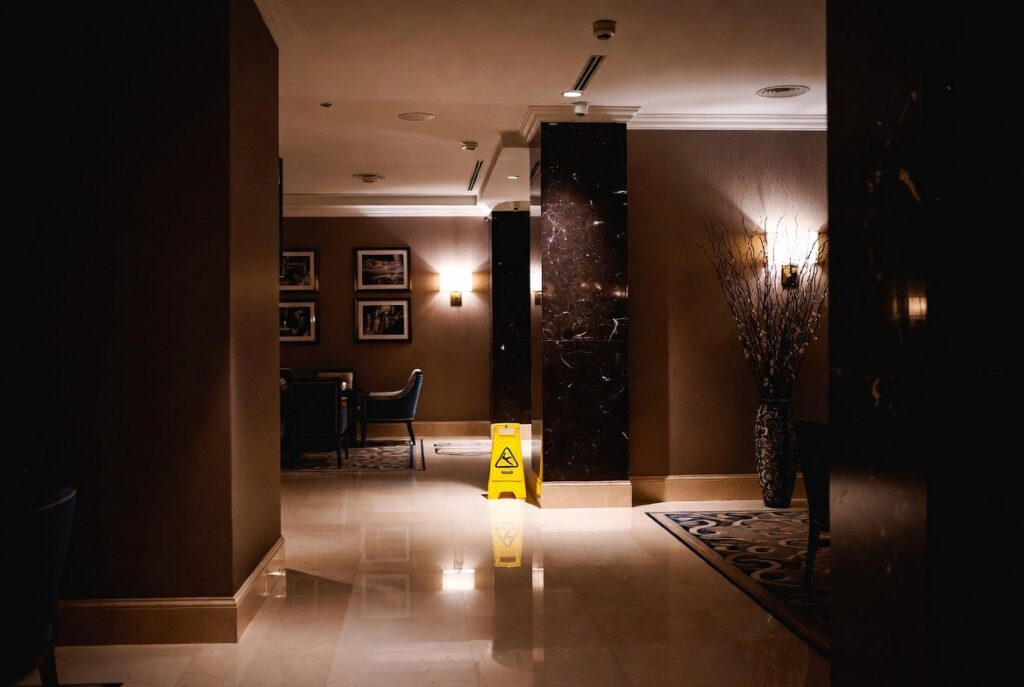
This is where hotel cases are often stronger than a typical store fall: hotels keep inspection logs, maintenance records, housekeeping schedules, and extensive camera coverage. A major San Francisco hotel documents its own operations in a way a corner store never does — and those records can prove exactly how long a hazard existed and whether the staff walked past it. They can also disappear on a routine retention schedule, which is why a preservation letter in the first days matters. Establishing notice is the heart of any premises liability claim.
Who You Actually Sue: Brand, Franchisee, or Management Company
Here is a wrinkle most injured guests never see coming: the name on the building is often not the company responsible for the floor you fell on. A typical San Francisco hotel involves several layers — a national brand that licenses its name, a franchisee or ownership group that holds the property, a separate management company that runs day-to-day operations, and sometimes third-party contractors handling housekeeping, restaurant service, or maintenance. When a claim comes in, each layer points at the others.
Identifying the correct defendants — and their insurance policies — is early, unglamorous work that decides whether a case has one source of recovery or three. I run down the ownership and management structure, the contracts that allocate responsibility for inspections and repairs, and every policy in the stack before the insurers can settle on a unified story. This is one of the clearest reasons an unrepresented guest recovers less: they make a claim against the brand name, and the brand name is often the party with the least legal responsibility.
When the Hotel Blames You
Expect the hotel’s insurer to argue you were careless — that you were not watching where you were going, that the hazard was “open and obvious,” or that your footwear was to blame. California’s comparative fault rules mean your recovery can be reduced by your share of fault, so insurers push that percentage as high as they can. But being partly at fault does not end your case in California, and a hazard the hotel created or ignored remains the hotel’s responsibility. I counter blame-shifting with the hotel’s own records, witness accounts, and the physical evidence of the condition that caused the fall.
Hotel Falls Cause Serious Injuries
People underestimate fall injuries until they happen. A fall onto a hard lobby floor or down a flight of stairs routinely causes traumatic brain injury, spinal and back injuries, hip and wrist fractures, and shoulder damage — especially for older guests. A guest who strikes their head may walk away with what seems like a bump and develop symptoms of a concussion injury over the following days; in older adults, the same impact can produce a subdural hematoma, a slow brain bleed that is a medical emergency. These injuries can mean surgery, long rehabilitation, and lasting limitation. Full documentation is what produces full value; in one serious case, careful work produced the $650,000 spinal injury settlement.
Special Issues for Out-of-Town Guests
Many hotel-fall clients are visitors who fly home days later, which creates unique challenges: evidence stays in San Francisco, follow-up treatment happens out of state, and the hotel may pressure a guest to sign paperwork before they leave. You can pursue a California claim even after returning home, and you should not sign anything or give a recorded statement on your way out the door. I handle the California side of the case so an injured visitor can focus on recovering.
Fell on the Sidewalk Outside the Hotel? Different Rules and a Shorter Deadline May Apply
Not every fall at a hotel happens inside it. Trips on the sidewalk out front — a raised concrete slab, a broken curb, a slick metal grate — are a category of their own, because responsibility can be split between the adjacent property owner and a public entity. Under California Streets and Highways Code section 5610, the owner of property fronting a sidewalk generally bears responsibility for maintaining it, and San Francisco ordinances place sidewalk repair duties on adjacent owners. But where the dangerous condition involves city-owned property or infrastructure, the claim runs against the City and County of San Francisco itself.
That distinction carries a deadline trap. A claim against a public entity is governed by the California Government Claims Act, and under Government Code section 911.2, a written government claim generally must be presented within six months of the injury — far shorter than the two-year deadline most people assume. If your fall happened on or near the public right-of-way, the safe course is to treat the six-month clock as running from day one and let an attorney determine who actually owns the defect. Guessing wrong on this question, or discovering it in month eight, can end an otherwise strong case.
Hotel Workers Are Protected Too
San Francisco’s hospitality industry runs on housekeepers, kitchen staff, bell staff, and maintenance workers — many of them Spanish-speaking — and they fall on the same wet floors and broken stairs guests do. An injured employee’s claim usually starts with workers’ compensation, but when a third party caused the hazard — an outside cleaning contractor, a negligent vendor, a property owner separate from the employer — a civil claim can exist alongside the comp claim, and it is often worth far more. For Spanish-speaking workers, I explain both tracks directly in Spanish; the same protections are described on my abogado de resbalones y caídas page, and your right to recover never depends on your immigration status.
What to Do After a Hotel Slip and Fall
- Report the fall to hotel management and make sure an incident report is created — then request a copy.
- Photograph the hazard immediately (the wet floor, the torn carpet, the missing sign) before it is cleaned up.
- Get the names of staff and any witnesses, and note nearby cameras.
- Seek medical care right away, even if you think you are only bruised — head injuries in particular can surface late.
- Do not give a recorded statement or sign a release before speaking with an attorney.
- If the fall happened on the sidewalk or any public property, note the six-month government claim deadline and get legal advice quickly.
Why a San Francisco Hotel Injury Lawyer Matters
Hotels and their insurers handle fall claims constantly, and they are good at minimizing them. As a trial-tested attorney since 2009, I move fast to preserve inspection logs and camera footage, prove the hotel’s notice of the hazard, identify every responsible entity in the ownership stack, and document the full extent of the injury. Hotel and premises injuries are part of the personal injury cases I handle across the city — you can see the full range on my practice areas page. For San Francisco’s many Spanish-speaking hospitality workers and guests, I provide consultations in Spanish directly — I speak with my Spanish-speaking clients personally, without a third-party interpreter. I work on contingency — no fee unless I recover.
Talk to a Hotel Slip and Fall Lawyer for Free
If you were hurt in a fall at a San Francisco hotel, the evidence that proves the hotel’s fault is already at risk — and if public property is involved, the clock is short. Call (415) 851-4557 or schedule a free case review. You can also review frequently asked questions about injury claims. Se habla español — hablo con mis clientes directamente en español, sin intérpretes.
Frequently Asked Questions
No. You generally must show the hotel created the dangerous condition, knew about it and failed to fix it, or should have known because it existed long enough that a reasonable inspection would have caught it. That element is called notice.
Wet or freshly mopped floors without warning signs, slippery pool decks and tubs, poorly lit stairwells, loose or torn carpeting, uneven flooring, and unattended spills in restaurants and breakfast areas.
Hotels keep inspection logs, maintenance and housekeeping records, and camera footage. These can show how long a hazard existed and whether staff ignored it — but they can be lost, so they should be preserved quickly.
California uses comparative fault, so your recovery can be reduced by your share of fault, but being partly at fault does not end your case. A hazard the hotel created or ignored remains its responsibility.
Yes. You can pursue a California claim even after returning home. Do not sign a release or give a recorded statement before leaving, and let an attorney handle the California side of the case.
This firm works on a contingency fee — no fees up front, and you owe attorney fees only if I recover for you. The consultation is free.
No. California civil courts decide injury cases on the facts, not immigration status, and your discussions with your attorney are confidential. Your right to recover does not depend on your status.