

John Roach, Esq. | October 20, 2026 | California Law \ Premises Liability
Report a Dangerous Sidewalk in San Francisco: A Lawyer’s 311 Guide

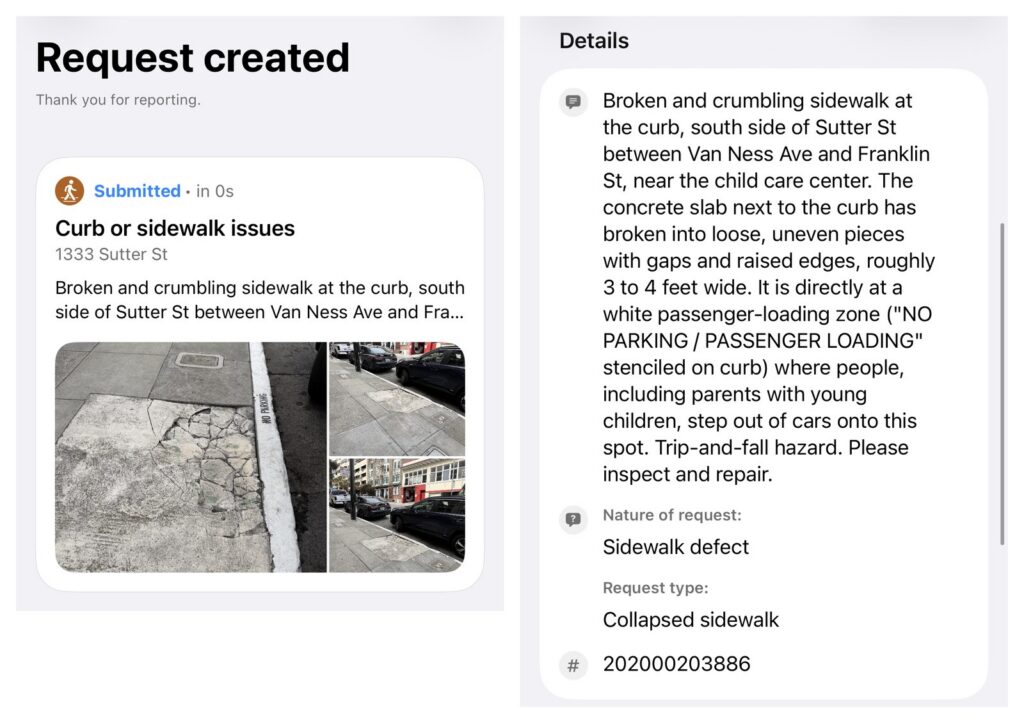
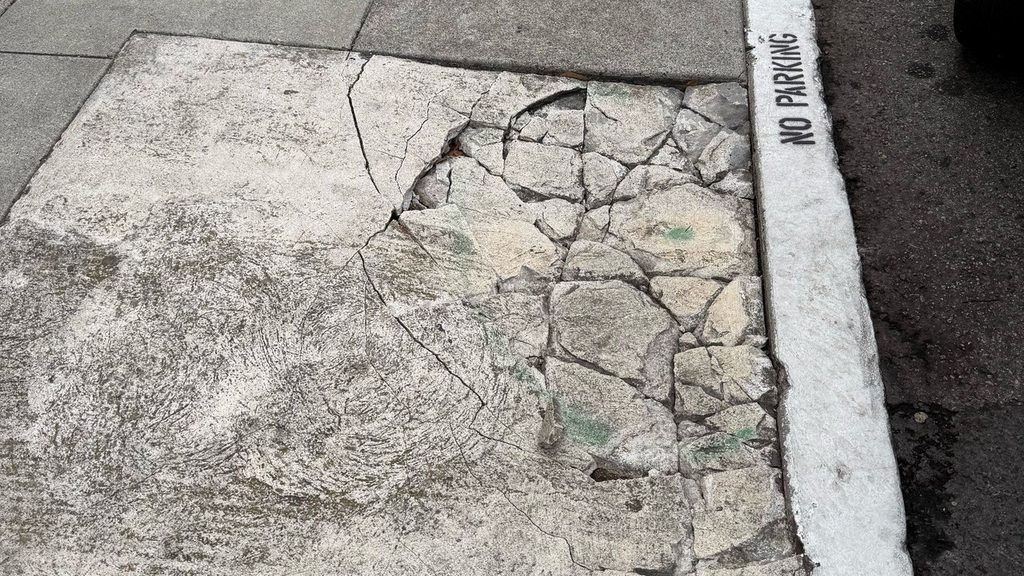
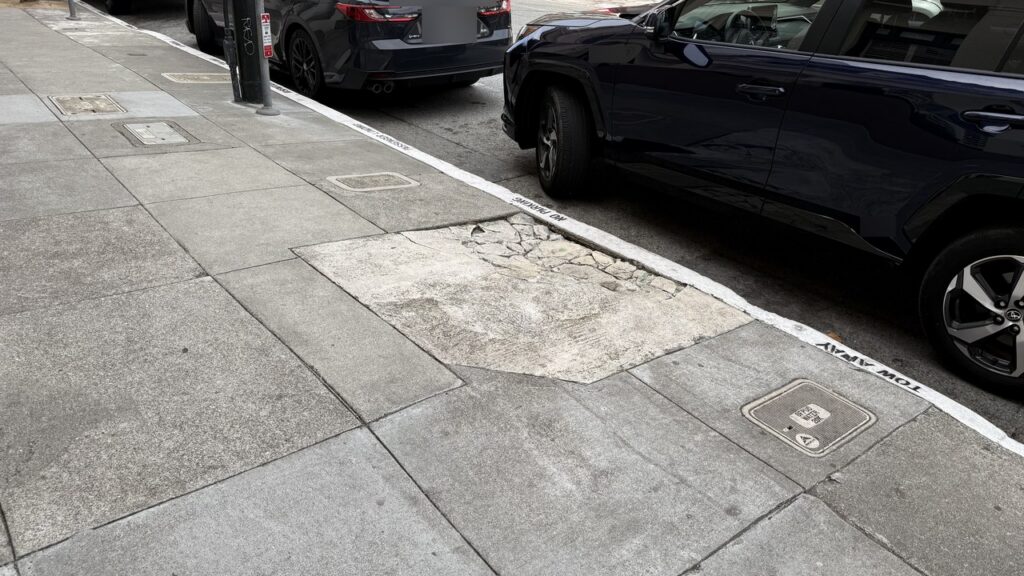
I took the photos in this post on Sutter Street, on the same block as my office. A section of sidewalk next to the curb has broken into loose, uneven chunks of concrete, right at a white passenger-loading zone near a child care center, where parents and small children step out of cars and onto the sidewalk without looking down. Nobody had been hurt there that I know of. That is exactly the point. I reported it to SF311 from my phone before I walked away, and the whole thing took about two minutes.
I am asking you to do the same thing the next time you see a hazard like this one.
Here is why. When someone gets hurt on a broken sidewalk, a crumbling curb, or a damaged public stairway, the city’s first line of defense is usually some version of “we didn’t know.” A report filed by someone like you, before anyone gets hurt, takes that defense away. You do not need to be injured. You do not need to know who owns the sidewalk. You do not need a lawyer. You need a phone and two minutes.
Do What I Did: Report It in Two Minutes
- Take three photos: one wide shot showing the surroundings, one from the angle a pedestrian would approach, and one close-up with your shoe or phone next to the break for scale.
- Open the SF311 app (or dial 311) and choose Curb or sidewalk issues, then Sidewalk defect.
- Drop the pin on the exact spot and describe what makes it dangerous, not just where it is.
- Leave your email on and keep the confirmation with the case number.
That is all it takes. The rest of this post explains why that two-minute report carries so much legal weight, how public entities defend these cases when nobody reported anything, and what to do if you have already been hurt.
Three Ways a City Can Be Liable for a Dangerous Sidewalk
When someone is injured by a dangerous condition of public property in California, the claim runs through Government Code section 835. The injured person has to show the property was in a dangerous condition, the condition caused the injury, and it created a reasonably foreseeable risk of that kind of injury. Then they have to prove one of two things: the public entity created the hazard, or it had notice of the hazard in time to fix it. Notice comes in two forms, actual and constructive. That gives an injured person three possible paths, and none of them is easy without help.
Path 1: The City Created the Hazard
Under section 835(a), if a public employee acting within the scope of employment created the dangerous condition through a negligent or wrongful act, the injured person does not have to prove notice at all. A trench backfilled and left sunken, a curb ramp poured at the wrong height, a utility box set out of level: if a city crew did it, the city owns the result from day one.
That sounds like the easiest path. In practice it is often the hardest, for four reasons:
- You have to identify the work. Sidewalks get cut and patched constantly for water and sewer connections, utility repairs, curb ramps, streetlights, signals, and private construction. A patch does not come with a label saying who poured it or when.
- You have to tie it to the right party. Work done by a city department counts. Work done by a private utility, the adjacent property owner, or the owner’s contractor does not make the hazard the city’s creation. Even a contractor hired by the city is generally not a public “employee” under the Government Claims Act (Government Code section 810.2 excludes independent contractors), so a hazard a contractor left behind may support a claim against the contractor rather than this kind of claim against the city.
- You have to show the work was done wrong, not that it wore out. A patch poured correctly that broke down over ten years of foot traffic was not “created” dangerous. It deteriorated, and a deterioration case is a notice case.
- The records are scattered and old. Permits, work orders, excavation records, and utility files usually come out only through Public Records Act requests or litigation discovery, often years after the work was done.
Look closely at my photos. The broken section is a different color and texture from the slabs around it, which suggests it was cut out and replaced at some point, and there is a water meter box a few feet away. Who poured that patch, and whether it was done badly or simply aged, are exactly the questions a “created the hazard” claim would turn on. I do not know the answers, and a pedestrian who fell there tomorrow would not know them either. That uncertainty is why most sidewalk cases end up depending on notice.
Path 2: Actual Notice
Under Government Code section 835.2(a), a public entity has actual notice if it actually knew the condition existed and knew, or should have known, that it was dangerous. The strongest evidence of actual notice is a record: a prior complaint, a service request, an inspector’s note, a notice to repair, or a prior injury claim at the same spot.
This is the path your report builds. It is also the path that is usually missing, because almost nobody reports a hazard until after someone gets hurt.
Path 3: Constructive Notice
When there is no record, the injured person has to prove constructive notice under section 835.2(b): the condition existed for such a period of time, and was of such an obvious nature, that the entity would have discovered it and recognized the danger if it had used due care.
Both halves are required. A defect that sat there for years but was hard to see does not qualify. Neither does a glaring hazard that appeared last week. The injured person has to prove both duration and obviousness, usually by reconstructing the past:
- Dated street-level imagery, such as older Google Street View captures, showing the same defect months or years earlier.
- The defect itself. Rounded, weathered edges, dirt packed into cracks, and plant growth suggest a condition that has been there a long time.
- Witnesses who live, work, or make deliveries nearby and remember how long it has looked that way.
- City presence at the spot. Evidence that city inspectors, crews, or other employees regularly worked on that block can be relevant to whether the city should have seen it. The block in my photos, for example, has weekly street-cleaning signs.
- Complaint history nearby, including earlier 311 cases on the same block.
The city’s answer is built into the statute. On the question of due care, section 835.2(b) allows evidence of whether a reasonably adequate inspection system would have revealed the condition, and whether the entity maintained and operated such a system with due care. In plain terms, the city argues: we have thousands of blocks of sidewalk, we have a reasonable program for finding problems, and we cannot be expected to find every broken slab on our own. Section 835.4(b) adds a separate defense: the entity can avoid liability by showing that what it did or did not do about the hazard was reasonable, given the time and opportunity it had to act and the cost and practicality of protecting against the risk.
Constructive notice cases can be won. They are also expensive, slow, and uncertain, and a judge may decide the evidence of time and obviousness falls short.
Why Your Report Changes the Case
A 311 report with a photo turns a constructive-notice fight into an actual-notice fact. Nobody has to reconstruct the past from old street imagery and fading memories. The city’s own system shows it was told about this exact hazard, at this location, on this date, with a picture of what made it dangerous.
The “we are too big to inspect everything” argument also loses most of its force. The question is no longer whether the city should have found one broken slab among thousands of blocks on its own. The question becomes: the city was told. What did it do, and how long did it wait? Every week that passes after a report makes “we did not have time” harder to argue, and a second report on a hazard that never got fixed is stronger still.
A report does not guarantee anyone a recovery. The condition still has to be dangerous rather than trivial (California courts can find small height differences legally “trivial” under Government Code section 830.2), the injured person still has to prove the hazard caused the injury, and in San Francisco the adjacent property owner often holds the repair duty. But a report removes the single most common reason strong sidewalk cases fail.
How to Report a Dangerous Sidewalk in San Francisco
San Francisco routes sidewalk, curb, and public stairway problems through SF311. The city’s service page covers sidewalks and curbs that are cracked, lifted by tree roots, or otherwise damaged, and lists an inspection target of three business days. You can report through the SF311 app (fastest when you are standing at the hazard, because it attaches the photo and drops a location pin in one step), online at sf.gov under “report curb and sidewalk problems,” or by dialing 311, or (415) 701-2311 from outside the city.
If you include your email, a confirmation arrives within a minute or so with the case number, the request category, and a link to check the status at sf.gov/track-your-311-cases. Mine arrived the same minute I hit submit.
A few habits make the report far more useful later:
- Keep the confirmation. Screenshot the case card and keep the email. Both show the case number, date, and time.
- Describe the hazard, not just the location. “Broken concrete at curb, loose chunks, about 3 feet wide, at passenger loading zone” is far more useful than “bad sidewalk.”
- Give a precise location. Nearest street address, which side of the street, and a landmark such as a utility box, a meter, or a building entrance.
- Follow up. If the case closes and the hazard is still there, report it again and reference the earlier case number.
You can report without an account, but leaving your email lets you track the outcome. San Francisco publishes 311 case data on its DataSF open data portal, but the published version leaves out the reporter’s contact information. If the hazard is immediately dangerous, such as a missing utility cover or an open hole, call 311 instead of filing online, and call 911 if someone is at risk right now.
How to Photograph a Sidewalk Hazard the Right Way
The photo is what turns “someone complained about a sidewalk” into proof of a specific dangerous condition, and later it is the best evidence of how obvious the hazard was.
- The wide shot shows context: the curb, the nearest building, signs and curb markings, lighting, and anything that would draw a pedestrian’s eyes away from the ground.
- The approach shot shows what a pedestrian sees walking toward it.
- The close-up shows depth and height. A shoe, phone, or key next to the break does more than any description.
Keep the originals, which carry the date and usually the location in their metadata. And stay safe: do not step into traffic or block a driveway to get the shot.
Who Actually Fixes It? You Do Not Need to Know
In San Francisco, the property owner next to a sidewalk generally carries the duty to maintain it under Public Works Code section 706, while the city handles many street-tree and corner repairs. I walk through how that liability sorts out after a fall on my slip and fall lawyer page.
For the person reporting a hazard, none of that matters. When Public Works inspects a reported defect, it determines who is responsible and can send the property owner a formal notice to repair. One 311 report can put the city on notice and trigger written notice to the private owner at the same time.
Reporting Hazards Elsewhere in the Bay Area
The same habits work everywhere: report early, include a photo, keep the confirmation.
- Oakland: OAK 311. Dial 311 inside Oakland or (510) 615-5566 from outside, file at 311.oaklandca.gov, or use the OAK 311 app. Call rather than file online for urgent problems. More on local claims on my Oakland car accident lawyer page.
- San José: San José 311 on the web or app, or dial 311 inside the city or (408) 535-3500. See my San Jose car accident lawyer page.
- State highways and freeways: Caltrans takes non-emergency reports through its Customer Service Request form at csr.dot.ca.gov.
- Everywhere else: Contact the city’s public works department in writing and keep a copy. For transit property, such as a station stair or platform edge, report it in writing to the agency and keep a copy.
If You Have Already Been Hurt
A report filed after an injury cannot create notice before the injury. What matters then is whether someone else reported it first, and whether the evidence of how long the hazard existed survives. The order of operations matters:
- Get medical care first. Even a fall that feels minor can cause a concussion, a more serious brain injury, or a fracture that shows up later.
- Photograph everything before anyone fixes it. Once a report goes in, a crew may patch or grind the defect within days. California’s evidence rules generally keep a later repair from being used to prove negligence, so the condition as it existed when you fell has to be captured in your own photos.
- Write down the exact location and get contact information from witnesses, especially anyone who lives or works nearby and might know how long the hazard was there.
- Find out who reported it before you. A lawyer can search San Francisco’s published 311 data and request the full complaint and inspection history for that location. A neighbor’s report from last year may be the actual notice your case needs.
- Talk to a lawyer before giving a recorded statement to the city or a property owner’s insurer.
The Government Claim Deadline: Six Months, Not Two Years
If the responsible party is a city, county, transit agency, school district, or Caltrans, the usual two-year deadline for California injury lawsuits does not control the first step:
- Six months from the injury to present a written government claim to the correct public entity (Government Code section 911.2).
- Six months from a written rejection to file a lawsuit (Government Code section 945.6).
- One year from the injury is the outer limit to apply for leave to present a late claim (Government Code section 911.4), and approval is not automatic.
In a sidewalk case, it is often unclear at first whether the responsible party is the city, a private property owner, a utility, or more than one of them. The safe approach is to treat the six-month deadline as running from day one. My guide to claims against California government entities explains the full process, and the public entity claims page covers how I handle these cases.
Your Turn: Two Minutes That Can Protect a Stranger
I have represented injured people in San Francisco since 2009, and I have seen how much a single dated record can matter in a case against a public entity. Most of the time, the person who could have created that record walked right past the hazard.
So here is my ask. Download the SF311 app today, before you need it. The next time you see a broken slab, a missing cover, a crumbling curb, or a lifted sidewalk near a school, a bus stop, or a senior center, stop for two minutes. Take three photos, file the report, and keep the confirmation. Then tell a neighbor to do the same.
Maybe the city fixes it next week and nobody ever gets hurt. That is the best outcome, and it happens. If it does not get fixed, your report means that when someone does get hurt, the city cannot say no one told them.
If you or someone in your family has been hurt on a broken sidewalk or other public property in the Bay Area, you can learn more about my practice, review my case results, or schedule a free consultation. I personally handle every case, and I am a bilingual personal injury lawyer in San Francisco who works directly with clients in English and Spanish. Call (415) 851-4557.
¿Se lesionó en una banqueta rota o en propiedad pública? Le atiendo personalmente en español, y el plazo para presentar un reclamo contra la ciudad puede ser de solo seis meses. Su consulta es gratuita y confidencial. Visite mi página principal en español, lea sobre casos de resbalones y caídas, o solicite una consulta gratuita. Llame al (415) 851-4557.
Frequently Asked Questions
Report it through SF311 using the SF311 mobile app, the “report curb and sidewalk problems” form on sf.gov, or by dialing 311 (or 415-701-2311 from outside the city). Include a photo, a precise location, and a short description of the hazard, then save the tracking number you receive.
Under California Government Code section 835, a public entity that did not create a hazard is generally liable only if it had actual or constructive notice of it in time to fix it. A dated 311 report with a photo creates a record of actual notice, so if someone is injured there later, the city cannot credibly say it never knew.
Not automatically. The injured person still has to prove the condition was dangerous rather than trivial, that it caused the injury, and who was responsible for it. A report removes one of the most common defenses, lack of notice, and makes it harder for the city to argue it had no time to act.
Under Government Code section 835(a), if a public employee’s negligent or wrongful act created the dangerous condition, the injured person does not have to prove notice. In practice this can be hard to prove: you have to identify who did the work, show it was a public employee rather than a utility, property owner, or contractor, and show the work was done wrong rather than simply wearing out over time.
Yes, SF311 accepts reports without an account. Leaving your email lets you track the case and lets the city follow up with questions, and San Francisco’s published open data leaves out reporters’ contact information either way.
Constructive notice under Government Code section 835.2(b) means the hazard existed long enough, and was obvious enough, that the public entity would have discovered it and recognized the danger if it had used due care. Both duration and obviousness must be proven, often with dated street imagery, the weathered condition of the defect, and witnesses, and the city can respond with evidence that its inspection system was reasonable.
Get medical care, then photograph the hazard before anyone repairs it, record the exact location, and collect witness contact information. If a public entity may be responsible, a written government claim generally must be presented within six months of the injury under Government Code section 911.2.
Yes. San Francisco publishes SF311 case data on its DataSF open data portal, covering cases created since July 1, 2008, with location information. A lawyer can also request a location’s full complaint and inspection history through a California Public Records Act request.