

John Roach, Esq. | October 15, 2026 | California Law \ Car Accidents
E-Bike and E-Scooter Accident Lawyer in San Francisco: Who’s Liable When You’re Hurt

San Francisco added more shared e-bikes and e-scooters to its streets in the past two years than in the decade before it, and the law covering who pays when one of them ends in an emergency room visit has not kept up. Most people riding a Lime or Bird home from dinner have no idea they clicked through a liability waiver, no idea California requires a driver’s license to operate a rental scooter, and no idea a six-month clock starts running the moment a Muni track or a pothole is the reason they went down. Most drivers who hit a rider — and most riders who hit a pedestrian — have even less idea what their insurance actually covers.
This is a genuinely new fact pattern for San Francisco injury law, not a rebranded car accident case. Here is how liability actually breaks down, in plain terms, from a lawyer who has been building trial-ready injury cases in this city since 2009.
Two Very Different Cases Hide Under One Headline
“E-bike accident” and “e-scooter accident” cover two opposite situations, and the legal analysis is different for each:
You were riding, and someone else hurt you. A driver failed to yield, opened a door into a bike lane, or turned left across your path. Your claim runs against that driver’s auto insurance, the same way a car-versus-car case would — except insurers routinely try to shift blame onto the rider simply because the vehicle was unfamiliar to the adjuster.
You were walking, driving, or riding, and an e-bike or scooter rider hurt you. A scooter rider blew through a crosswalk, or a delivery rider on an e-bike ran a red light and hit your car. Here the rider is the at-fault party, and the question becomes what insurance — if any — stands behind them.
Both fact patterns are showing up in San Francisco with real frequency, and both require figuring out, fast, which of several possible insurance policies is actually going to pay.
The Lime and Bird Waiver: What It Actually Covers
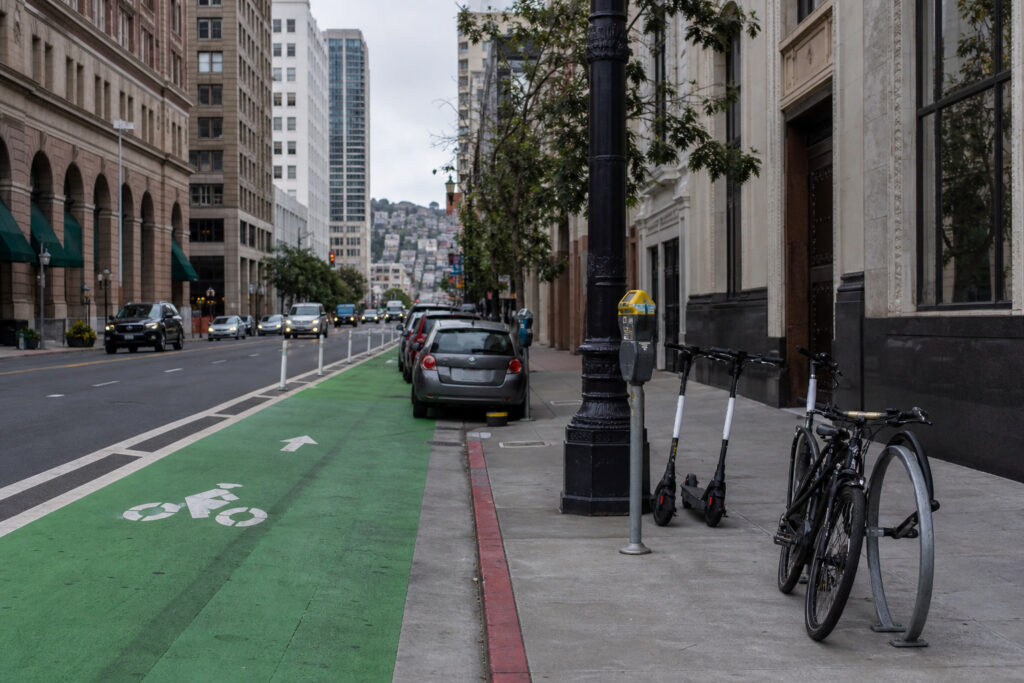
Every rider who opens the Lime or Bird app clicks through a liability waiver and an arbitration clause before the scooter unlocks. Most riders assume that click ends any chance of a claim. It does not — and the gap between what the waiver says and what it actually does is one of the most consistently misunderstood pieces of this entire practice area.
A waiver you sign with a scooter company binds you to that company. It has no legal effect on a claim against a driver who hit you, a property owner whose defective sidewalk caused you to fall, or a public entity responsible for dangerous street conditions — none of those parties were part of your agreement with Lime or Bird. If a driver ran a red light and hit you while you were on a scooter, the waiver you clicked through on the app is irrelevant to that driver’s liability.
Even against the company itself, California law does not allow a liability waiver to erase every kind of claim. A properly drafted waiver can bar an ordinary negligence claim for the everyday risks of riding — a rider losing balance on a rough patch of pavement, for example. It cannot waive claims for gross negligence, willful misconduct, or a genuinely defective product: a throttle that sticks, brakes that fail, a battery that was improperly maintained. Those claims survive the waiver, and they are the claims worth investigating early, before a scooter is returned to circulation and the physical evidence disappears.
California’s Three Classes of E-Bike — and Why the Class Matters to Your Case
California Vehicle Code § 312.5 splits e-bikes into three classes, and which class was involved changes both the rules of the road that applied and the arguments an insurer can raise:
- Class 1 — pedal-assist only, motor cuts off at 20 mph. No throttle.
- Class 2 — throttle-assisted, motor also cuts off at 20 mph. This is the class most bike-share and delivery e-bikes fall into.
- Class 3 — pedal-assist, motor cuts off at 28 mph, must have a speedometer. Riders must be at least 16, and helmets are required regardless of age.
The classification matters in a claim because it defines where the bike was legally allowed to be. Class 3 e-bikes are frequently restricted from bike paths that Class 1 and 2 bikes can use, and an insurer looking to reduce a payout will comb through exactly this kind of detail — arguing a Class 3 rider had no business being on a particular path, or that a rider under 16 shouldn’t have been on that bike at all. Getting the classification right, early, closes off an entire category of comparative-fault argument before the insurance company gets to raise it.
Motorized Scooters Play by Different Rules — Starting With a License
Motorized scooters are defined separately under Vehicle Code § 407.5, and the operating rules in Sections 21220 through 21235 catch almost every rider off guard.
A valid California driver’s license is required to legally operate a motorized scooter on public roads. Not an app account. Not a credit card on file. A license. Most Lime and Bird riders have never been told this, and most have no idea that riding without one is itself a violation an insurance adjuster can — and will — raise to argue comparative fault if a crash happens.
The rest of the rules follow the same pattern of being widely ignored and rarely enforced, right up until they matter in a claim: no sidewalk riding, a 15 mph speed cap, and operation generally restricted to streets with speed limits of 25 mph or less unless a marked bike lane is present. A rider found to have been on the sidewalk, or riding on a fast arterial street without a bike lane, hands the other side’s insurer a ready-made argument for reducing what they owe — an argument California’s comparative fault rule allows them to make, but that a lawyer who knows these specific code sections can usually blunt or defeat.
When San Francisco Itself Is the Reason You Fell
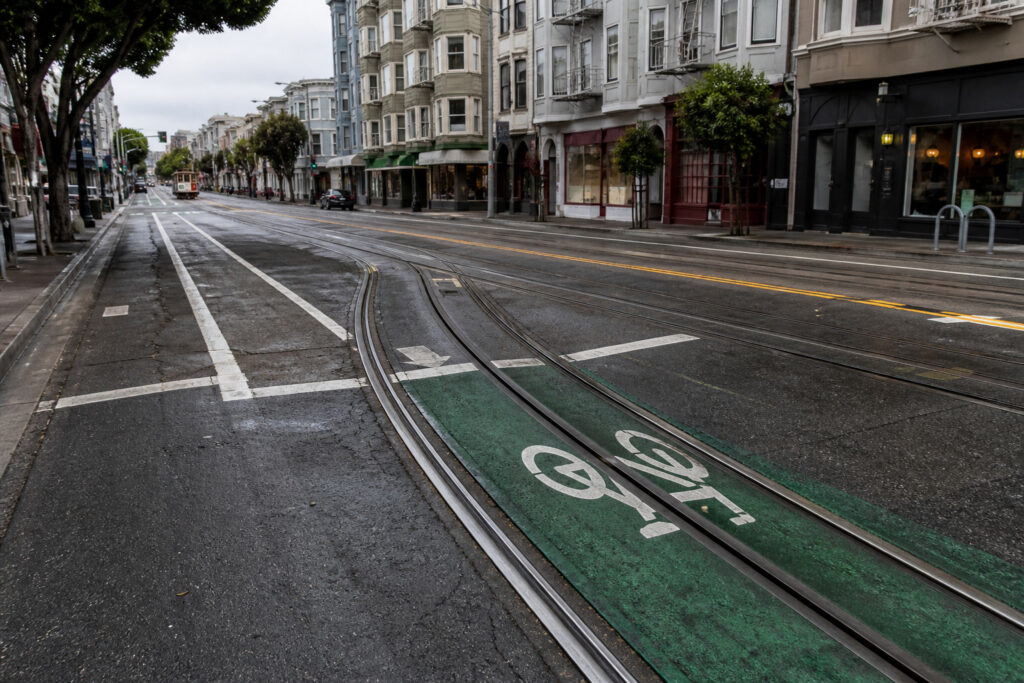
A meaningful share of e-bike and e-scooter injuries in this city have nothing to do with another driver or rider at all. They happen because of the street: a rail track groove wide enough to catch a narrow scooter wheel, a bike lane that dead-ends without warning into traffic, a pothole in a corridor the city has known about for months. When the City and County of San Francisco, SFMTA, or another public entity is responsible for the condition that caused the crash, the claim is against a government body — and government claims run on an entirely different, much shorter clock than an ordinary injury case.
Six months. That’s it. Under California Government Code § 911.2, a claim against a public entity must be formally presented within six months of the incident — not the two years California generally allows for injury claims. Miss that window and the claim is very likely gone permanently, no matter how strong the underlying case would otherwise have been. If a road, rail track, or bike lane defect played any role in your crash, that deadline needs to be on your calendar immediately, not discovered later. (Full breakdown: Claims Against California Government Entities: The Six-Month Deadline.)
Who Actually Pays: Sorting Through the Insurance Layers
A single e-bike or scooter crash can put two, three, or four different insurance policies in play, and figuring out which one applies — and in what order — is most of the early work in one of these cases:
- A driver hit you while you were riding: the driver’s auto liability policy is primary, with your own underinsured/uninsured motorist coverage as backup if the driver is uninsured or flees the scene.
- A rider on their own e-bike hit you: that rider’s homeowner’s or renter’s insurance often provides liability coverage for their negligence off their property — a coverage most people never think to check.
- A rider on a rental scooter hit you: the scooter company’s commercial general liability policy may apply, particularly if a mechanical defect contributed, alongside any personal coverage the rider carries.
- You were riding and a defect in the bike or scooter itself caused the crash: the company’s product liability coverage comes into play, separate from and unaffected by the waiver.
Sorting this out quickly, before evidence disappears and before an insurer locks in a low first offer, is exactly where a case either gets built correctly or gets undervalued from day one.
What To Do in the First 48 Hours
E-bike and scooter cases have their own version of “preserve the evidence,” and it moves fast:
- Get medical care and get the police report. SFPD categorizes these separately from standard car-on-car collisions; the report needs to accurately reflect that an e-bike or scooter was involved.
- Photograph everything, including the pavement. A rail groove, a pothole, or a lane that vanishes without warning is only provable if it’s documented before the city repaves or the scooter company relocates the unit.
- Do not let the scooter or bike disappear. If a rental unit is involved, note the unit ID displayed on the vehicle — the company’s own ride and maintenance data is frequently the strongest evidence in a defect claim, and it needs to be preserved before the unit is serviced or wiped.
- Get witness contact information on the spot. Sidewalk and street witnesses in these cases tend to scatter faster than in a typical car accident.
- Do not accept a quick settlement offer from a scooter company’s insurer before a lawyer has reviewed the case — early offers in this space are frequently calculated on the incorrect assumption that the app waiver bars most of what you’re actually entitled to claim.
Yes. California law requires a valid driver’s license to legally operate a motorized scooter on public roads, including Lime and Bird rentals. Riding without one does not automatically bar a claim if you’re hurt, but insurers will raise it to argue shared fault, which is exactly the kind of argument a lawyer familiar with these statutes can push back on effectively.
No. That waiver only applies to your claim against the scooter company itself, and even then it does not cover gross negligence or a defective product. It has no effect at all on a claim against a driver, property owner, or public entity whose negligence contributed to your crash.
The at-fault rider is personally liable, and coverage often comes from their homeowner’s or renter’s insurance policy, or a rental company’s commercial liability coverage if they were on a rented unit. If the rider fled or has no insurance, your own uninsured motorist coverage may apply.
Potentially, yes — but claims against San Francisco or SFMTA must be formally presented within six months under Government Code § 911.2, far shorter than the two-year deadline for most injury claims. This deadline should be addressed immediately after a road-defect-related crash.
Class 3 e-bike riders must wear a helmet regardless of age. Scooter helmet requirements vary by age under current California law, but riding without one, where required, can be raised by an insurer as comparative fault even in a case that’s otherwise strong.
It depends on the driver’s app status at the moment of the crash — whether they were waiting for a ride request, en route to a pickup, or actively transporting a passenger changes which of several possible insurance tiers applies, similar to how Uber and Lyft crashes are analyzed generally.
Possibly. California follows a comparative fault rule, meaning your recovery can be reduced by your own percentage of fault rather than eliminated entirely. Sidewalk riding is a common insurer argument, but it is rarely the whole story, and it does not erase the other side’s liability for the underlying crash.
Get medical care, get a police report that correctly identifies the vehicle type involved, photograph the scene including any road or track defect, note the rental unit’s ID number if applicable, and get witness contact information before people disperse. Contact a lawyer before accepting any settlement offer from a scooter company’s insurer.