

John Roach, Esq. | August 28, 2026 | California Law \ Car Accidents
San Francisco Muni Accident Lawyer: Why Another Muni Operator Fell Asleep at the Controls

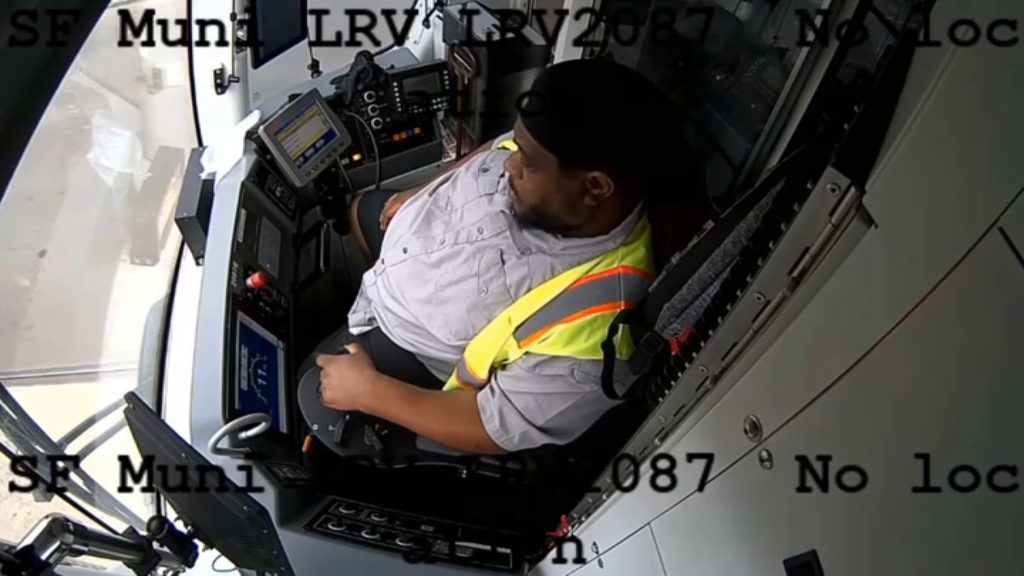
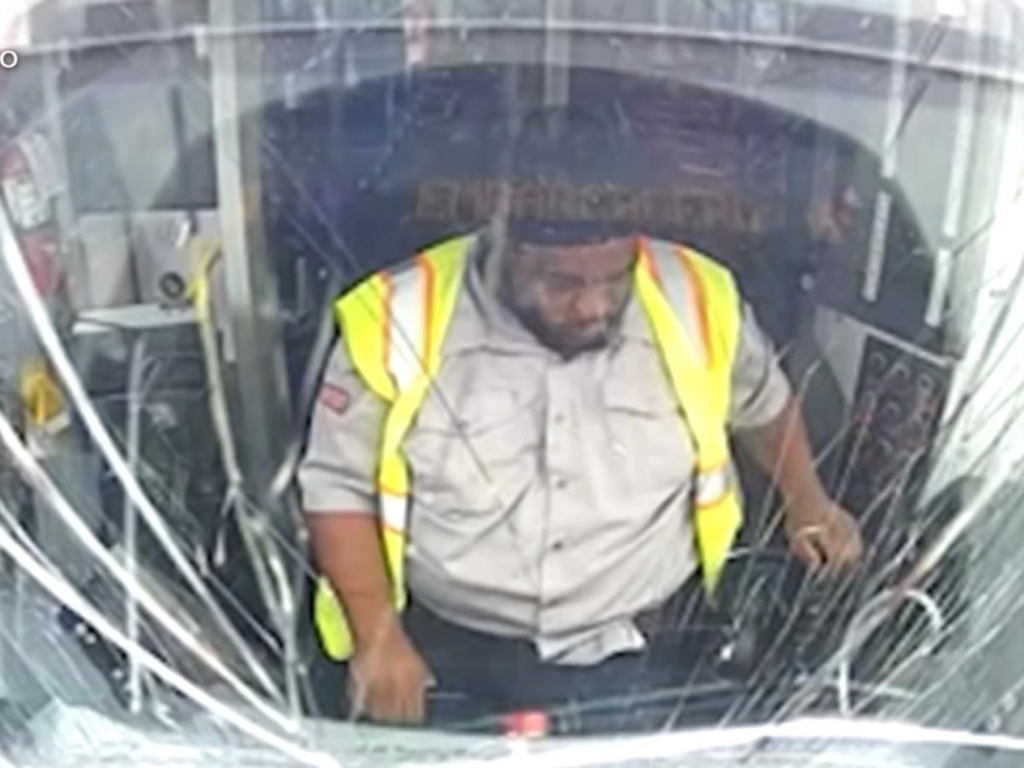
For the second time in less than a year, video has surfaced showing a San Francisco Muni operator asleep at the controls of a moving train. On July 31, 2026, at roughly 8:30 a.m., an L Taraval train ran into a stopped, empty train near 47th Avenue and Wawona Street — footage the SFMTA later confirmed shows the operator apparently dozing off in the moments before impact. Two passengers were aboard the moving train. No one was hurt, but window glass shattered on impact, and the video is now circulating widely online.
If you or someone you love is dealing with a fresh accident right now, my free guide, The First 10 Days After a Car Accident in San Francisco, covers the immediate steps and the same six-month government claim deadline that applies to Muni cases.
I wrote about MUNI bus and rail accident claims back in June, focused on the six-month deadline that catches so many injured riders off guard. I’m returning to the topic now because this isn’t a one-off. In September 2025, footage showed a different Muni operator asleep on a crowded N-Judah train that hit roughly 50 mph exiting the Sunset Tunnel near Duboce Park — five to six times the normal speed for that curve — throwing standing and seated passengers around the car. SFMTA called that incident “operator fatigue” too, launched a fatigue-awareness campaign, and the California Public Utilities Commission opened a formal safety review. Ten months later, it happened again.
As a San Francisco car accident lawyer who has represented injured people since 2009, I get asked the same three questions every time one of these videos goes viral: why does this keep happening, why isn’t the operator simply fired, and what are my rights if I’m the person on that train next time. Here’s what the record actually shows.
Two Incidents, One Pattern
- September 24, 2025 — N-Judah, Sunset Tunnel/Duboce Park. Video showed the operator with eyes closed and head tilted
- as a two-car train exited the tunnel at roughly 50 mph — five to six times Muni’s normal 8–10 mph curve speed. Standing and seated riders were thrown from their seats. SFMTA confirmed “operator fatigue,” placed the operator on non-driving status, launched a fatigue-awareness campaign, and the CPUC opened a formal review of SFMTA’s fatigue-management practices.
- July 31, 2026 — L Taraval, 47th Avenue and Wawona Street. An inbound train struck a stopped, empty train directly ahead of it at about 8:30 a.m., shattering window glass. Two passengers were aboard the moving train; no injuries were reported. SFMTA again pointed to “operator fatigue” after ruling out mechanical and infrastructure causes, placed the operator on non-driving status, and said it has since increased random video review of operators and added rest time to shift schedules — an acknowledgment, whether the agency frames it that way or not, that the problem sits in the scheduling, not just the individual.
Two confirmed incidents in under a year, on two different lines, is not a coincidence. It’s a pattern, and the pattern points somewhere specific: how Muni schedules its operators.
Why Muni Operators Are Falling Asleep on the Job
I explained the science of drowsy driving in detail in my guide to drowsy driving accident cases — the short version is that sleep deprivation degrades reaction time and judgment the same way alcohol does, and a driver running on four to five hours of sleep carries a crash risk comparable to someone at or near the legal blood-alcohol limit. That science doesn’t change based on whether the person is behind the wheel of a sedan or the controls of a two-car light-rail train. What’s different about Muni is why its operators are running on so little rest in the first place, and the numbers are not subtle.
A 2024 analysis of SFMTA’s own payroll records found that 91% of the agency’s transit operators worked overtime that year, for a combined $41 million — an average of roughly $22,500 in overtime pay per operator on top of a roughly $93,000 base salary. That overtime is frequently built by tacking up to four additional hours onto a scheduled shift, turning an 8-hour workday into a 12-hour one. It exists because Muni has struggled to keep operator seats filled: recent reporting has put first-year attrition among new operators at roughly 40%, with absenteeism running above 25%. When operators call in sick or leave the agency faster than it can replace them, the shifts still have to be covered — and the agency covers them with the operators willing to work the extra hours. Those are the same operators driving trains and buses full of the public the next morning.
Transit scheduling has a second structural problem that has nothing to do with staffing shortages: early report times and split shifts. Both confirmed fatigue incidents happened during the morning — one during the height of the morning commute, the other at 8:30 a.m. Researchers who study transit operator schedules have long flagged early-morning and “split” shifts — a block of driving, an off-duty gap too brief for real sleep, then another block — as a chronic driver of on-the-job fatigue in bus and rail transit generally. Layer four hours of overtime onto a schedule already built around circadian-unfriendly report times, and the operator who falls asleep at 8:30 a.m. isn’t an aberration. He or she is the predictable output of the system.
And unlike interstate trucking, there is no federal law capping how long a transit bus or rail operator can be kept on duty. The Federal Motor Carrier Safety Administration has enforced hard hours-of-service limits on truck drivers for decades — generally 11 hours of driving after 10 consecutive hours off duty, with a 60-to-70-hour weekly cap — precisely because fatigue-impaired truckers cause catastrophic crashes. The Federal Transit Administration proposed something comparable for transit workers in an October 2023 advance notice of rulemaking, but formally withdrew that rulemaking in July 2025. What’s left is voluntary “fatigue risk management” guidance — recommendations, not requirements. SFMTA can schedule its operators however its budget, staffing, and union contract allow, and no federal hours-of-service statute says otherwise.
How Is an Operator “Shielded” From Consequences?
This is the question I get the most after these videos circulate, and the honest answer is more about due process than about any special deal for transit workers. Muni operators are City and County of San Francisco employees represented by Transport Workers Union Local 250-A, and like nearly every public employee in California — police officers, teachers, city clerks — they’re entitled to due process before serious discipline: an investigation, a chance to respond, and, if the agency moves to terminate, the right to grieve and ultimately arbitrate that decision under the union contract. None of that is unique to Muni. It’s how public-sector employment works everywhere, and it exists to prevent an agency from firing someone on a supervisor’s say-so without proof.
What it means in practice is that “non-driving status” — the term SFMTA used for both operators here — is not the same as being fired. It generally means continued pay while the agency investigates and decides what discipline, if any, is warranted. That process can run for weeks or months, and even a termination decision isn’t final until any grievance and arbitration process plays out, which can take considerably longer. SFMTA has, at least once before, shown how that gap can go wrong in practice: in 2011, after a rider recorded a Muni operator texting while driving and the agency recommended her termination, that same operator was found driving the same route weeks later — an administrative failure the agency’s own transit operations director publicly acknowledged and said had been corrected. I’m not aware of anything suggesting that happened with either of the current fatigue cases, but the 2011 episode is a useful reminder that “termination recommended” and “off the road” are not automatically the same day.
Should an operator be fired outright for falling asleep and causing a collision? That’s ultimately a personnel question for SFMTA, the union, and — if it comes to that — the City’s Civil Service Commission, not something a lawyer can resolve from a blog post. But here is what actually matters if you’re the injured person: your civil claim does not depend on what happens to the operator’s job. Under the doctrine of respondeat superior, SFMTA is liable for the negligence of its employee acting within the scope of employment regardless of whether that employee is ultimately disciplined, retrained, or terminated. And if the agency’s own scheduling and overtime practices contributed to the fatigue — which the “additional rest time” fix SFMTA announced after July 31 strongly suggests — that opens a second, potentially more significant theory: negligent scheduling by the agency itself, the same theory that applies when a trucking company pushes its drivers past safe hours. The operator falling asleep is the visible failure. The agency’s staffing and shift design is very often the real one.
MUNI’s Duty to You Is Higher Than an Ordinary Driver’s
California law doesn’t treat Muni like an ordinary motorist, and this cuts in favor of injured riders. Under California Civil Code section 2100, a carrier of persons for reward — which includes MUNI buses, light-rail trains, historic streetcars, and cable cars — “must use the utmost care and diligence” for passengers’ safe carriage, a standard well above the ordinary reasonable-care standard that applies to a driver in traffic. An operator who falls asleep and causes a train-on-train collision, or who executes a sudden, violent stop or swerve, is about as far from “utmost care” as a common carrier can get. I described this heightened duty — and the injuries these crashes actually cause, from traumatic brain injury to spinal cord injury — in my earlier guide to MUNI bus and rail accident claims, which also covers who besides passengers gets hurt in these incidents: pedestrians, cyclists, and other drivers hit in rear-end collisions caused by a transit vehicle.
The Six-Month Government Claim Deadline Still Applies
None of the above changes the fact that MUNI is the SFMTA — a public entity — and that changes your deadline dramatically. As I explained in that earlier post, a personal injury claim against a government agency follows the California Government Claims Act, not the ordinary two-year statute of limitations:
- File a written government claim within six months of the incident. Under Government Code section 911.2, this is the deadline that catches the most people off guard — many are still in physical therapy when it expires.
- The agency has 45 days to respond. SFMTA typically either rejects the claim or lets the response period lapse.
- A rejection starts a new, short clock. If SFMTA formally rejects the claim and mails proper notice, you generally have only six months from that notice to file a lawsuit — far shorter than the standard two-year window.
- Missed the six months? California allows a late-claim application in limited circumstances, but it must be filed within a reasonable time and no later than one year from the incident — a narrow backstop, not a plan.
If you were hurt by a Muni operator — asleep or otherwise — treat the calendar as seriously as the injury itself. Schedule a free case review and I will calendar every deadline that applies to your situation.
If You’re Ever the Person on That Train
- Get medical care immediately, even if you feel only shaken. Sudden-stop and collision forces routinely cause injuries that surface days later.
- Report the incident to a Muni employee or SFMTA and get the run number, line, and vehicle number if you safely can.
- Photograph the scene, your injuries, and any incident paperwork you’re given.
- Ask that SFMTA preserve the onboard and platform video, in writing, immediately. Transit surveillance systems typically overwrite footage on a set retention cycle — once it’s gone, the clearest evidence in your case goes with it.
- Identify other passengers as witnesses. They scatter quickly once a train reaches the next stop.
- Do not give a recorded statement to any claims adjuster before speaking with your own attorney.
- Call a lawyer promptly. Between the video-preservation window and the six-month government claim deadline, a Muni case rewards speed more than almost any other kind of injury claim I handle.
Why These Cases Are Unusually Provable
In an ordinary drowsy driving case, as I’ve written before, there’s no breathalyzer for exhaustion, and proving someone fell asleep comes down to circumstantial evidence — the absence of skid marks, black-box data, the time of day. A Muni fatigue case is different, and better for the injured person: the agency’s own surveillance cameras frequently capture the operator asleep directly, on video, before the impact — which is exactly why the public has now seen it happen twice. Add CPUC-mandated incident reporting for rail transit, and a Muni fatigue claim often arrives with a paper trail few ordinary car-accident cases ever have.
Hurt on Muni? Get the Clock Started Correctly
If you or someone in your family was hurt by a Muni bus, train, or streetcar — whether the cause looks like operator fatigue or anything else — call me at (415) 851-4557 for a free consultation. I’ve represented injured people in San Francisco since 2009, including a $6 million pedestrian TBI settlement and a $750,000 UIM arbitration award, and I provide bilingual representation in English and Spanish directly, with no interpreter and no handoff. Se habla español — hable conmigo directamente sobre su caso en la página de lesiones personales en español.
Frequently Asked Questions
Is this the first time a Muni operator has fallen asleep on the job?
No. This is the second confirmed incident within about ten months — a September 2025 N-Judah incident where a crowded train hit roughly 50 mph exiting the Sunset Tunnel, and the July 31, 2026 L Taraval collision. SFMTA attributed both to operator fatigue.
Was anyone hurt in the July 31, 2026 crash?
No injuries were reported. Two passengers were aboard the moving train when it struck a stopped, empty train; the impact shattered window glass but caused no reported injuries.
Can I sue Muni if I’m hurt because an operator fell asleep?
Yes, subject to the California Government Claims Act. You’ll generally need to file a written government claim within six months of the incident before you can sue, and MUNI’s heightened “utmost care” duty to passengers under Civil Code section 2100 works in your favor.
Does it matter whether the operator gets fired?
Not to your civil claim. SFMTA is liable for its employee’s on-the-job negligence under respondeat superior regardless of the outcome of any internal discipline, grievance, or arbitration. If agency scheduling or overtime practices contributed to the fatigue, that can support a separate negligence theory against the agency itself.
Why isn’t there a law limiting how many hours a Muni operator can work, the way there is for truck drivers?
There isn’t a binding federal hours-of-service rule for transit operators. The Federal Transit Administration proposed one in 2023 but formally withdrew the rulemaking in July 2025, leaving only voluntary fatigue-management guidance in place of the hard hourly limits that apply to commercial trucking.
What if I was a pedestrian or another driver, not a Muni passenger, when this happened?
The same Government Claims Act deadlines and government-entity rules apply. Whether you were a rider, a pedestrian, a cyclist, or another driver, a claim against SFMTA follows the same six-month filing clock.
How long do I actually have to file a claim against SFMTA?
Generally six months from the incident to file the government claim itself, and if it’s rejected, typically six months from that rejection notice to file a lawsuit — both far shorter than the standard two-year deadline for an ordinary car accident claim.
Is the news footage of the July 31 or September 2025 incidents usable evidence for my case?
Only SFMTA’s own onboard and platform video — not the news footage — is likely to be usable evidence, and it is typically overwritten on a retention schedule. If you were hurt in any Muni incident, ask your attorney to send a written preservation request immediately.