

John Roach, Esq. | September 29, 2026 | Attorney Tips \ California Law
Pain and Suffering Damages Under CACI 3905A: A San Francisco Personal Injury Lawyer Explains

Your medical bills add up to a number. Your pain doesn’t come with an invoice. That gap — between what an injury costs on paper and what it actually took from you — is the entire subject of California Civil Jury Instruction 3905A, and it is routinely the hardest number in a personal injury case to pin down: for you, for the insurance adjuster reading your file, and eventually for a jury. Most explanations of CACI 3905A online summarize it in a sentence and move on. Here is what the instruction actually says, what California law lets a lawyer argue from it, how experienced trial lawyers actually ask a jury for this number — backed by real research and real verdicts, not just trial-lawyer folklore — and what it actually takes to prove pain and suffering in a way that holds up.
If your injury isn’t catastrophic, this instruction still applies to you. Most of what gets discussed about pain and suffering online involves severe, visible harm: paralysis, amputation, traumatic brain injury. But most personal injury cases in California involve something less dramatic and no less real: a herniated disk that still lets you go to work, a concussion that cleared on imaging but changed how your evenings go, chronic pain that doesn’t show up in a photograph. CACI 3905A doesn’t distinguish. Physical pain, inconvenience, and loss of enjoyment of life are compensable whether or not the injury is visible, permanent, or dramatic — the instruction asks what the evidence shows about your actual experience, not how severe your diagnosis sounds on paper.
What CACI 3905A Actually Tells the Jury

CACI No. 3905A — “Physical Pain, Mental Suffering, and Emotional Distress (Noneconomic Damage)” — is short, and its brevity is the point. Two instructions work together here: CACI No. 3905 lists which categories of noneconomic harm apply to a given case, while 3905A is the “no fixed standard” instruction that tells the jury how to value them. In relevant part, 3905A instructs jurors: “No fixed standard exists for deciding the amount of these noneconomic damages. You must use your judgment to decide a reasonable amount based on the evidence and your common sense.”
That is the entire legal standard — no chart, no per-injury schedule, no minimum or maximum written into the instruction itself. California courts have called this one of the most difficult tasks given to a jury. The Court of Appeal has described the inquiry as “inherently subjective and not easily amenable to concrete measurement” (Pearl v. City of Los Angeles (2019) 36 Cal.App.5th 475), and the California Supreme Court has recognized that pain and suffering can be translated into a dollar figure “only with great difficulty,” left to “the impartial conscience and judgment of jurors” (Capelouto v. Kaiser Foundation Hospitals (1972) 7 Cal.3d 889).
CACI 3905’s category list — physical pain, mental suffering, emotional distress — is the headline, but noneconomic damage in California can also include loss of enjoyment of life, disfigurement, physical impairment, inconvenience, grief, anxiety, and humiliation, whichever actually fit the injury and are supported by the evidence.
One detail worth knowing if a loved one died from their injuries: CACI 3905A’s Directions for Use carve out survival actions under Code of Civil Procedure section 377.34(b), and note that whether a jury may consider a shortened life expectancy as its own item of noneconomic damage is still unsettled in California law — a genuinely open question worth raising directly with a wrongful death or survival action attorney.
How Do You Put a Number on Something With No Formula?

Two different approaches come up here, and they are not the same thing, legally.
The multiplier method is an informal valuation tool, mostly used in pre-litigation negotiation — take the medical specials and multiply by some factor to arrive at a suggested figure. It is not a rule of California law, it is not in CACI 3905A, and no court requires or endorses it. It shows up because it gives adjusters and lawyers a starting number to negotiate from. Treat any “our formula says your case is worth X” pitch — from either side — as a negotiating anchor, not a legal standard.
The per diem argument is different — a courtroom advocacy tool with real legal history. In Beagle v. Vasold (1966) 65 Cal.2d 166, the California Supreme Court held it was error to bar a plaintiff’s attorney from suggesting a specific dollar figure — including a per-day rate multiplied out over life expectancy — during closing. California allows it, but the trial court retains real power to keep the argument within bounds, can instruct the jury that counsel’s figure is argument, not evidence, and can bar a per diem figure the evidence doesn’t support. Chief Justice Traynor concurred only in the judgment, calling the formula itself “so misleading that it should never be allowed.” Sixty years later, that’s still the tension underneath every per diem argument in a California courtroom: permitted, but bounded, and not universally trusted even by the court that allowed it.
How Trial Lawyers Actually Ask a Jury for This Number
Because CACI 3905A hands the jury no formula, experienced trial lawyers have developed real, recurring techniques for closing that gap — and unlike most online summaries of this topic, the effectiveness of several has actually been studied. Patterns that show up repeatedly:
Reframing what the number is for, and choosing how to deliver it. Many closings spend real time reframing the question itself — away from what the plaintiff is “getting” and toward what was taken and can’t be given back. From there, delivery style splits: some lawyers present the figure as a conclusion the evidence already supports, stated with the same confidence as any other fact; others do the opposite, openly acknowledging that arriving at the number took real work, betting that visible effort reads as more considered than flat certainty. Neither approach has been tested against the other in controlled research. What both share is that the number has to be fully built from the record before either style can carry it.
Deciding what to do with the number the jury already has — the medical bills. Because the multiplier method invites anchoring on medical specials, some trial lawyers keep the focus off the bills entirely, to avoid a “bills times some number” shortcut and to keep the two damages categories cleanly separated; others use the bills openly as a floor or cross-check. Neither approach is required by CACI 3905A, which doesn’t reference economic damages in the noneconomic calculation at all.
A client-centered “fair trade” question, kept distinct from an improper appeal. Not what a juror would want if this happened to them — that’s a “Golden Rule” appeal, which California courts don’t allow — but what this specific plaintiff, given their actual life, would consider fair compensation. One version asks jurors to substitute their own hypothetical reaction, which courts reject; the other keeps the focus on the plaintiff’s own documented loss, which is what CACI 3905A asks a jury to evaluate. Some trial lawyers extend this into language choices generally — avoiding second-person “you” and “your family” framing, so the story stays the plaintiff’s own.
Directly rebutting a “money can’t replace what was lost” defense theme. A common defense argument suggests no verdict can undo the harm — sometimes phrased as “life goes on” or “you can’t put a price on it.” Some trial lawyers meet that directly in rebuttal: the jury isn’t being asked to replace anything, only to award what the law requires for harm the evidence has already proven. Left unanswered, that theme can make any number feel inadequate by comparison; addressed head-on, it reframes what the jury is actually being asked to do.
Itemizing each category of harm separately instead of one lump figure. CACI 3905’s list — physical pain, mental suffering, loss of enjoyment of life, disfigurement, physical impairment, inconvenience, grief, anxiety, humiliation — invites walking through each one individually rather than asking for a single combined number. That has real research behind it, not just intuition: a peer-reviewed study of itemized damages verdicts found awards rose as the number of separately-valued categories increased, holding the underlying facts constant (more on the study below).
Turning that itemized list into a chart, crossed against past and future. Some trial lawyers build this out visually — each harm category down one axis, “past” and “future” across the top — handing the jury a working draft of the verdict form. It’s a logical extension of the itemization research, applied to time as well as category.
Not every trial lawyer itemizes — some ask for two whole numbers instead. A different school skips the category chart and simplifies to two figures — harm already suffered, harm still to come — delivered directly and with conviction, on the theory that a long, granular breakdown can dilute the ask rather than reinforce it. The itemization research measured category breakdowns specifically; it doesn’t settle whether a two-number approach performs better or worse, which makes this a genuine, unresolved disagreement among trial lawyers.
Breaking future harm into time blocks instead of one flat future number. A single lump future figure treats every remaining year the same, which isn’t how injuries or lives work — losses in the next ten years can look different thirty years out, as circumstances and milestones change. Some trial lawyers walk a jury through future harm in blocks rather than one undifferentiated number covering an entire life expectancy. No controlled study isolates this technique, but it follows the same logic as the itemization research: smaller, evidence-connected pieces tend to produce a more considered total.
Using per diem-style math to test a number, not build one from scratch. Rather than deriving the ask from a daily or hourly rate, some trial lawyers total the itemized categories first, then check whether that figure still sounds reasonable converted to a per-day rate. The same math works in reverse on a defense figure that’s clearly too low — converting it into a few dollars a day exposes how little it reflects the harm shown. Either way, the comparison has to stay tied to this plaintiff’s own documented harm, never borrowed from somewhere unrelated (see the real example below).
Confirming during jury selection that panelists can award each category of harm, and a large total when the evidence supports it. Some trial lawyers use voir dire to walk panelists through the categories of harm in human terms — not dollar figures yet — and ask directly whether each juror could award a meaningful amount for each one. One useful technique: asking whether a juror would need more certainty than the law actually requires before awarding a substantial figure — a juror holding the plaintiff to a higher burden than the law sets is a legitimate cause-challenge candidate, identified before trial rather than discovered during deliberation.
Reframing evidence that looks damaging at first glance. Surveillance footage or a social media photo showing a plaintiff engaged in some activity — walking a dog, attending a family event — is a standard defense tool (more below). Some trial lawyers meet it head-on: putting that footage in front of the jury and explaining, through testimony, what it actually shows — someone pushing through pain to be present for a moment that mattered, not evidence the pain isn’t real.
Asking for what the evidence supports, and staying honest about it. Jurors tend to negotiate down from whatever figure is presented, not up from a number softened to seem reasonable — so an artificially conservative ask can concede ground before deliberation starts, though the research below shows real limits on how high an ask can go before that backfires. What holds every technique above together is honesty: jurors punish exaggeration faster than a large but credible number, and every itemized category needs to be tied to a specific piece of trial evidence, not argued in the abstract. Genuine investment from counsel can reinforce that credibility; a performative version tends to undercut it.
“Reptile” or safety-rule framing — tying the defendant’s conduct to a broader community-safety standard — is common in trial-lawyer seminars, but there’s no rigorous empirical study confirming it outperforms straightforward, well-documented advocacy. Courts have pushed back on it when it crosses into arguing broader policy: the Kansas Supreme Court found a “safe medicine or unsafe medicine” framing improper in Castleberry v. DeBrot (2018) 424 P.3d 495, and a Massachusetts appellate court flagged similar appeals in Fitzpatrick v. Wendy’s Old Fashioned Hamburgers of N.Y., Inc. (2019) 96 Mass. App. Ct. 410.
What Actual Research Says About Which Techniques Work
This is the part almost no online explainer of CACI 3905A touches, and it’s more specific — and more useful — than the seminar-circuit version.
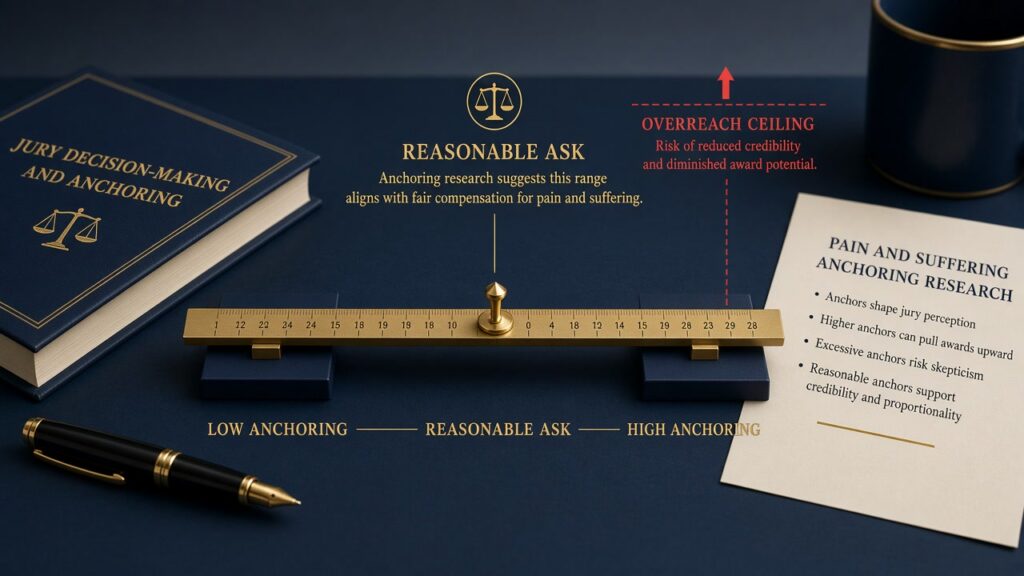
A higher ask really does produce a higher award, and it’s hard for the other side to counter. A 2016 study in the Iowa Law Review (Campbell, Chao, Robertson & Yokum, “Countering the Plaintiff’s Anchor,” 101 Iowa L. Rev. 543) ran mock trials with identical evidence and varied only plaintiff’s counsel’s requested figure — $250,000 in one version, $5 million in another. The higher anchor produced meaningfully higher awards, and none of three tested defense counter-strategies — a competing low number, ignoring the ask, or attacking it as unreasonable — reliably neutralized it. One real-world defense worry the study didn’t confirm: offering a competing number of their own did not hurt the defense on the separate question of liability.
But there’s a real ceiling, and crossing it costs credibility. A separate study (Marti & Wissler, “Be Careful What You Ask For: The Effect of Anchors on Personal Injury Damages Awards,” Journal of Experimental Psychology: Applied, 6(2), 91–103 (2000)) tested anchors of $1.5 million, $15 million, and $25 million for the same injury. Awards rose from the $1.5M anchor to the $15M anchor, as ordinary anchoring would predict — but the $25M anchor didn’t keep pushing awards higher; jurors discounted it as overreach, and awards under it came in lower than under the $15M anchor. Asking for more has diminishing returns, and past a point can actively hurt the number.
An anchor untethered from the evidence risks more than a lower award — it risks the verdict itself. In Gregory v. Chohan, 670 S.W.3d 546 (Tex. 2023), the Texas Supreme Court reversed a verdict where closing argument compared the noneconomic damages request to the price of a fighter jet and a painting, and separately converted the defendant trucking company’s annual mileage into a per-mile damages rate — none of it connected to the plaintiff’s own evidence. The court called this “unsubstantiated anchoring” and held those comparisons “have nothing to do with the emotional injuries suffered by the plaintiff.” It’s Texas authority, not California, but the caution travels: a comparison figure has to be tied to this plaintiff’s own record, not borrowed from somewhere unrelated.
How a number is framed can matter as much as the number itself. A study by McAuliff and Bornstein (“All Anchors Are Not Created Equal,” Law and Human Behavior, 34(2), 164–174 (2010)) tested the same $175,000 total framed four ways: no anchor, a lump sum, or that total broken into $10/hour, $240/day, or $7,300/month. The largest awards came from the lump-sum and hourly framings; the monthly framing produced the lowest — even though respondents judged the $7,300/month figure to look like the biggest number. Jurors react to how a number feels on its face, not the underlying arithmetic — a real caution against assuming per diem automatically beats a lump sum.
Itemization has its own separate research base. A 2011 study (Hyman Gregory & Winter, “More than the Sum of Its Parts? Itemizing Impairment in Civil Cases,” Legal and Criminological Psychology, 16(1), 173–187) found awards rose as the number of separately-valued harm categories rose, independent of the anchoring effect. The two techniques — a high-but-credible anchor, and itemizing it into categories — aren’t competing; the research suggests they compound.
The same logic likely extends to time as well as category, though this hasn’t been tested directly. Breaking future damages into time blocks follows the same mechanism the itemization research demonstrates: smaller, evidence-connected figures tend to produce a more considered total. That’s a reasonable inference from established research, not a separately confirmed finding.
“Ask for a specific number” versus “trust the jury’s judgment with no figure at all” is the least settled question here — no controlled study tests those two approaches head-to-head. The strongest thing the research shows: once any number enters the room, it moves the outcome, which is a real part of why CACI 3905A leaves this to the jury’s “judgment and common sense” instead of a formula.
Real Verdicts Show Both Sides of This

A few recent, publicly reported trials illustrate the anchoring research above — reported by Courtroom View Network, which covers verdicts nationally:
- Fenton v. Nevada Property 1 LLC (Nevada casino slip-and-fall): counsel asked roughly $37 million; the jury returned $15 million.
- Al Rabadi v. Three Amigos Restaurant Group LLC (Nevada, security injury at a Caesars property): counsel asked $50–70 million; the jury returned $56.5 million, inside the requested range.
- Dudley v. Central Iowa Hospital Corp. (Iowa medical malpractice): counsel asked $25 million; the jury returned $27 million — exceeding the ask, and well above a rejected $250,000 settlement offer.
- Deragon v. Amazon Logistics, Inc. (Middlesex County, Mass. 2026, delivery-crash case): counsel’s closing ask was $300 million; the jury returned $56 million — well below the ask, but nearly triple a rejected $20 million settlement offer.
None of these is a formula or a guarantee — results vary by facts, venue, and evidence. What they show, consistently with the research above, is that the ask genuinely moves the outcome, and that “ask for more” stops being free advice well short of an unlimited number.
Is There a Cap on Pain and Suffering Damages in California?
For an ordinary personal injury case — a car accident, a dog bite, a slip and fall — no. CACI 3905A puts no ceiling on noneconomic damages; the jury’s reasoned judgment controls, subject only to a post-verdict reasonableness check.
The cap people are often thinking of — MICRA, Civil Code section 3333.2 — applies only to medical malpractice claims, not to a car accident, a fall, a dog bite, or almost any other ordinary personal injury claim. Confusing the two is one of the most common and costly misconceptions injured people bring into a first consultation, because it can make someone undervalue their own claim before a lawyer ever looks at it. If your case isn’t medical malpractice, CACI 3905A — uncapped, judgment-based — is the rule that governs your damages. And in the narrower set of cases where a cap genuinely does apply: it limits what can ultimately be recovered, not how the human harm gets presented — the full record still gets proven the same way it would in any uncapped case.
Why the Insurance Adjuster Doesn’t Want a Full Pain and Suffering Conversation
An adjuster’s early offer is almost always built around your medical bills, because bills are the one category with a number already attached — which is exactly why pain and suffering is most likely to get shortchanged. A recorded statement requested early and framed as routine is often an attempt to get you describing your pain in minimizing language while you’re still in shock. Social media gets monitored for a single photo stripped of context to argue your suffering isn’t real; the same image, in full context, can just as easily prove what the injury costs. And a fast, bills-only offer made before treatment is finished hasn’t accounted for pain and suffering at all — that figure can’t be estimated until your medical picture is complete.
What Actually Proves Pain and Suffering

Because CACI 3905A gives the jury no formula, what you bring to prove the harm matters enormously. A contemporaneous pain journal carries more weight than a memory reconstructed months later — but the most useful version isn’t a general mood log. Note the specific moments you hesitated before an ordinary task — bending down, sitting through a workday, driving somewhere you used to drive without thinking — and what it cost you to do it anyway. That’s exactly the kind of small-moment documentation that separates a credible number from an invented one, especially where the injury doesn’t show up on a scan. Consistent treatment matters too: gaps in care get used by the defense to argue the injury wasn’t serious, even when the real reason was a scheduling conflict. Photographs over time — bruising, swelling, a scar’s progression — document what words can’t. Testimony from a spouse or coworker about what changed often does more to humanize a claim than the plaintiff’s own account, because it isn’t self-interested. And where emotional distress is part of the claim, mental health treatment records kept in the ordinary course of care are part of the proof.
One honest caution: a claim built around three well-documented categories is stronger than one that lists nine and can only support a few. A well-prepared claim is built around what the record actually proves, not a maximal list for its own sake — the same honesty principle running through the research above.
What Pain and Suffering Has Actually Been Worth in Real San Francisco Cases
No lawyer can responsibly tell you what a claim is worth before reviewing the medical records. What real results can show is the range noneconomic damages have reached in cases I’ve tried and resolved: a pedestrian traumatic brain injury case settled for $6 million; a separate brain injury case for $2.185 million; a spinal injury case for $650,000; an underinsured motorist arbitration for a TBI and PTSD was awarded $750,000; a jury returned $300,000 in Converse v. Adkins (Alameda County, 2025), a dog-attack case. None of these figures is an average or a prediction for any other case — every claim turns on its own facts. With extensive trial experience and a 9-for-9 verdict record, I prepare every claim as though a jury, not an adjuster, will decide it — because the instruction that governs this number rewards a documented, credible record, not a well-worded demand letter.
If the insurance company’s number doesn’t reflect what the pain has actually cost you, a free consultation — in English or Spanish — costs nothing and doesn’t commit you to anything: (415) 851-4557.
Frequently Asked Questions
CACI 3905A is the California civil jury instruction that tells jurors how to decide pain and suffering damages. It states there is no fixed standard for the amount — the jury must use its judgment and common sense based on the evidence presented.
No. CACI 3905A specifically instructs jurors that no fixed formula exists. Multiplier methods you may hear about are informal negotiation tools used before a lawsuit is filed, not a rule of California law or part of the jury instruction itself.
It’s a courtroom tactic where an attorney suggests a dollar amount per day of pain, multiplied out over the relevant time period. California allows it under Beagle v. Vasold (1966), but the trial court can limit the argument, and jurors are told the figure is argument, not evidence.
Research on jury decision-making says yes, up to a point. A 2016 Iowa Law Review study found higher requested figures produced higher awards and were difficult for the defense to counter — but a separate study found awards actually dropped once an anchor was perceived as unreasonably high, so there’s a real ceiling.
Research suggests it can. A peer-reviewed study of itemized damages verdicts found awards rose as the number of separately-valued harm categories increased, holding the underlying facts constant — consistent with CACI 3905’s own approach of listing specific categories of noneconomic harm rather than one combined term.
Sometimes, depending on context. Surveillance or social media showing a plaintiff engaged in some activity is a common defense tool, but the same image can also show someone pushing through pain to be present for a specific moment — evidence of what the injury actually costs rather than evidence it isn’t real. Context, not the image alone, decides which way it cuts.
No. CACI 3905A places no ceiling on noneconomic damages in an ordinary personal injury case. The cap many people have heard about, under Civil Code section 3333.2 (MICRA), applies only to medical malpractice claims — not car accidents, falls, dog bites, or most other injury claims. And even in the narrower set of cases where a cap does apply, it limits what can ultimately be recovered, not how fully the human harm gets proven and presented.
Generally two years from the date of injury under Code of Civil Procedure section 335.1. If a government entity is involved, a formal claim must be presented within six months under Government Code section 911.2 — far sooner than most people expect.