

John Roach, Esq. | March 26, 2026 | California Law \ Car Accidents
Wrongful Death Claims: Bay Area Families’ Guide

Losing a family member due to someone else’s negligence is one of the most devastating experiences a family can face. On top of grief, families are suddenly confronted with financial pressures, insurance companies, and legal deadlines they were never prepared for. A wrongful death claim in California is the legal mechanism that allows surviving family members to hold the responsible party accountable and recover compensation for what was taken from them — financially and relationally.
I’m John J. Roach, a San Francisco personal injury attorney with extensive trial experience handling wrongful death cases throughout the Bay Area, including Oakland, San Francisco, and San Mateo County. I work on a contingency fee basis — you pay nothing unless I recover money for you. This guide covers what California wrongful death law requires, who can file, what the deadlines are, and what your family’s case may be worth.
What Is a Wrongful Death Claim in California?
A wrongful death claim is a civil lawsuit filed by surviving family members when a person’s death is caused by the wrongful act, negligence, or recklessness of another party. This includes deaths caused by car accidents, trucking accidents, medical malpractice, workplace incidents, defective products, and premises liability. Unlike criminal charges, which focus on punishment, a wrongful death claim seeks to compensate the surviving family for their losses — financial and relational — and to hold the responsible party accountable through the civil justice system.
California’s wrongful death statute is codified at Code of Civil Procedure Section 377.60. It is important to distinguish a wrongful death claim from a survival action, which covers the deceased person’s own losses before death — medical expenses, lost earnings during the period before death, and similar claims that the deceased would have had. As of 2026, survival actions in California no longer include damages for pain and suffering, reverting to pre-2022 rules. The two types of claims are often filed together but involve distinct damages and distinct legal standards.
Who Can File a Wrongful Death Claim in California?
California law limits who can bring a wrongful death claim to those most directly impacted by the loss. Eligible parties — referred to as “heirs” under the statute — include the surviving spouse or registered domestic partner; children, including adopted children and stepchildren who were financially dependent on the deceased; grandchildren if the deceased’s children are also deceased; parents or legal guardians; siblings or other relatives under California’s intestate succession laws; putative spouses — those who believed in good faith that they were legally married; and financial dependents, including minors who lived with and relied on the deceased for at least 180 days prior to death.
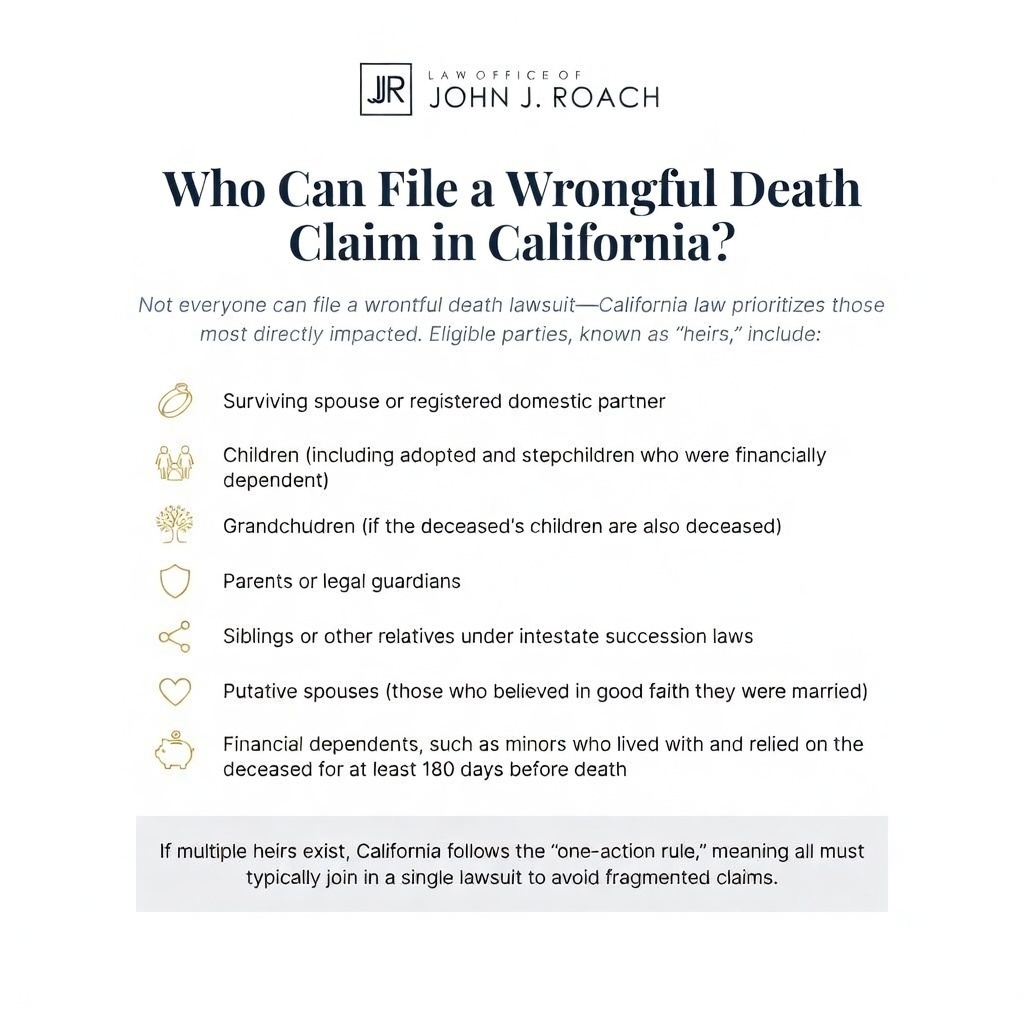
When multiple heirs exist, California’s one-action rule requires that all heirs typically join in a single lawsuit rather than file separate claims. This prevents fragmented litigation and ensures damages are apportioned among all eligible family members in a single proceeding. If there is disagreement among heirs about whether or how to proceed, that is a situation where early legal guidance is particularly important.
Deadlines: The Statute of Limitations in California Wrongful Death Cases
Missing a legal deadline in a wrongful death case typically bars the claim permanently — regardless of how strong the facts are. The deadlines vary by case type and defendant.
| Claim Type | Deadline | Notes |
|---|---|---|
| Standard wrongful death | 2 years from date of death | CCP Section 335.1 — applies to most cases |
| Medical malpractice | 3 years from death or 1 year from discovery of negligence | Strict discovery rules apply |
| Government entity defendant | Government tort claim within 6 months of death | Full lawsuit can follow if claim is rejected |
| Delayed discovery | Clock may start from discovery of cause of death | Rare — applies when cause was not immediately apparent |
The six-month government tort claim deadline is the most frequently missed — and the most unforgiving. If the death involved a government vehicle, a public entity employee, a dangerous condition on public property, or a public hospital, the six-month deadline applies and there are no exceptions for grief, confusion, or lack of knowledge about the requirement. If there is any possibility a government entity was involved, contact an attorney immediately.
What Damages Are Available in a California Wrongful Death Case?
Wrongful death damages in California fall into two categories. Economic damages include funeral and burial costs, medical bills incurred before death, the financial support the deceased would have provided to the family over their lifetime, the value of household services the deceased provided, and the value of gifts or other benefits the family would have received. Non-economic damages include the loss of the deceased’s love, companionship, comfort, care, assistance, protection, affection, society, and moral support — the relational losses that cannot be assigned a dollar figure but are fully compensable under California law.
Note that grief or sorrow itself is not compensable as a standalone category — but the loss of the relationship and everything that came with it is. In medical malpractice wrongful death cases, non-economic damages are capped — at $650,000 as of 2026 updates under MICRA, with the cap scheduled to increase incrementally in subsequent years.
Calculating the full value of a wrongful death case requires economic expert testimony on the deceased’s projected lifetime earnings, benefits, and household contributions. It also requires carefully documenting the nature of the relationship between the deceased and each heir. I work with qualified economic experts and life care planners on significant wrongful death cases to ensure the full value of the claim is presented — not just the most obvious and easily quantifiable losses.
The Wrongful Death Claims Process
The process begins with investigation — gathering the police report, medical records, autopsy reports, employment records, and witness statements needed to establish both liability and damages. I handle this process so the family can focus on what matters. Once the investigation is complete and all heirs are identified, the lawsuit is filed in Superior Court. The discovery phase follows — depositions, document requests, and expert disclosures. Most wrongful death cases resolve through settlement negotiations before trial, but I prepare every case as if it is going to a jury, because that preparation is what produces fair settlement results.
If the case proceeds to trial, the jury determines liability and the total damages award. The court then apportions the award among the heirs based on each person’s relationship to and dependence on the deceased. If the heirs have agreed in advance on apportionment, that agreement controls.
Grief Support Resources for Bay Area Families
Legal proceedings run on a separate track from grief, and families navigating both simultaneously deserve support on both fronts. The following Bay Area organizations provide bereavement support at low or no cost.
By the Bay Health offers sliding-scale individual counseling and support groups for adults and children at locations in San Francisco (415-927-2273), San Mateo, Marin, and Sonoma (415-526-5699).
The Compassionate Friends provides peer-led support groups for parents who have lost a child, with Bay Area chapters in Oakland, Burlingame, and Santa Clara (877-969-0010).
Kara Grief Support offers donation-based peer groups for adults, children, and families — including parent loss and sibling groups — based in Palo Alto (650-321-5272), with Spanish-language services available.
Mission Hospice provides free virtual and in-person bereavement groups for individuals on the Peninsula and in the South Bay.
East Bay Agency for Children (EBAC) Circle of Care offers family peer support groups specifically for children coping with the death of a loved one.
Jewish Family and Children’s Services (JFCS) runs eight-week grief groups in Marin and San Francisco, open to all faiths.
If you lost a family member due to someone else’s negligence in the Bay Area, call me at (415) 851-4557 for a free, confidential consultation. I handle wrongful death cases on a contingency fee basis — you pay nothing unless I recover money for you. I am bilingual in English and Spanish.
Injured in the Bay Area? I handle every case personally, with extensive trial experience and $25 million+ recovered for my clients since 2009. Call (415) 851-4557 or schedule a free consultation. ¿Habla español? Soy un abogado de lesiones personales en San Francisco que lo atiende directamente en su idioma — solicite una consulta gratuita aquí. Para familias hispanas: abogado de muerte injusta en San Francisco.
Frequently Asked Questions: Wrongful Death Claims in California
Generally two years from the date of death under California Code of Civil Procedure Section 335.1. However, medical malpractice wrongful death claims are subject to a three-year or one-year-from-discovery rule. Claims against government entities require filing a government tort claim within six months of the death — missing this deadline typically bars the claim permanently. If there is any possibility a government entity was involved in the death, contact an attorney immediately.
California Code of Civil Procedure Section 377.60 defines eligible heirs as the surviving spouse or registered domestic partner, children (including financially dependent stepchildren), grandchildren if the deceased’s children are also deceased, parents or legal guardians, siblings or other relatives under intestate succession, putative spouses, and financial dependents who lived with and relied on the deceased for at least 180 days before death. When multiple heirs exist, California’s one-action rule requires all heirs to join in a single lawsuit.
Economic damages include funeral and burial costs, medical bills before death, lost financial support the deceased would have provided over their lifetime, the value of household services, and the value of gifts or benefits. Non-economic damages include loss of love, companionship, comfort, care, protection, affection, society, and moral support. In medical malpractice wrongful death cases, non-economic damages are capped under MICRA — at $650,000 as of 2026, increasing incrementally in subsequent years. Grief or sorrow alone is not compensable, but the full relational loss is.
A wrongful death claim is brought by surviving family members for their own losses — the relational and financial losses they suffer as a result of the death. A survival action is brought on behalf of the deceased’s estate for losses the deceased personally suffered before death — medical expenses, lost earnings during the period before death, and similar claims. As of 2026, California survival actions do not include damages for pain and suffering, reverting to pre-2022 rules. Both types of claims are often filed simultaneously but involve distinct damages and legal standards.
Cases with clear liability and cooperative insurers can resolve in 6 to 12 months. Complex cases involving disputed liability, multiple defendants, or government entities can take 2 to 3 years or longer. The severity of the investigation required, the number of expert witnesses involved, and whether the case proceeds to trial all affect the timeline. Most wrongful death cases resolve through settlement before trial, but thorough trial preparation is what produces fair settlement results.
Disclaimer: This blog post is for informational purposes only and does not constitute legal advice. Consult a licensed attorney for advice specific to your situation.




