
John Roach, Esq. | June 15, 2026 | California Law \ Car Accidents
Pacific Heights Pedestrian Accident Lawyer: Crosswalk Laws, Common Injuries, and Insurance Coverage in San Francisco’s Most Walkable Neighborhood

Pacific Heights is one of San Francisco’s most walkable neighborhoods. Residents stroll along Fillmore Street, walk dogs to Alta Plaza and Lafayette Park, and move through a grid of leafy residential blocks that feel — and largely are — safer than the city’s denser commercial corridors. But the neighborhood produces pedestrian collisions every month. A few are catastrophic.
I represent injured pedestrians and their families across San Francisco, and Pacific Heights cases show up in my practice with regularity. They are not random. They follow patterns rooted in the neighborhood’s grid of permissive-left-turn intersections, its dense rideshare and delivery traffic, its hills, and the simple fact that drivers in residential neighborhoods routinely underestimate how often a pedestrian is in front of them.
This post explains how California crosswalk law works in cases like these, the Pacific Heights collision patterns I see most often, the injuries that recur, and the insurance landscape that — for an experienced personal injury attorney who has been investigating these cases since 2009 — often expands beyond what the at-fault driver’s basic auto policy suggests.
Why Pacific Heights Pedestrian Crashes Are Different
Three features distinguish Pacific Heights pedestrian collisions from the rest of the city.
Genuine walkability and high rideshare density. The Fillmore commercial corridor draws steady foot traffic. The residential grid generates school-walk and dog-walk pedestrian volume. Compared to drive-through commercial neighborhoods like the Financial District, Pacific Heights produces a higher ratio of resident-on-foot exposure per block. Layered on top: dense Uber, Lyft, DoorDash, and Amazon Flex traffic — drivers watching app screens, stopping at unfamiliar addresses, executing left turns at intersections they don’t know.
Steep grades change stopping dynamics. The hills above Broadway, Pacific, and Jackson change the physics of an emergency stop. Drivers maintaining a safe following distance on level ground can have dramatically less stopping distance on a downhill block. Fog and rain compound this.
Permissive-left-turn intersections. Most Pacific Heights intersections allow left turns on green without a dedicated arrow. The driver is responsible for yielding to pedestrians during a permissive turn. Drivers routinely fail to do so. This single mechanism produces a disproportionate share of the serious crashes I see in the neighborhood.
California Vehicle Code § 21950: The Driver’s Duty to Yield in a Crosswalk
California Vehicle Code § 21950 is the foundation of nearly every pedestrian injury case in the state. Subsection (a): “The driver of a vehicle shall yield the right-of-way to a pedestrian crossing the roadway within any marked crosswalk or within any unmarked crosswalk at an intersection.”
Three points matter in practice.
Marked and unmarked crosswalks both qualify. Most pedestrians assume “crosswalk” means painted lines. California law is broader: an unmarked crosswalk exists at every intersection of two streets, even if no painting is on the ground. Drivers owe the same duty at both. Pacific Heights’ residential intersections along Pacific, Jackson, Washington, and Clay are full of unmarked crosswalks that pedestrians and drivers alike misunderstand.
The duty is to yield, not merely to slow. California courts have repeatedly held that § 21950 requires the driver to take the action necessary to avoid the pedestrian — not just reduce speed in a way that still produces a collision. Drivers who hit pedestrians at slow speeds still violate § 21950.
Subsection (b) — the pedestrian’s responsibility — is narrower than insurance companies suggest. Subsection (b) prohibits a pedestrian from “suddenly” leaving a curb into the path of a vehicle that is so close as to constitute an immediate hazard. Insurers use this language to argue comparative fault in nearly every case. The operative word is “suddenly.” A pedestrian who enters the crosswalk normally — even mid-block where an unmarked crosswalk exists — has not violated § 21950(b). The cases turn on whether the entry was sudden enough to deprive the driver of reasonable opportunity to stop.
The Left-Turn-Through-Crosswalk Pattern Under California Vehicle Code § 21801
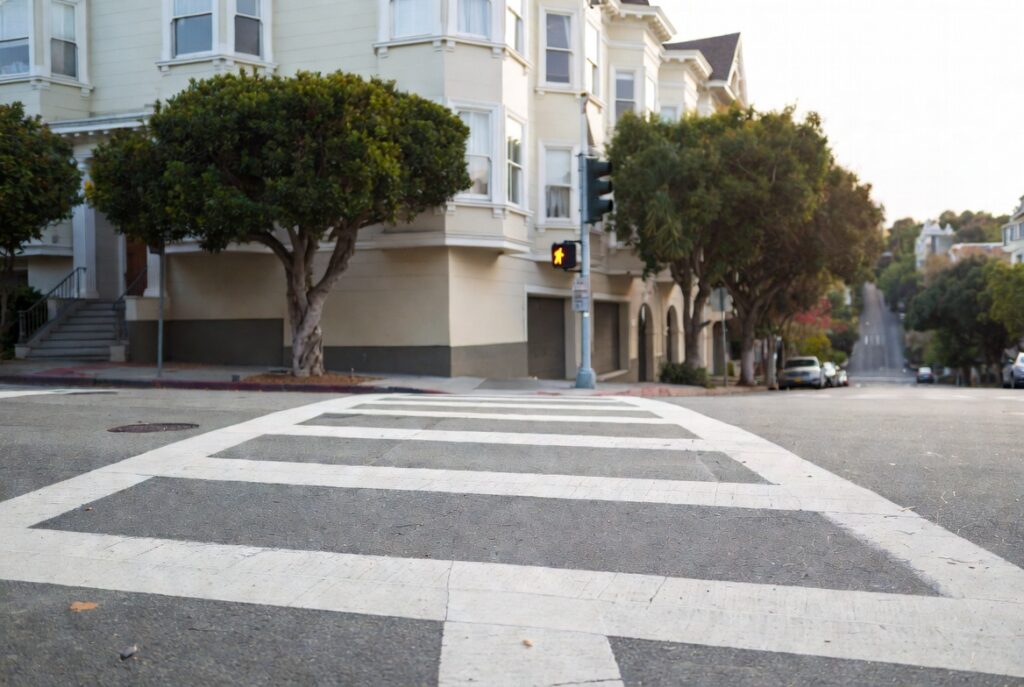
The single most common Pacific Heights pedestrian collision pattern is the left turn through a crosswalk while the pedestrian has the walk signal.
The scenario: a driver is stopped at a controlled intersection. The light turns green; the driver begins a permissive left turn. A pedestrian has just stepped into the marked crosswalk at the far side of the intersection with their walk signal lit. The driver — looking forward and to the left for oncoming traffic in the opposing lane — never looks at the pedestrian completing the cross. The driver accelerates through the turn and strikes the pedestrian midway across.
California Vehicle Code § 21801(a) requires a driver intending to turn left to yield the right-of-way to all vehicles approaching from the opposite direction. Subsection (b) extends the duty to pedestrians. Read together with § 21950, the driver’s duty in this scenario is unambiguous: the driver must yield.
In practice, the fact pattern strongly favors the pedestrian on liability. The vehicle is moving; the pedestrian is in a designated crossing area with the right of way. Disputes usually involve insurers trying to characterize the pedestrian’s entry as “sudden,” or claiming visibility was obstructed by parked cars or street furniture. These defenses generally fail when the pedestrian was midway through the crosswalk at impact — by then they have been visible to a reasonably attentive driver for several seconds.
Other Pacific Heights Pedestrian Collision Patterns
Three other patterns recur.
Right turn on red without a complete stop. Drivers approach a red light intending to turn right. They slow but do not stop, then proceed while looking left for oncoming traffic. A pedestrian crossing from the right side of the intersection is not in their field of view. California Vehicle Code § 22450 requires a full stop before turning right on red. § 21456 requires the driver to yield to pedestrians regardless.
Driveway and garage back-out collisions. Pacific Heights has a higher density of single-family homes with private driveways than any other San Francisco neighborhood. Drivers backing out of garages onto Pacific, Jackson, Washington, and the residential cross streets strike pedestrians walking on the sidewalk. California Vehicle Code § 22106 prohibits backing up unless it can be done safely.
Hill-grade visibility on crests. On the steeper blocks of Broadway, Pacific, Jackson, and Vallejo near the Russian Hill border, a driver cresting a hill has limited forward visibility. A pedestrian crossing just past the crest may not be visible until the driver is too close to stop. Impact speeds in these crashes tend to be higher because the driver had less time to brake.
Common Injuries from Pacific Heights Pedestrian Accidents
Pedestrian collisions transfer the full force of a vehicle into an unprotected body. The injuries are correspondingly severe.
- Traumatic brain injury. Direct head impact with the vehicle or pavement causes severe TBI including subdural hematoma, contusions, and diffuse axonal injury. My practice has reached $6 million for a pedestrian with severe TBI from a crosswalk strike.
- Concussion and mild TBI. Even without direct head contact, pedestrians can suffer concussion from rotational forces. Insurers aggressively minimize these despite well-documented long-term cognitive consequences.
- Spinal cord and back injuries. Pedestrian-impact spinal injuries range from catastrophic cord damage to disc, ligamentous, and soft tissue injuries that can produce months or years of functional limitation. My practice has reached $650,000 in spinal injury recoveries for individual clients.
- Pelvic and lower-extremity fractures. The classic pedestrian-versus-vehicle injury pattern: pelvic fractures from the bumper, tibial and fibular fractures from the bumper or hood, contralateral injuries from the secondary pavement impact.
- Fatal outcomes. Pedestrians account for nearly 40% of serious-injury collisions in San Francisco. Wrongful death claims from pedestrian crashes are among the most legally complex cases I handle.
The Insurance Landscape: More Coverage Is Often Available Than People Realize
Pedestrian collisions in affluent residential neighborhoods often involve more available insurance coverage than the at-fault driver’s basic auto policy suggests. Identifying every applicable policy is one of the highest-leverage activities in a serious injury case.
Auto liability and personal umbrella policies. California’s state-minimum bodily injury coverage is $30,000 per person and $60,000 per accident. Many drivers carry more. More importantly, personal umbrella policies — adding $1 million to $5 million on top of the underlying auto policy — are significantly more common in affluent neighborhoods. Pacific Heights drivers carry umbrella policies at well above the national average rate. Establishing whether the at-fault driver carries one is a routine investigative step that frequently transforms initial coverage analysis.
Rideshare and employer commercial coverage. When the at-fault driver is operating an Uber or Lyft vehicle with a passenger in the car (Period 3 under California Public Utilities Code § 5430), or en route to pick up a passenger after accepting a ride (Period 2), the rideshare company’s $1 million commercial liability policy is in play. Similarly, when the at-fault driver was operating in the course of employment — a contractor, sales representative, real estate agent between showings — the employer’s commercial policy may apply through respondeat superior. Coverage availability does not automatically determine recovery, but the available coverage is meaningfully larger than a state-minimum personal policy.
UM/UIM and government liability. California auto policies include uninsured and underinsured motorist coverage that follows the insured even while walking. A pedestrian struck by a hit-and-run, uninsured, or underinsured driver can pursue UM/UIM benefits under their own policy — one of the most undersold coverages in California. Separately, if traffic signal malfunction, defective road design, or sidewalk maintenance failure contributed, the City of San Francisco or another public entity may share liability. Government claims trigger a six-month administrative deadline under California Government Code § 911.2 — far shorter than the standard two-year personal injury statute discussed in my complete guide to California statute of limitations rules.
How Insurance Companies Fight Pacific Heights Cases (and How a Lawyer Pushes Back)
Pedestrian cases are higher-value claims. Carriers fight them harder. The recurring tactics:
Sudden-entry comparative fault under § 21950(b). Insurers will argue the pedestrian “suddenly” entered the crosswalk. Even a 20% fault assignment reduces recovery by 20% under California’s pure comparative negligence rule (Li v. Yellow Cab Co. (1975)). Defeating this requires sequence-of-events evidence — video, witness testimony, and accident reconstruction when needed.
Pre-existing condition and delayed-onset defenses. Insurers use any prior medical history — a previous strain, an old MRI showing degenerative changes, a documented chronic condition — to argue current symptoms predate the crash. They will also argue that symptoms which emerged 24 to 72 hours after impact must be from something other than the crash. Both arguments are generally wrong. California’s eggshell plaintiff rule means a defendant takes the plaintiff as found — pre-existing conditions made symptomatic by negligence are compensable. And delayed-onset symptoms are medically normal: adrenaline and inflammation cycles routinely mask injury for the first day or two. Defeating these defenses requires careful medical records work, treating physician testimony, and where appropriate retained medical experts.
Quick lowball settlement offers. Within the first weeks after a crash, the at-fault driver’s insurance company will call with a settlement offer that sounds reasonable. It is not. Soft tissue and orthopedic injuries take months to fully manifest. Quick offers are calculated to close the file before the full damages picture is visible.
What to Do After a Pacific Heights Pedestrian Accident
The action plan after any San Francisco pedestrian collision applies here. The eight-step plan is in my complete guide to what to do after a car accident in San Francisco. Three points specific to pedestrian cases are worth emphasizing.
Get medical care the same day even if you feel functional. Adrenaline masks significant injury for 24 to 72 hours. Pedestrians who feel only “sore” at the scene routinely develop disabling radicular pain and disc-related dysfunction within days. Same-day evaluation creates the medical baseline that establishes causation.
Photograph everything before evidence disappears. Crosswalk lines. Vehicle damage and position. Debris. Parked vehicles that may have obstructed sight lines. Nearby businesses with surveillance cameras (note addresses).
Do not give a recorded statement to the at-fault driver’s insurance company. Anything you say in those first conversations will be used to discount your claim. Refer the adjuster to your attorney before agreeing to anything in writing or on a recording.
Frequently Asked Questions
Under California Vehicle Code § 21950, a driver must yield to a pedestrian in any marked or unmarked crosswalk at an intersection. The pedestrian’s duty under subsection (b) is narrow — only not to “suddenly” leave a curb into the path of an immediate hazard. In most Pacific Heights cases, the pedestrian had the right of way and the driver violated the duty to yield.
Mid-block crossings can still be legal at unmarked crosswalks (the legal continuation of sidewalks at intersections). Even where mid-block crossing is technically jaywalking under Vehicle Code § 21955, California’s pure comparative negligence rule (Li v. Yellow Cab Co. (1975)) allows recovery reduced by the pedestrian’s percentage of fault. As long as the pedestrian was not 100% at fault, a claim exists.
Two years from the date of the collision against private drivers under California Code of Civil Procedure § 335.1. Six months for any claim involving the City of San Francisco, MUNI, or Caltrans under Government Code § 911.2 — substantially shorter and easy to miss. Full deadline analysis is in my California statute of limitations guide.
If the driver was operating a ride with a passenger in the vehicle (Period 3) or en route after accepting a ride (Period 2), the rideshare company’s $1 million commercial liability policy is in play. Driver status is determined by the app records, which must be obtained through formal demand. Coverage availability does not automatically determine recovery — liability and damages still have to support it — but the available coverage is meaningfully higher than a typical state-minimum personal auto policy.
Talk to a San Francisco Pedestrian Accident Lawyer About Your Pacific Heights Case
If you or a loved one was struck by a vehicle in Pacific Heights, Cow Hollow, the Marina District, or anywhere in San Francisco, I offer free consultations and handle every case personally — no associate handoffs. With $25 million+ recovered for Bay Area clients, including a $6 million pedestrian TBI settlement, I have the experience and resources to investigate every applicable insurance policy, build the full damages picture, and fight for what your case actually supports. Call (415) 851-4557 or email john@representmyinjury.com.