

John Roach, Esq. | December 15, 2025 | Car Accidents
Does Filing an Uninsured or Underinsured Motorist Claim Raise Your Insurance Rates in California? | San Francisco Injury Lawyer Explains

If you’ve been in a car accident in California and the at-fault driver had no insurance, or not enough of it, you may be hesitating to file a claim under your own policy because you’re worried it will raise your rates. It won’t. California law makes it illegal for your insurer to raise your premium, cancel your policy, or refuse to renew it because you filed an uninsured motorist (UM) or underinsured motorist (UIM) claim through no fault of your own. That protection comes from Proposition 103, and it exists specifically so drivers don’t have to choose between using coverage they paid for and protecting their rates.
As a San Francisco personal injury lawyer with extensive trial experience, I’ve walked countless clients through UM and UIM claims without a single one seeing a rate increase tied to the claim itself. Here’s what the law actually protects, how the claim process works, the deadline that catches people off guard, and what I’ve learned from arbitrating these cases for maximum value.
What Is Proposition 103, and Why Can’t Your Rates Go Up?
Proposition 103 is a California insurance reform law, passed by voters in 1988, that restructured how auto insurers are allowed to set rates. Before Prop 103, insurers had far more discretion to raise premiums after any claim, regardless of fault. Prop 103 changed that by requiring insurers to base rate decisions on a limited set of factors, primarily your driving record, the number of miles you drive, and your years of driving experience, rather than penalizing you for making a claim you didn’t cause.
Under Prop 103 and the California Department of Insurance regulations that implement it, an insurer cannot surcharge you, cancel your policy, or decline to renew it because you filed a claim where you were not at fault. A UM or UIM claim is, by definition, a claim arising from someone else’s negligence: you didn’t cause the accident, and the only reason you’re using your own policy is that the at-fault driver couldn’t cover the damage they caused. That’s precisely the scenario Prop 103 was written to protect.
Uninsured vs. Underinsured Motorist Coverage: What’s the Difference?
The two coverages work together, but they apply in different situations:
Uninsured motorist (UM) coverage applies when the at-fault driver has no auto insurance at all. Despite California’s mandatory insurance law, a significant share of drivers on the road are uninsured. UM coverage steps in to pay for your medical bills, lost wages, and pain and suffering up to your policy’s UM limits, just as the at-fault driver’s liability policy would have if they’d carried one.
Underinsured motorist (UIM) coverage applies when the at-fault driver has insurance, but not enough to cover your losses. If their policy carries the state minimum ($30,000 per person) and your medical bills and lost wages alone total $80,000, UIM coverage can make up the difference, again up to your own policy’s UIM limits.
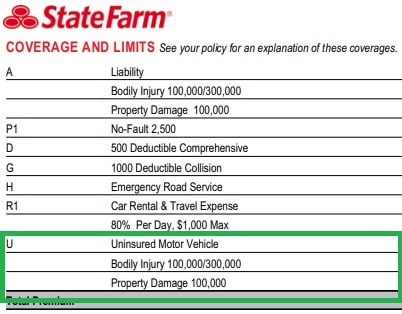
Both coverages are optional in California, though insurers are required to offer them, and most drivers carry some amount without realizing how much it matters until they need it. If you’re not sure what your UM/UIM limits are, pulling your declarations page is worth doing before you’re ever in a position to need it.
How the UM/UIM Claim Process Works in California
A UM/UIM claim is different from a typical liability claim because you’re making it against your own insurance company, even though the fault lies entirely with the other driver. Procedurally, that usually means:
- Notifying your insurer of the accident and the at-fault driver’s lack of, or insufficient, coverage.
- Submitting your damages: medical records, wage-loss documentation, and evidence of pain and suffering, just as you would in a standard injury claim.
- Negotiating a settlement, which sometimes resolves without further action if the insurer’s offer reflects the actual value of the claim.
- Demanding arbitration if the insurer’s offer falls short. Most California UM/UIM policies require unresolved disputes to go to binding arbitration rather than a jury trial, with each side selecting an arbitrator (or agreeing to a single neutral arbitrator) to decide the value of the claim.
Because your insurer is financially on the other side of this negotiation (even though they’re not the one who caused the crash), these claims are frequently undervalued in the initial offer. That’s where having counsel who has actually arbitrated UM/UIM cases, rather than just settled them, makes a measurable difference.
The Deadline You Can’t Miss: How Long You Have to Demand UM/UIM Arbitration
This is the part of a UM/UIM claim that catches the most people off guard. Unlike a straightforward lawsuit against an at-fault driver, a UM/UIM arbitration demand generally has to be made within the same window as California’s personal injury statute of limitations: in most cases, two years from the date of the accident. Simply notifying your insurer of the accident, or negotiating informally, does not necessarily stop that clock from running.
If the two-year window closes before a formal arbitration demand is made, you can lose the right to pursue the claim entirely, regardless of how strong it is on the merits. Some policies also contain their own notice and demand provisions that are worth reading closely. If you’re approaching the two-year mark on a UM/UIM claim and haven’t formally demanded arbitration, that’s not a “wait and see” situation. It’s worth getting a case evaluation from a San Francisco personal injury lawyer immediately so the deadline doesn’t decide the outcome for you.
Can My Insurance Company Block or Deny My UM/UIM Claim?
Insurers can’t deny a valid UM/UIM claim outright, but they can, and do, dispute liability, the extent of your injuries, or whether the at-fault driver was actually uninsured or underinsured in the first place. I’ve written in more detail about the specific tactics insurers use to try to block or minimize a UIM claim in California and what policyholders can do about each one. The short version: a denial or lowball offer isn’t the end of the process, it’s usually the start of the negotiation.
A San Francisco Lawyer’s Track Record in UM/UIM Arbitrations
I’ve arbitrated UM/UIM claims to results that materially exceeded what the insurer initially offered. In one recent case, I secured a $750,000 arbitration award for a client whose insurer had offered $125,000, six times the original offer and the full available policy limits. That case is a useful example of how these claims are actually built and argued: I’ve broken down the strategy in a case study on the UIM arbitration victory if you want to see how the numbers moved.
That result, along with $25 million+ recovered for Bay Area clients across my practice, comes from treating UM/UIM arbitrations with the same preparation as a jury trial, because the arbitrator is, in effect, your jury.
Insider Strategies for Maximizing a UM/UIM Arbitration Award
A few things I’ve found make a consistent difference in how these arbitrations resolve:
Choose the Right Arbitrator and Schedule Early
Selecting a neutral arbitrator with genuine subject-matter experience, and setting hearing dates promptly, keeps momentum on your side. Delay tends to favor the insurer, not the claimant.
Use a CCP 998 Offer Strategically
A well-timed offer under California Code of Civil Procedure section 998, made before expert costs are incurred, can shift the cost-recovery calculus if the eventual award exceeds your offer, which keeps pressure on the insurer to negotiate seriously rather than run out the clock.
Tell the Full Story, Not Just the Medical Record
Medical bills and wage-loss statements establish the floor of a claim’s value, not the ceiling. Arbitrators respond to how an injury has actually changed a person’s daily life, relationships, and independence. The per-diem method for valuing pain and suffering is one tool I use to put a defensible number on that part of the claim rather than leaving it to guesswork.
Recover Your Costs and Fees
Deposition costs, expert fees, and arbitration expenses can often be recovered from the award itself, either through the arbitrator’s discretion or a formal costs memorandum. Leaving that on the table is a common and avoidable mistake.
What to Do If Your Insurer Illegally Raises Your Rates After a UM/UIM Claim
If your insurer raises your premium, cancels your policy, or refuses to renew it specifically because you filed a not-at-fault UM/UIM claim, that’s a Prop 103 violation, not a routine underwriting decision. Start by putting the dispute in writing directly with your insurer. If that doesn’t resolve it, you can file a complaint with the California Department of Insurance, which investigates exactly this kind of rate-practice violation. If you’re unsure whether a rate change is connected to your claim or to an unrelated factor (a lapse, a new violation, a policy renewal cycle), that’s worth having a lawyer look at directly rather than assuming the worst or assuming it’s fine.
Frequently Asked Questions About Uninsured and Underinsured Motorist Claims in California
Does filing a UM or UIM claim raise my insurance rates in California?
No. Under Proposition 103, insurers cannot raise your rates, cancel your policy, or refuse to renew it because you filed a claim for an accident you didn’t cause, which is exactly what a UM/UIM claim is.
What’s the difference between uninsured and underinsured motorist coverage?
Uninsured motorist (UM) coverage applies when the at-fault driver has no insurance at all. Underinsured motorist (UIM) coverage applies when they have insurance, but not enough to cover your damages.
Is UM/UIM coverage required in California?
No, but insurers are required to offer it, and most California drivers carry it. Given how many drivers on the road are uninsured or carry only the state minimum, it’s coverage worth confirming and, in many cases, increasing.
How long do I have to file a UM/UIM claim or demand arbitration?
Generally, the same two-year window that applies to a personal injury lawsuit in California. Missing that window can bar the claim entirely, so it’s not something to leave until the last few weeks.
Do UM/UIM claims go to court?
Typically not. Most California auto policies require unresolved UM/UIM disputes to go to binding arbitration rather than a jury trial, which makes arbitrator selection and case preparation especially important.
Can my insurance company deny my UM/UIM claim?
They can dispute liability, injury severity, or the at-fault driver’s coverage status, but they can’t simply refuse a valid claim. A denial or low offer is usually the opening position, not the final word.
Do I need a lawyer for a UM/UIM claim?
You’re not required to have one, but you’re negotiating directly against your own insurer’s incentive to minimize the payout. Having counsel who has actually arbitrated these claims, not just settled them, tends to change the number on the table.
Talk to a San Francisco Uninsured Motorist Claim Lawyer Today
If you were hit by a driver with no insurance, or not enough of it, you have every right to use the UM/UIM coverage you’re paying for, without fear of it costing you at renewal. I’ve built a practice around getting full value out of these claims, including a $750,000 arbitration award on a case the insurer initially offered $125,000 to settle.
Call (415) 851-4557 or visit representmyinjury.com for a free consultation. I’m fluent in English and Spanish, and I handle these cases personally from intake through resolution.
¿Prefiere hablar en español? Puede comunicarse directamente conmigo al (415) 851-4557 o visitar mi página en español; atiendo sus casos personalmente, en español, de principio a fin.
Complete our intake form: https://lawofficeofjohnjroach.cliogrow.com/intake/5d22773fd05d3aa4c6bc3d4ff3c7de0a
Disclaimer: This blog post is for informational purposes only and does not constitute legal advice. Consult a licensed attorney for advice specific to your situation.