
John Roach, Esq. | October 29, 2026 | California Law \ Car Accidents
Halloween Pedestrian Accidents in San Francisco: What a Lawyer Wants Every Driver and Parent to Know

Every October 31st, I brace for the same phone calls. A driver who says the child “came out of nowhere.” A parent standing in an emergency room hallway, still wearing a witch’s-hat headband, trying to explain to a six-year-old why the car didn’t stop. Halloween is the one night of the year I tell my own neighbors to slow down before it’s fully dark — not to be dramatic, but because the numbers back it up, year after year.
The Halloween Numbers Every San Francisco Parent Should Know
The federal Centers for Disease Control and Prevention has tracked this pattern for decades: comparing 4 p.m. to 10 p.m. on October 31 with that same window on every other night of the year, CDC researchers found pedestrian deaths among children ages 5 to 14 were roughly four times higher on Halloween evening. A later analysis of 42 years of NHTSA fatality data, published in JAMA Pediatrics, found the overall pedestrian fatality risk was 43% higher on Halloween evening than on comparable fall nights — and for children ages 4 to 8 specifically, the risk was roughly ten times higher. Both studies point to the same narrow window: risk peaks around 6 p.m., the exact half-hour when the sun disappears and the sidewalks fill with trick-or-treaters.
I bring up the statistics not to talk anyone out of trick-or-treating, but because as a personal injury lawyer, I want San Francisco families to understand that this isn’t bad luck. It’s a predictable, well-documented spike concentrated in a narrow window of time — and that predictability matters enormously when a case turns on whether a driver should have seen a child in time to stop.
Why San Francisco’s Geography Makes This Worse
Daylight saving time doesn’t end until the first Sunday in November, so Halloween always falls during the darkest stretch of trick-or-treating hours before the clocks even give drivers an extra hour of morning light. The same physics apply on October 31: a driver’s eyes need time to adjust from daylight driving to judging distance and speed in near-dark conditions, right as costumed kids are darting between parked cars instead of walking to a marked corner.
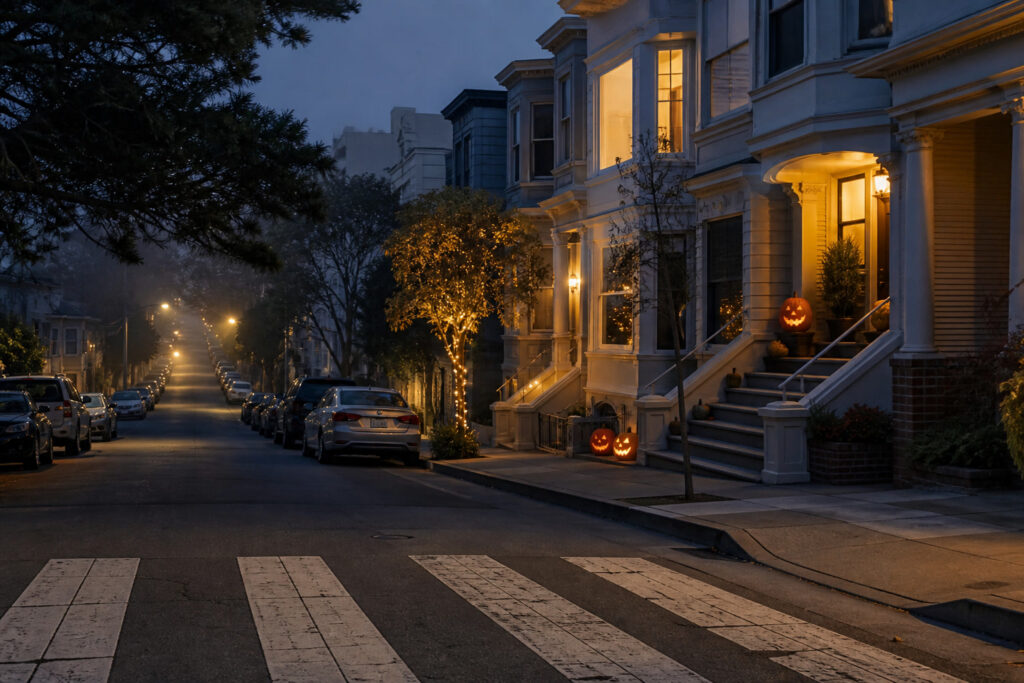
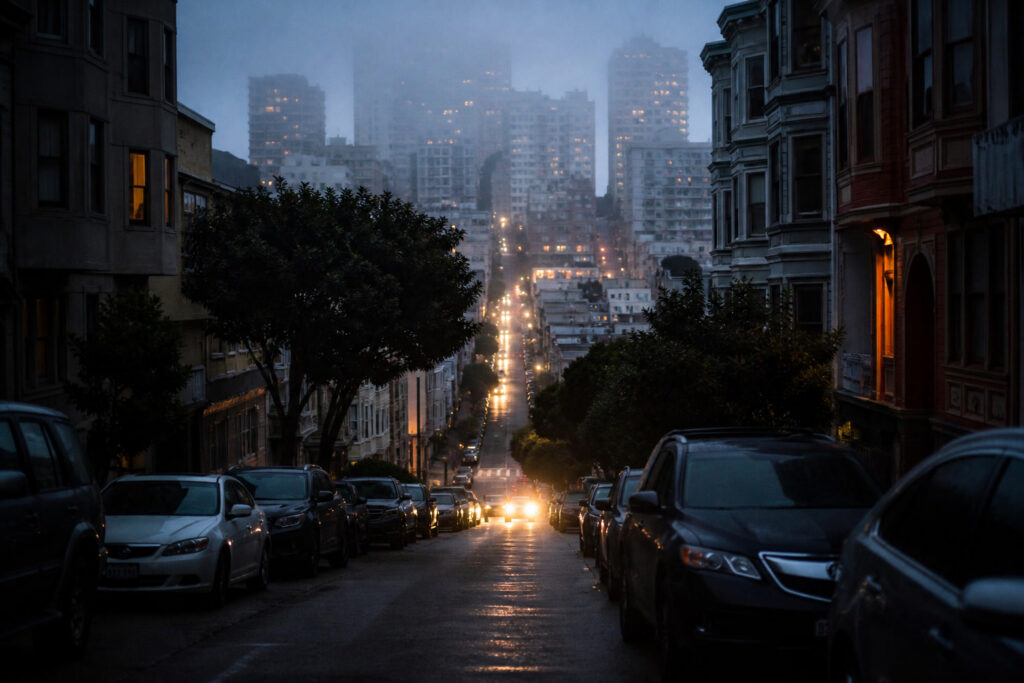
San Francisco’s hills and fog compound the problem. The residential streets that draw the heaviest trick-or-treat traffic — dense, walkable neighborhoods with front-stoop candy bowls and short blocks — are often exactly the streets with steep grades, blind curves, and cars parked bumper to bumper that make it hardest for a driver to spot a small child stepping into the roadway. A driver who’d have a clear sightline in daylight can lose several critical seconds of reaction time once dusk fog rolls in on top of the dark.
Costumes compound it further, in ways that have nothing to do with a child’s judgment. Dark fabric absorbs headlight beams instead of reflecting them. Masks narrow a child’s peripheral vision and muffle the sound of an approaching engine. None of that is the child’s fault — but all of it means a driver needs more following distance, slower speeds, and more attention on residential streets than an ordinary Tuesday night requires.
Do Drivers Have to Stop for Trick-or-Treaters? What a San Francisco Lawyer Wants You to Know
Does a driver have to yield only in a marked crosswalk, or does the duty go further?
California Vehicle Code § 21950 requires drivers to yield the right-of-way to pedestrians crossing in a marked crosswalk, or in an unmarked crosswalk at an intersection, and to exercise due care and reduce speed whenever a pedestrian is in the roadway. That statute is the centerpiece of most Halloween liability arguments — but it isn’t the whole picture. Every driver in California also owes a general duty of reasonable care under Civil Code § 1714, and the state’s basic speed law, Vehicle Code § 22350, requires driving at a speed that is safe for actual conditions — not simply the posted limit. On a night when a reasonable driver knows children will be out at dusk in costumes, “I was going the speed limit” is rarely a complete defense if that speed was still too fast to stop for a foreseeable hazard.
None of this erases a pedestrian’s own duty of care. California law is clear that a person cannot suddenly dart from a curb into the path of a car that has no realistic chance to stop, and officers retain the ability to act when a pedestrian creates a genuine, immediate danger. But as the next section covers, that standard is applied very differently when the pedestrian is a child.
“My Child Ran Into the Street” — Why That Doesn’t End the Case
I hear this concern from parents almost every year, usually from the driver’s insurance adjuster before they hear it from me: the suggestion that a child darted out, so the family shares the blame. California law does not hold a six-year-old to an adult’s judgment.
Under California’s civil jury instructions, a child’s conduct is measured against what a reasonably careful child of the same age, intelligence, and experience would do in that situation — not what a careful adult would do. For the youngest trick-or-treaters, the law goes further still: children under five years old cannot be found negligent at all, as a matter of law, no matter what happened in the moment before the crash.
California law places a mirroring duty on the other side of the crash, too. Adults are legally required to anticipate the ordinary, sometimes unpredictable behavior of children and to exercise greater care around them than they would around another adult — that isn’t a courtesy, it’s a jury instruction (CACI No. 412). A driver on a residential street full of trick-or-treaters is expected to already know that kids dart, forget to look both ways, and misjudge distances in a mask. That expectation is built into the standard of care before an adjuster ever opens a file.
That distinction matters because insurance adjusters routinely open Halloween claims by trying to shift blame onto a five-year-old in a dinosaur costume. It is an argument that can sound reasonable to an exhausted, frightened parent — until they know the actual legal standard, which is exactly why I don’t let it go unanswered.
When the City Shares the Blame
Not every Halloween crash comes down to a driver’s judgment alone. I’ve seen cases shaped by a city-owned streetlight that had been out for weeks, a crosswalk signal at a residential intersection that was miscalibrated, or a stop sign obscured by an overgrown city tree — conditions that make it harder for any driver to see a child in time, and conditions the City of San Francisco has a legal duty to maintain.
Claims against a government entity work differently than a claim against another driver. California Government Code § 911.2 gives you only six months from the date of the incident to file a formal claim with the city before you can sue — far shorter than the two-year deadline that applies to a claim against a private driver. If a defective streetlight, signal, or sidewalk played any role in your child’s accident, that six-month clock is the single most important date on your calendar — and it is one most families don’t learn about until it’s nearly too late.
How Insurance Companies Handle Halloween Claims
Halloween claims move differently than an ordinary fender-bender. Insurance adjusters know the calendar too, and many treat October 31 and November 1 claims as an opportunity to lock in a favorable version of events before a family has had time to think, let alone speak with a lawyer. It is common for an adjuster to call within a day or two, sound sympathetic, and ask for a “quick recorded statement to get the claim moving” — and then use the parent’s own shaken, adrenaline-fueled description of a chaotic evening to argue later that the child was running, unsupervised, or “impossible to see.”
I tell every parent the same thing: sympathy on the phone is not the same as a fair valuation of your child’s injury, and a recorded statement given the same night as the accident is exactly the kind of evidence an adjuster is trained to extract before the full picture — the streetlight that was out, the driver’s phone records, the witness across the street — has been gathered.
What to Do in the First 24 Hours
- Call 911, even for what looks like a minor impact. A police report anchors the timeline and the driver’s statement while it’s fresh, and it creates an independent record an insurance company can’t later rewrite.
- Photograph the scene before conditions change: the child’s costume and mask, the vehicle’s position, any streetlight or signal that was out, and the actual lighting at the time of the crash.
- Get names and phone numbers of anyone who saw it happen. Halloween sidewalks are full of other parents, and they often saw more of the sequence than the driver did.
- Have your child evaluated the same night, even if they insist they’re fine. Adrenaline and the excitement of the evening mask pain in young children far more than most parents expect, and some injuries — concussions especially — don’t show clear symptoms for hours.
- Be careful what you say to the driver’s insurance company before speaking with a lawyer. A recorded statement taken while you’re still shaken is exactly when an adjuster tries to lock in language about a child “running into the street.”
What a Halloween Accident Claim Can Recover
A California personal injury claim after a Halloween pedestrian accident can cover emergency care, follow-up treatment, and any ongoing medical needs, along with a parent’s own lost wages from time away from work caring for an injured child. Pediatric injuries also carry considerations adult cases don’t: a fracture near a growth plate can affect a child for years, and the fear of crossing streets that follows a young child after a crash is real and often outlasts the physical injury. A thorough claim accounts for both the medical bills already in hand and the ones still ahead.
It also covers non-economic damages — the pain, fear, and disruption the whole family goes through — which an insurance company will always try to minimize with a formula, and which I make a point of documenting thoroughly rather than letting an algorithm decide. I don’t use online case-value calculators with clients, and I’d encourage any parent to be skeptical of a website that offers one: every Halloween case turns on its own facts, not a generic number pulled from a database.
Frequently Asked Questions
Not automatically, but California law puts real weight on the driver’s side of the equation. A driver who was going too fast for dusk conditions, distracted, or failed to yield in a crosswalk carries most or all of the fault even when the child was moving quickly or wearing a dark costume.
Often, yes. Vehicle Code § 21950 covers crosswalks specifically, but every driver also owes a general duty of reasonable care under California law, including slowing down and watching for pedestrians on a night when children are known to be out. A mid-block crossing changes the analysis; it doesn’t automatically end it.
That can cut against the driver, not for them. Halloween’s risks — dark costumes, masks, children darting between parked cars — are well documented and foreseeable, and California drivers are expected to adjust their speed and attention accordingly on October 31st.
Against a private driver, California generally allows two years from the date of the accident. If a defective city street, signal, or streetlight contributed, you have only six months to file a formal claim with the government entity — a much shorter and stricter deadline.
I’d talk to a lawyer first. Insurance adjusters often reach out within days of a Halloween accident, and early recorded statements are frequently used later to argue the child was at fault.
If Your Child Was Hurt This Halloween
I’ve represented San Francisco families in personal injury cases since 2009, with the trial experience to take a case all the way to a verdict when an insurance company won’t offer a fair number. Halloween cases are some of the ones I take most personally, because the families sitting across from me almost always did everything right — and the case still comes down to convincing an insurance company that a costumed six-year-old isn’t held to a driver’s standard of care.
If a driver hit your child, or hit you while you were walking your kids through the neighborhood, call my office for a free consultation. También hablo español — llámeme si usted o su familia necesita ayuda después de un accidente.