

John Roach, Esq. | December 30, 2025 | Attorney Tips
Maximizing Non-Economic Damages in Personal Injury Cases: The Per Diem Approach Explained

If you regularly handle personal injury cases, you already know that non-economic damages are where cases are won or lost. Medical bills are fixed. Lost wages are calculable. But pain and suffering, loss of enjoyment of life, and emotional distress — these are the damages that insurance companies fight hardest to minimize, and where an unprepared presentation leaves the most money on the table.
I’m John J. Roach, a San Francisco personal injury trial attorney who has practiced since 2009, handling catastrophic injury cases throughout the Bay Area. One of the most effective tools in my practice for establishing full non-economic damage value is the per diem method. If you are handling a complex California personal injury matter — or considering a referral — this breakdown explains why I use this approach in every serious case and how it consistently produces better outcomes than the multiplier method.
What Non-Economic Damages Cover Under California Law
California Civil Jury Instruction 3905A sets out the categories of non-economic loss available to personal injury plaintiffs: physical pain and discomfort, mental suffering, anxiety, humiliation, and emotional distress, loss of enjoyment of life and inability to pursue hobbies and activities, inconvenience, grief, and disfigurement or physical impairment. Unlike medical malpractice cases, standard California personal injury cases carry no MICRA cap on non-economic damages — meaning in a catastrophic case, the ceiling is set by the evidence and the jury, not the legislature.
In the serious traumatic brain injury, spinal cord injury, and catastrophic car accident cases I handle, non-economic damages routinely drive the majority of the total recovery. Getting this component right is the difference between a case that settles at policy limits and one that doesn’t.
Why the Multiplier Method Undervalues Serious Cases
The multiplier method — applying a factor of 1.5 to 5 to total medical bills — is the default approach most insurers use and, unfortunately, what many plaintiff attorneys accept as a starting point. The fundamental problem is that it anchors non-economic damages to medical expenses, which are often artificially deflated by Medi-Cal rates, insurance adjustments, or gaps in treatment caused by lack of coverage.
A client with $80,000 in medical bills at a 3x multiplier yields $240,000 in pain and suffering. But if that client is 32 years old with a permanent traumatic brain injury who will live another 45 years with cognitive deficits, daily headaches, and personality changes — $240,000 is a fraction of what that suffering is actually worth over a lifetime. The multiplier obscures this. The per diem method makes it visible.
The Per Diem Method: How It Works
The California Supreme Court endorsed the per diem approach in Beagle v. Vasold (1966), recognizing it as a legitimate framework for helping juries quantify non-economic harm. The method assigns a reasonable daily dollar value to pain and suffering — supported by evidence — and multiplies it by the number of days affected, past and future.
Here is a practical example. A client suffers a serious back injury in a slip and fall accident at age 40. Their treating physician documents chronic daily pain and projects a permanent partial disability. Life expectancy tables put remaining life at approximately 40 years. Working with medical experts, I establish a conservative daily value of $150 for the pain and functional limitation this client experiences every day.
Past pain and suffering (2 years since accident): $150 × 730 days = $109,500
Future pain and suffering (40 years projected): $150 × 14,600 days = $2,190,000
Total non-economic damages: $2,299,500
Compare that to a 3x multiplier on $80,000 in medical bills: $240,000. The per diem analysis produces a figure nearly ten times higher — and it is fully defensible because it is grounded in the actual daily experience of the injury, not an abstract ratio.
Step-by-Step: Implementing Per Diem in Your Cases
Step 1: Categorize Non-Economic Harms Under CACI 3905A
Start by mapping each category of non-economic loss to your specific client. In a TBI referral, this means documenting chronic headaches, cognitive difficulties, memory loss, emotional dysregulation, social isolation, and loss of vocational and recreational identity. The more granular the categorization, the more defensible the daily value assigned to each component.
Step 2: Assign Evidence-Based Daily Values
Daily values must be anchored in the record — not asserted without foundation. For chronic physical pain supported by medical expert testimony, a range of $100–$200 per day is defensible in Bay Area courts. For significant emotional distress and loss of enjoyment, $50–$150 per day is a reasonable range depending on the evidence. Use jury-accessible analogies in mediation and trial: what does a San Francisco resident pay per day for their gym membership, their commute, or a meal out? Frame the daily value as a floor, not a ceiling.
Step 3: Separate Past and Future Calculations
Past damages run from the date of injury to the date of trial or settlement. Future damages project from that point forward based on medical prognosis and life expectancy. Critically, no present value discount applies to future non-economic damages in California — unlike future economic damages, which are typically discounted. This distinction significantly increases the total figure in long-duration cases.
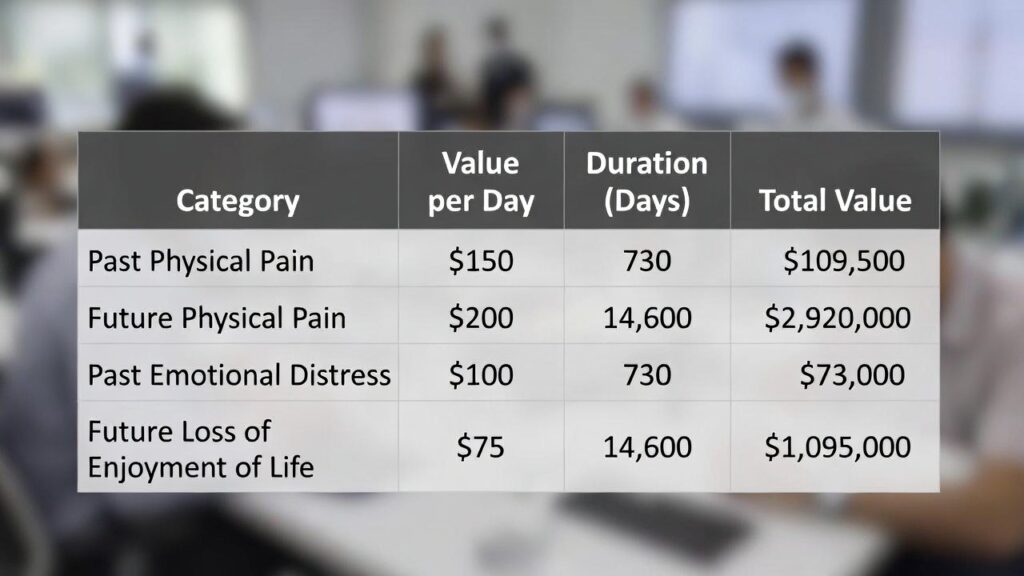
Step 4: Build a Clear Spreadsheet
Transparency is persuasive. A well-constructed per diem spreadsheet presented at mediation or to a jury breaks the calculation into components that are easy to follow and hard to dismiss as speculative. Here is an example of the format I use:
Step 5: Retain the Right Experts
In catastrophic injury cases, the per diem calculation is only as strong as the expert foundation beneath it. I retain neuropsychologists for TBI cases, pain management specialists for chronic pain conditions, life care planners for long-term projection, and vocational rehabilitation experts to document the impact on earning capacity. In co-counsel matters, I am happy to collaborate on expert selection and retention strategy from the outset.
When Per Diem Is Most Effective
The per diem method produces its greatest advantage in permanent or long-duration injury cases — particularly those involving traumatic brain injury, spinal cord injury, chronic pain conditions, and serious orthopedic injuries. The longer the projected suffering, the more dramatically per diem outperforms the multiplier. In cases where medical bills are low relative to injury severity — common when clients are uninsured or treated under Medi-Cal — per diem is essential to avoid having non-economic damages artificially anchored to a deflated economic base.
It is also particularly effective in cases involving younger clients. A 28-year-old with a permanent partial disability has potentially 50 years of suffering ahead of them. A per diem analysis makes that visible in a way that a multiplier on current medical bills never will.
Addressing Defense Challenges
Defense counsel will argue that per diem calculations are speculative. The answer is evidence. Every daily value must be tied to documented medical findings, expert opinions, and client testimony. When insurers push back with their own multiplier-based analysis, I pivot to the human narrative: day by day, this is what this person’s life looks like now. That is not speculation — that is the record.
For future projections, defense experts will attempt to minimize prognosis. Retaining the right medical experts early — before the defense IME — allows you to establish the permanence and severity of the injury in the record before the defense has the opportunity to contest it.
Referrals and Co-Counsel
If you have a catastrophic injury case in California — TBI, spinal cord injury, serious pedestrian or bicycle accident, or any matter where the full value of non-economic damages is critical to the outcome — I welcome the opportunity to discuss it. I handle referrals and co-counsel arrangements on a case-by-case basis and am happy to have a confidential conversation about whether a matter is a good fit.
I have recovered over $25 million for injured clients throughout the Bay Area, including a $6,000,000 settlement in a pedestrian TBI case and a $750,000 UIM arbitration award. I work on contingency and handle every significant case personally.
Call me at (415) 851-4557 or reach out through the contact form to discuss a potential referral or co-counsel arrangement.
Frequently Asked Questions: Non-Economic Damages and the Per Diem Method
Yes. The California Supreme Court endorsed the per diem method in Beagle v. Vasold (1966), recognizing it as a legitimate framework for helping juries quantify non-economic damages. California Civil Jury Instruction 3905A sets out the categories of non-economic loss available to plaintiffs, and per diem calculations tied to those categories are well-established in California personal injury practice.
No. Unlike medical malpractice cases subject to the MICRA cap, standard personal injury cases in California carry no statutory cap on non-economic damages. A jury may award whatever amount is reasonable and supported by the evidence, making thorough non-economic damages presentation particularly important in catastrophic injury cases.
Per diem produces its greatest advantage in permanent or long-duration injury cases where the client is relatively young and the projected duration of suffering is significant. It is also most effective when medical bills are low relative to injury severity — common in cases involving Medi-Cal, uninsured clients, or gaps in treatment — because it anchors non-economic damages to the injury itself rather than to a deflated economic base.
A credible per diem case requires medical expert testimony documenting the severity, permanence, and functional impact of the injury; contemporaneous client pain journals recording daily limitations and emotional impact; lay witness testimony from family members and coworkers; and in catastrophic cases, life care planners and vocational rehabilitation specialists who project long-term functional limitations. The daily value must be tied to the evidentiary record — not asserted without foundation.
Yes. I handle referrals and co-counsel arrangements for catastrophic injury cases throughout California, with particular depth in traumatic brain injury, spinal cord injury, and serious pedestrian and bicycle accident cases. I am happy to have a confidential conversation about whether a matter is a good fit. Call (415) 851-4557 or reach out through the contact form on this site.
Disclaimer: This blog post is for informational purposes only and does not constitute legal advice. Consult a licensed attorney for advice specific to your situation.




