

John Roach, Esq. | July 13, 2026 | California Law \ Car Accidents
Hit by an Amazon, UPS, or FedEx Delivery Truck in San Francisco? A Lawyer Explains Who Actually Pays

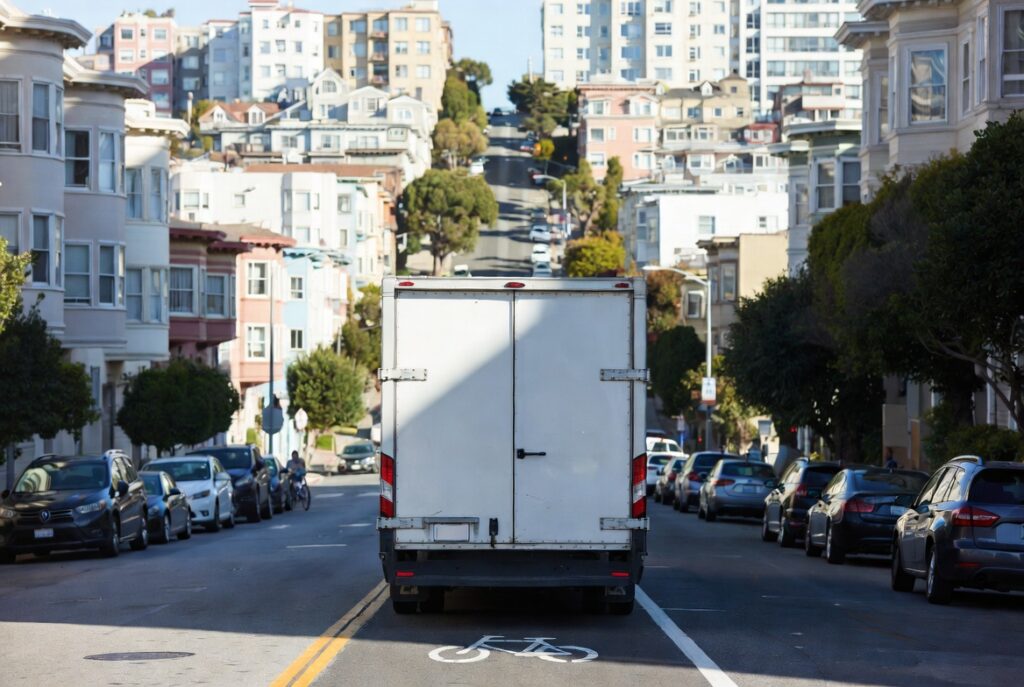
Delivery vehicles have taken over San Francisco’s streets. Amazon vans double-park in the Valencia Street bike lanes, UPS trucks back across crosswalks in SoMa alleys, and FedEx drivers race quotas up hills with blind crests. When one of them causes a crash, the injury is only half the problem. The other half is a question most people never anticipate: who is actually responsible — and whose insurance pays? With these companies, the answer turns on a web of employment and contractor relationships that each company has deliberately built differently. As a San Francisco car accident lawyer practicing since 2009, I untangle exactly that.
The Liability Question Hinges on Employment Structure
In a delivery-truck case, the most valuable work happens before a single negotiation: identifying who employed the driver, who owned the vehicle, and which insurance policies apply. Each major carrier is structured differently, and those differences decide the case:
- UPS. UPS drivers are generally employees operating company-owned trucks. Under California’s respondeat superior doctrine, an employer is responsible for an employee’s negligence within the scope of the job — which makes UPS directly liable, backed by substantial corporate insurance. My dedicated UPS truck accident page explains why the real fight in these cases is valuation, not liability.
- FedEx. FedEx historically splits its operations — its express side has used employee drivers, while its ground side has relied heavily on independent “service provider” contractors. That structure invites finger-pointing over who is liable, but FedEx and the contracting company can both be on the hook. The Ground-versus-Express distinction matters enough that I maintain a dedicated FedEx truck accident page breaking it down.
- Amazon. Amazon is the most complex. Many “Amazon” vans are operated by separate Delivery Service Partner (DSP) companies, and Amazon Flex uses gig drivers in their own personal vehicles. Amazon often points to these layers to distance itself, but a claim can reach the driver, the DSP, and sometimes Amazon itself — the more control Amazon exercised over routes, quotas, and monitoring, the harder it is for Amazon to hide behind the contractor label. I cover the DSP and Flex structures in depth on my Amazon delivery truck accident page.
There is a second layer beyond the driver’s negligence: the company’s own. A DSP that put an untrained driver behind the wheel, kept a driver with a bad record on the road, or enforced quotas that made safe driving impossible can face direct claims for negligent hiring, supervision, and retention — independent of what the driver did in the moment. Those claims open the company’s own records to discovery, and they change how a case is valued.
The Hidden Insurance Gap With Amazon Flex
Amazon Flex deserves special attention, because it creates the same coverage trap I see in gig cases. A Flex driver delivers in a personal vehicle, often under a personal auto policy that excludes commercial use. When that driver causes a crash on the clock, the personal insurer may deny the claim as a business-use exclusion — leaving an injured person staring at a coverage gap. Sorting out which policy responds, and forcing a commercial layer into the picture, is the same analysis that makes rideshare commercial coverage cases so technical. Getting it wrong can mean leaving real money unclaimed.
Hit by a USPS Truck? The Rules Change Completely
One delivery vehicle on San Francisco streets follows an entirely different rulebook: the mail truck. USPS drivers are federal employees, which means a crash with a postal vehicle falls under the Federal Tort Claims Act — not ordinary California car-accident rules. You cannot simply sue the driver or the Postal Service in state court. Instead, you must first present a written administrative claim (Standard Form 95) to USPS within two years of the crash, stating a specific dollar amount. The agency then has six months to act; only after a denial or six months of silence can you file suit, and only in federal court, where a judge — not a jury — decides the case. Miss a step in that sequence and the claim can be lost entirely. It is the federal cousin of the six-month government claim deadline that applies when a city vehicle like a MUNI bus is involved: whenever the driver works for the government, the deadlines shorten and the procedure hardens.
Why Delivery Crashes Are So Common in San Francisco
Delivery work runs on speed, and speed on San Francisco streets is dangerous. Drivers under tight quotas double-park, block sightlines, reverse without spotters, and rush turns — and app-based routing means many are working off a screen between every stop, the same structural distraction I break down in my guide to proving a driver was on their phone. The predictable results are rear-end crashes when a van stops short, backing collisions in alleys and driveways, and the most severe outcomes of all — a person hit as a pedestrian stepping around a double-parked truck, or a cyclist forced into traffic by a van in the bike lane, where cyclist injury representation overlaps with delivery liability.
And because a loaded delivery van outweighs a sedan — let alone a person — these impacts routinely cause traumatic brain injury, spinal cord injury, and fractures. The vehicle’s weight transfers directly into the severity of the harm, which is exactly why these cases are valued differently than an ordinary fender-bender.
Evidence in a Delivery-Truck Case Moves Fast
Like all commercial cases, delivery crashes reward early action. The proof you need is held by companies that would rather you never see it:
- Delivery route and GPS data showing speed, stops, and how far behind schedule the driver was running.
- Van, dashcam, and warehouse camera footage — Amazon DSP vans in particular run driver-facing and road-facing cameras — often overwritten within days.
- Driver scheduling and quota records that show pressure to rush.
- Driver qualification, training, and prior-incident files — the raw material of a negligent hiring claim.
- The contracts between Amazon/FedEx and their DSP or service-provider companies, which reveal who controlled the work.
A preservation letter has to go out quickly, and the corporate contracts have to be obtained to map liability. For larger commercial vehicles, federal FMCSA safety regulations add another layer of standards — and another source of proof — which is the same disciplined approach I bring to any trucking accident case.
How the Companies Fight These Claims
Delivery companies and their insurers run a playbook, and it starts within hours of the crash. Expect a rapid-response adjuster to call while you are still in pain, sounding helpful and asking for a recorded statement — the purpose of which is to lock you into minimizing your injuries before you know their extent. Expect an early settlement offer that looks like real money until you compare it to a future of medical care. And expect the corporate shell game: Amazon pointing to the DSP, the DSP pointing to the driver, and the driver’s personal insurer pointing to the business-use exclusion — each hoping the claim lands on the party with the least insurance.
The counter is structural, not rhetorical: name every entity in the chain, obtain the contracts that show who controlled the work, and make the layer with real coverage answer. A defendant who knows the case has been built to reach the correct policy — and that the lawyer across the table has a trial record — negotiates very differently than one facing an unrepresented claimant on the phone.
What a Delivery-Truck Case Is Worth
Two things separate these cases from an ordinary crash. First, the injuries are heavier, for the physics reasons above — and serious injuries must be documented to their full extent: future medical care, lost earning capacity, and the disruption to your life, not just the first hospital bill. Second, the coverage is bigger. Commercial auto policies carried by delivery companies and their contractors dwarf the minimum-limits personal policies involved in most car crashes, which means a properly built case is not fighting over a $30,000 policy ceiling. Full documentation against real coverage is how significant recoveries happen — my results include a $6 million pedestrian TBI settlement, the kind of outcome that is only possible when the injury record and the insurance layers are both fully developed.

What to Do After a Delivery Truck Accident
- Call the police and get a report; note the company name and any van/truck or DSP markings.
- Photograph the vehicle, all company logos and ID numbers, the scene, and your injuries.
- Get the driver’s name and whether they say they work for the company directly or a contractor — that one answer shapes the whole claim.
- If it was a mail truck, note it prominently — the federal deadlines and forms are different from day one.
- Seek medical care immediately, even if symptoms feel minor.
- Do not give a recorded statement to any insurer before consulting an attorney.
Why a San Francisco Delivery Truck Lawyer Matters
These companies are built to make accountability hard to trace. As a trial-tested attorney practicing since 2009 with a 9-for-9 verdict record, I identify every responsible party, force the right insurance layer to respond, and preserve the corporate evidence before it disappears. Sorting out delivery liability is part of the car accident cases I handle across the city, and I do it on contingency — you pay nothing unless I recover.
For Spanish-speaking clients — including the many delivery and warehouse workers in our community — I provide consultations in Spanish directly, with no interpreter. And if you are a delivery driver who was hurt on the job by someone else’s negligence, know that workers’ compensation is often not your only remedy: a third-party claim against the negligent driver can recover damages workers’ comp never pays, including full pain and suffering. Si un camión de reparto lo lesionó, como abogado de lesiones personales en San Francisco manejo su caso completamente en español, incluyendo los accidentes de camiones comerciales.
Talk to a Delivery Truck Accident Lawyer for Free
If an Amazon, UPS, FedEx, or USPS vehicle hurt you in San Francisco, do not let the company’s structure decide whether you get paid. Call (415) 851-4557 or schedule a free case review. Se habla español.
Frequently Asked Questions
It depends on the structure. Many Amazon vans are operated by separate Delivery Service Partner companies, and Amazon Flex uses gig drivers in personal vehicles. A claim can reach the driver, the DSP, and sometimes Amazon itself, depending on how much control Amazon exercised over routes, quotas, and monitoring.
Generally yes. UPS drivers are typically employees in company-owned trucks, which makes UPS directly responsible for a driver’s negligence under California’s respondeat superior doctrine, backed by significant corporate insurance.
FedEx has historically used employee drivers on its express side and independent contractor service providers on its ground side. That difference can affect who is liable, but FedEx and the contracting company can both be responsible.
Flex drivers use personal vehicles, often under policies that exclude commercial use. After a crash on the clock, the personal insurer may deny the claim, creating a coverage gap. An attorney works to force the correct commercial coverage to respond.
USPS drivers are federal employees, so the case falls under the Federal Tort Claims Act. You must first file an administrative claim (Standard Form 95) with USPS within two years, stating a specific dollar amount; only after a denial or six months of agency silence can you sue, and only in federal court before a judge. The sequence is strict, so involve an attorney early.
Route and GPS data, van and warehouse camera footage, quota and scheduling records, driver qualification and training files, and the contracts between the company and its DSP or service providers. Much of it can be lost quickly, so a preservation letter should go out fast.
This firm handles these cases on a contingency fee, so you pay nothing up front and owe attorney fees only if I recover compensation for you. The consultation is free.
No. California civil courts decide injury cases on the facts, not immigration status, and your discussions with your attorney are confidential. Your right to recover does not depend on your status.