
John Roach, Esq. | October 21, 2026 | California Law \ Car Accidents
Pedestrian Accident Lawyer in San Francisco: The Most Dangerous Weeks Begin When Daylight Saving Time Ends

On Sunday, November 1, California’s clocks fall back an hour, and San Francisco’s sunset moves from around 6:13 p.m. to around 5:12 p.m. in the space of a single weekend. For most people that means an easier morning and an earlier dark. For pedestrians, it means the exact hour the city fills with people walking home from work, picking kids up from after-school programs, and walking the dog after dinner flips from daylight to darkness almost overnight.
This is not a seasonal-inconvenience story. It is a liability story, and the government’s own crash data explains why. Pedestrian deaths cluster overwhelmingly in the evening hours the clock change pushes into darkness — and San Francisco already has the highest share of pedestrian deaths of any major American city with data tracked. Here is what the numbers actually show, what California law says about who is at fault when a driver “didn’t see” someone crossing in the dark, and what to do if the weeks after the time change go wrong for you or someone you love.
The Math Insurance Companies Hope You Never Do
Nighttime pedestrian detection comes down to a straightforward, sobering calculation. Federal research on driver visibility has found that a pedestrian in ordinary dark clothing is reliably detectable by an oncoming driver at roughly 150 feet at night — and even in higher-reflectance clothing, that distance only extends to about 300 feet. A vehicle traveling 55 mph, by contrast, needs about 265 feet to perceive a hazard, react, and come to a full stop.
Run those numbers together and the problem is obvious: a driver going the speed limit on a road like that has, at best, a few feet and a fraction of a second of margin — and a driver approaching a pedestrian in ordinary dark clothing may already be past the point where stopping in time is physically possible before that pedestrian is even visible. This is not a story about careless drivers or careless pedestrians. It is a story about physics that doesn’t change just because the clock does — which is exactly why the law places an affirmative duty on drivers to adjust their speed and attention to match what they can actually see, a duty explored in the liability section below.
That highway math gets tighter, not safer, on the surface streets where most San Francisco pedestrian crashes actually happen. At a more typical city speed of 30 mph, total stopping distance under a relatively fast 1.5-second reaction-time assumption runs approximately 109 feet; at 35 mph, about 136 feet. Both fall at or inside that same roughly 150-foot detection distance for dark clothing, which sounds reassuring until it isn’t: a driver at the speed limit, fully attentive, usually has just enough room to stop. Go a few miles over the limit, glance at a phone for even a second, or meet a pedestrian in clothing less visible than the baseline, and that margin is gone.
The Hour That Changes Overnight
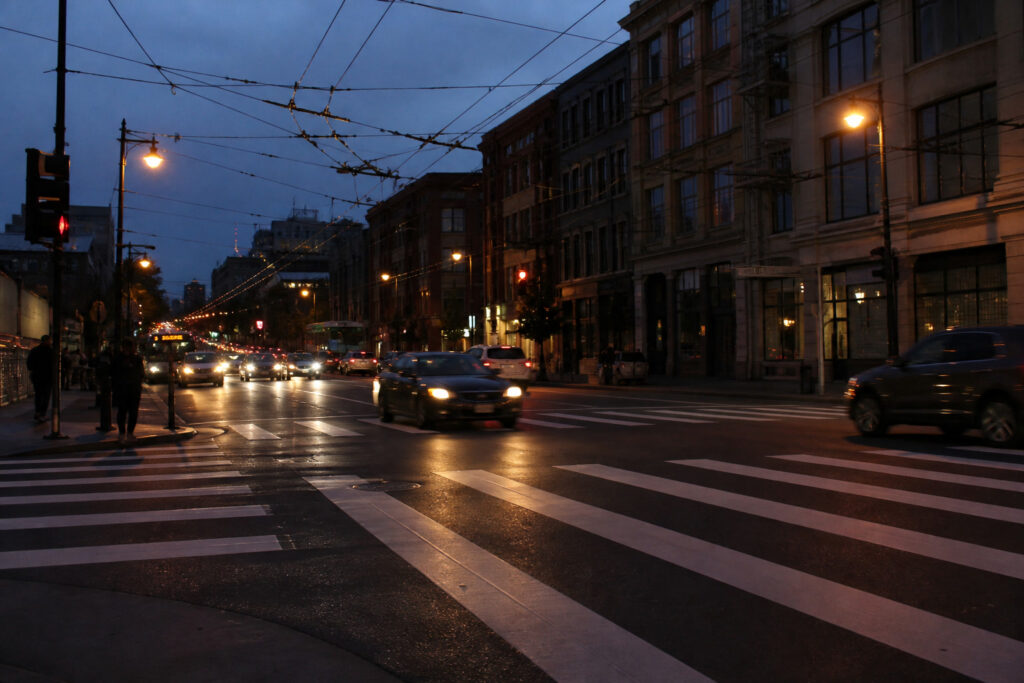
The National Highway Traffic Safety Administration’s most recent nationwide crash data shows that 77 percent of pedestrian fatalities occur in the dark, compared to 19 percent in daylight and a combined 4 percent at dawn or dusk. Broken down by time of day, the single deadliest three-hour window of the entire day is 6:00 p.m. to 8:59 p.m., accounting for 26 percent of all pedestrian deaths nationwide — more than any other block, including the overnight hours long after most commuters are home.
That window is not a coincidence. It is the evening commute, the dinner-hour dog walk, the after-school pickup. For most of the year, at San Francisco’s latitude, at least part of that window is still lit by daylight or twilight. The week of November 1, none of it is. A driver who has spent months conditioned to seeing pedestrians silhouetted against a lit sky at 5:45 p.m. is, without any change in behavior at all, suddenly driving the identical route in full darkness — and state transportation departments that track fatalities by lighting condition report the same pattern nationwide: a large majority of pedestrian deaths happen at dawn, dusk, or after dark, concentrated in exactly this kind of commute-hour window.
What the Research on Clock Changes Actually Shows
The clock change itself has been studied directly. The Insurance Institute for Highway Safety analyzed a decade of fatal-crash data surrounding both the spring and fall time changes and found that shifting the clock does not meaningfully change the total number of fatal crashes nationwide — but it does redistribute when pedestrians, cyclists, and vehicle occupants are at risk. The entire measured shift in fatal pedestrian and bicyclist crashes tied to the clock change occurred during the specific hours affected by the change in light — the exact commute-hour window described above. Pedestrian deaths nationally have risen roughly 80 percent since 2009 and now account for close to one-fifth of all traffic deaths, a trend researchers attribute in part to exactly this kind of exposure: more people walking, more low-light driving hours, and a vehicle fleet less equipped to handle either.
Why an SUV or Pickup Makes the Same Crash More Dangerous
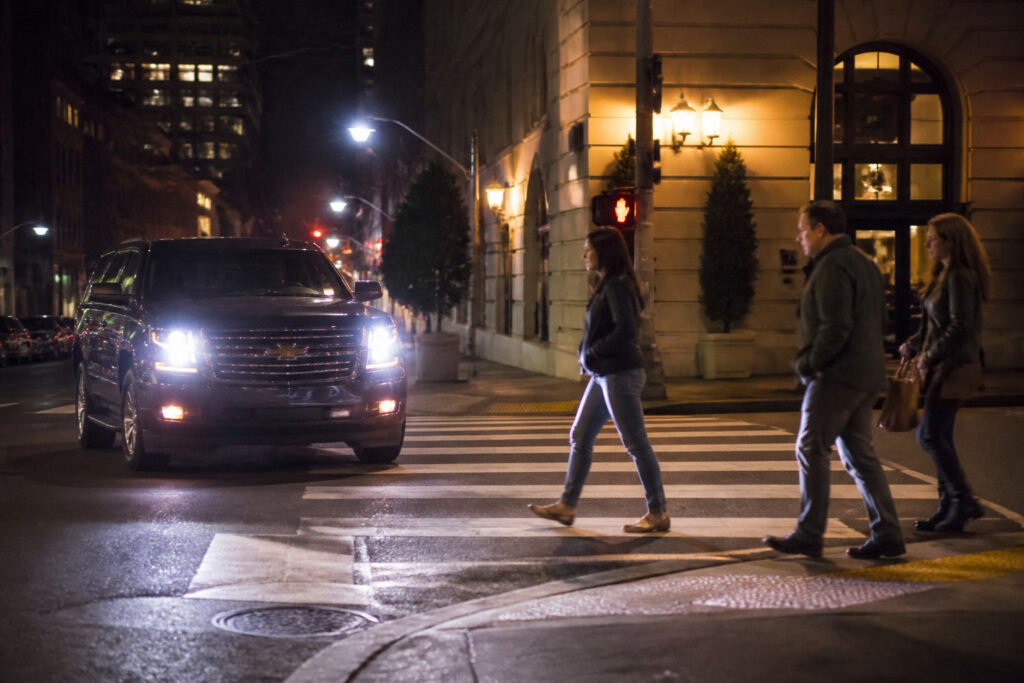
That last point matters more in the Bay Area every year, because the vehicle doing the hitting has changed even when the road hasn’t. A large 2024 study by the Insurance Institute for Highway Safety, examining nearly 18,000 real-world pedestrian crashes across almost 3,000 vehicle models, found that vehicles with hood heights above 40 inches were 45 percent more likely to cause a pedestrian fatality than lower vehicles with sloped front ends. Medium-height vehicles with blunt, vertical front ends carried a 26 percent higher risk, and flat-hood designs added another 25 percent, independent of height. A taller, blunter front end strikes a pedestrian higher on the body — closer to the torso and head instead of the legs — which is a meaningful part of why dusk and dark pedestrian strikes in a city full of SUVs and pickups so often produce catastrophic traumatic brain injury rather than a survivable leg fracture. It is also why the firm’s pedestrian TBI work — including a $6 million settlement for a San Francisco client left with a traumatic brain injury after being struck as a pedestrian — sits at the center of this practice rather than at its edge.
San Francisco Already Leads the Country in the Wrong Category
This is where the national data becomes a local problem. An SF Standard analysis of Vision Zero and city crash data found San Francisco has the highest proportion of pedestrian deaths relative to total traffic fatalities of any major U.S. city it tracked: 52.9 percent of all fatal crashes in the city involve a pedestrian, a share that has been rising since 2020 and runs nearly double the comparable rate in New York and Boston. The city logged 25 traffic deaths in 2025, down meaningfully from 43 the year before — genuine, documented progress after over a decade of Vision Zero commitments spanning three mayors. Despite that progress, the same reporting found a pattern worth tracking: San Francisco’s pedestrian fatalities keep clustering at intersections already on the city’s own Vision Zero “High Injury Network” — locations the city has already identified, and in many cases already retrofitted with safety upgrades, specifically because people have been killed there before.
Statewide, California’s Office of Traffic Safety reported 1,106 pedestrian deaths in 2023, the most recent finalized year of state data — down from 1,213 the year before, but still averaging roughly three pedestrian deaths a day across California. None of this is abstract to a firm built on representing pedestrians and their families in exactly this city.
Who’s Liable When a Driver Says They “Didn’t See” You
California law does not treat “I didn’t see them” as a defense. It treats it as an admission that the driver wasn’t keeping the lookout the law requires. California Vehicle Code § 21950 requires drivers to yield the right-of-way to pedestrians in marked and unmarked crosswalks at intersections, and separately requires every driver approaching any pedestrian in a crosswalk to exercise all due care and reduce speed or take other action necessary for that pedestrian’s safety — a duty that exists independent of who technically has the right-of-way. Darkness does not suspend that duty. If anything, it raises what “due care” requires: slower speeds, more following distance, and closer attention in exactly the conditions where an insurance adjuster — or the attorney representing them — will later argue the pedestrian simply “came out of nowhere.” Given the detection-and-stopping math above, “I didn’t see them in time” is frequently not a defense at all — it is a description of a driver traveling too fast for conditions to stop for what any driver should have expected to encounter.
Pedestrians outside a marked crosswalk are not without rights either. Vehicle Code § 21954 requires a pedestrian crossing mid-block to yield to vehicles close enough to be an immediate hazard — but the same section explicitly preserves the driver’s independent duty to exercise due care for any pedestrian on the roadway, crosswalk or not. California’s 2023 Freedom to Walk Act changed how these sections get enforced: a peace officer can no longer cite a pedestrian for crossing outside a marked crosswalk unless there was a genuine, immediate collision danger. That change carries real weight in a civil claim, because insurers have long tried to use a jaywalking citation — even a groundless one — to shift blame onto an injured pedestrian and reduce what they pay.
None of this makes fault automatic in either direction. California follows a comparative-negligence rule: if a pedestrian shares some responsibility — stepping out from between parked cars, crossing against a signal — a jury can reduce the recovery by that percentage without eliminating it. That is precisely the fight insurance adjusters pick in dusk and dark pedestrian cases, and precisely where the driver’s own duty of care under §§ 21950 and 21954, the posted speed limit, and any evidence of excessive speed for the lighting conditions become the pedestrian’s strongest answer.
When the City’s Own Lighting or Signals Are Part of the Problem
Some of these crashes are not just about a driver and a pedestrian. A pedestrian-activated crosswalk signal that has been malfunctioning for weeks. A streetlight the city has known was out since summer. A crosswalk where the striping is so faded it is nearly invisible the moment the sun goes down. When San Francisco, SFMTA, Caltrans, or another public entity is responsible for the lighting, signal timing, or visibility of the location where a crash happened, the claim is not just against the driver — it is against the government, and the rules are completely different.
Under California Government Code § 911.2, a claim against a public entity must be formally presented within six months of the incident — not the two years California generally allows for an ordinary injury claim. Miss that window and the claim against the city is very likely gone for good, no matter how clearly a known, unreported streetlight outage or a broken pedestrian signal contributed to the crash. If a lighting or signal defect played any role in a dusk or dark pedestrian accident, that six-month clock belongs on the calendar immediately — not discovered months later when it is already too late. (Full breakdown: Claims Against California Government Entities: The Six-Month Deadline.)
What to Do If You’re Hit During the Dark Commute Weeks
The weeks around the time change call for the same urgency as any serious crash, with a few details specific to low-light cases:
- Get medical care and get a police report — and make sure the report accurately records the lighting conditions at the time of the crash: dusk, full dark, streetlight functioning or not. This field gets filled in quickly and is rarely double-checked later.
- Photograph the scene at the same time of day, if you safely can. Actual lighting conditions — whether a streetlight was on, how far headlights genuinely illuminated, how visible the crosswalk striping was — are far easier to prove with same-time photos than with a daytime photo taken later that misrepresents what the driver could actually see.
- Report a malfunctioning signal or streetlight outage immediately, both to the city and to your own file. A defect reported the same week carries far more weight in a government claim than one reconstructed months later from memory.
- Get witness contact information on the spot. Evening-commute witnesses disperse quickly, and in low light, an independent witness who can describe exactly what was and wasn’t visible is often the difference in a disputed case.
- Do not accept an early settlement offer before a lawyer has reviewed the case. Insurers move quickly on dusk and dark pedestrian claims specifically because “it was dark, they came out of nowhere” is a narrative they are practiced at selling — often before an injured pedestrian has any real sense of what the claim is worth.
The days after November 1 are entirely predictable. They happen every year, at the same time, for the same reason, and they still catch drivers and pedestrians alike off guard. Trial-tested representation since 2009 means knowing exactly how insurers try to use “it was dark” against an injured pedestrian — and exactly how California law says they can’t.
Clocks fall back one hour on Sunday, November 1, 2026, moving San Francisco’s sunset from roughly 6:13 p.m. to roughly 5:12 p.m. overnight. Federal crash data shows the 6:00–8:59 p.m. window is already the deadliest three-hour block of the day for pedestrians nationwide, and the time change pushes that entire window into darkness a month or more before most drivers adjust their habits.
No — darkness does not lower a driver’s legal duty of care, it raises what that duty requires. California Vehicle Code § 21950 requires drivers to exercise all due care around pedestrians in a crosswalk regardless of lighting, which generally means adjusting speed and attention to match visibility rather than driving as though conditions were unchanged.
Often, yes. Vehicle Code § 21954 requires a driver to exercise due care for any pedestrian on the roadway regardless of location, and California’s comparative-negligence rule allows a jury to reduce — rather than eliminate — a recovery based on shared fault. Crossing mid-block does not automatically bar a claim.
That may create a claim against San Francisco, SFMTA, Caltrans, or another public entity, in addition to any claim against the driver. Claims against public entities carry a strict six-month filing deadline under Government Code § 911.2 — far shorter than the two years generally allowed for a standard injury claim.
California’s 2023 Freedom to Walk Act limits when a pedestrian can even be cited for crossing outside a marked crosswalk to situations involving genuine, immediate collision danger. Even where a citation was issued, it does not automatically defeat a civil claim against the driver — it is one factor among several a jury weighs on comparative fault.
Research from the Insurance Institute for Highway Safety analyzing nearly 18,000 real-world crashes found vehicles with taller, more vertical front ends are significantly more likely to cause a pedestrian fatality — and more likely to cause a severe brain or head injury rather than a lower-body injury — because of where on the body they strike a pedestrian.
An ordinary claim against a driver generally must be filed within two years under California’s statute of limitations. If a public entity’s negligence — a broken signal, a lighting outage, a road design defect — contributed to the crash, that portion of the claim must be formally presented within six months, a far shorter and stricter deadline.
Get medical care, get a police report that accurately reflects the lighting conditions, photograph the scene at the same time of day if it’s safe to do so, report any broken streetlight or signal to the city right away, and get witness contact information before people disperse. Talk to an attorney before accepting any settlement offer.