

John Roach, Esq. | June 3, 2026 | California Law \ Car Accidents
Rear-End Collision Lawyer in San Francisco: Who Is at Fault and How Insurance Companies Attack These Cases

You are stopped at a red light at Van Ness and Geary. A glance at the rearview mirror catches the SUV behind you closing too fast. There is a second of bracing, then the crash — and then the slow, sickening realization that something in your neck or your back is not right.
If that scene sounds familiar, you are not alone. Rear-end collisions are the most common type of car accident in San Francisco and across California. The good news for injured victims is that California law starts from a position that favors the front driver. The harder news is that insurance companies have spent decades developing a playbook to fight these cases, and most of that playbook is invisible to people who have never been through a personal injury claim before.
I represent injury victims across San Francisco and the Bay Area, and I have handled hundreds of rear-end collision claims since 2009. This post explains how fault works in California rear-end cases, the specific tactics insurance carriers use to discount or deny these claims, and what a trial-tested attorney does to push back.
California’s Rear-End Presumption: What Every Personal Injury Lawyer Knows About Fault
California Vehicle Code § 21703 — the “following too closely” statute — provides the foundation for almost every rear-end collision case in the state. It reads: “The driver of a motor vehicle shall not follow another vehicle more closely than is reasonable and prudent, having due regard for the speed of such vehicle and the traffic upon, and the condition of, the roadway.”
That statute, combined with the basic speed law at Vehicle Code § 22350, creates what most California personal injury attorneys refer to as a rebuttable presumption that the rear driver is at fault. The logic is straightforward: a driver maintaining a reasonable speed and a safe following distance would have had time to stop. The fact that the rear driver did not stop is itself evidence that something about that driver’s conduct was unreasonable.
This presumption matters in two practical ways. First, in negotiations, the insurance adjuster for the rear driver knows a jury is likely to assign fault to their insured. That changes the math on settlement value. Second, in the rare cases that go to trial, the rear-end fact pattern is one of the few that allows a plaintiff’s attorney to argue fault as a near-certainty rather than a contested issue.
But the presumption is rebuttable. It is not automatic. And that brings us to the cases where rear-end fault gets complicated.
When the Rear Driver Is Not Automatically at Fault
Insurance companies fight rear-end cases hardest when they have a fact pattern that lets them argue the front driver did something wrong. The most common scenarios:
- Sudden unjustified stop. If the lead driver slams on the brakes for no apparent reason — not for a pedestrian, not for traffic ahead, not for a hazard — the rear driver may have a comparative fault argument. The keyword is “unjustified.” Stopping for a child running into the street is not unjustified. Stopping to gawk at something on the sidewalk might be.
- Brake light failure. California Vehicle Code § 24603 requires every vehicle to have functioning stop lamps. If the lead vehicle’s brake lights were not working, the rear driver did not have the same warning a reasonable driver would expect. That shifts at least some fault to the lead driver.
- Sudden lane change followed by braking. If a driver cuts into your lane and then immediately brakes, you may not have had a meaningful following distance to maintain. This is common on I-280, the Bay Bridge, and the merges onto 101. Surveillance video, dashcam footage, and witness testimony become critical.
- Multi-vehicle chain reaction. When a third vehicle rear-ends the car behind you and pushes that car into your bumper, the middle driver may not be at fault at all. Identifying the actual point of first impact requires accident reconstruction.
Even where the rear driver bears most of the fault, California’s pure comparative negligence rule — articulated by the California Supreme Court in Li v. Yellow Cab Co. (1975) — allows defense counsel to argue the front driver was 10%, 20%, or 30% responsible. That percentage reduces the plaintiff’s recovery proportionally. Knocking down those comparative fault arguments is one of the central battles in a contested rear-end claim.
Why “Minor Damage” Doesn’t Mean “Minor Injury”
Insurance adjusters lean on one argument harder than any other in rear-end cases: if the bumper barely has a scratch, the injury can’t be serious. It’s a convenient argument for them, and it’s not how the human body actually works.
Modern bumpers are engineered to absorb low-speed impacts without visible damage — that’s the bumper doing its job, not evidence that nothing happened. The energy from the collision still has to go somewhere. In a rear-end impact, it transfers into occupant motion: your torso is pushed forward by the seat while your head, unsupported for a fraction of a second, lags behind — the acceleration-deceleration motion that causes whiplash, cervical strain, and disc injury. That motion doesn’t require crumpled sheet metal. It requires a car behind you and a body inside yours.
This is why I don’t let an adjuster’s property-damage photos set the terms of the conversation. Vehicle repair cost and injury severity are two different questions, backed by two different kinds of evidence — and I build the injury case on medical records, imaging, and (when the defense pushes hard enough) biomechanical expert testimony, not on how bad the bumper looks.
A Jury Didn’t Buy the “Minor Impact” Argument Either
I’ve tried this exact defense in front of a jury. The insurance company’s opening offer was $50,000, built on the same low-property-damage argument above. We took it to trial. The jury came back at $140,000 — nearly three times the offer — once they heard the medical evidence for what it actually was instead of what the adjuster wanted it to look like.
I’ve also taken a rear-end UIM claim to arbitration where the insurer opened at $125,000 for a client with a traumatic brain injury and PTSD; the arbitrator awarded $750,000. Different case, same pattern: insurers price these claims low at the outset, and the number moves substantially once the evidence is actually tested. Read the full case study.
Prior results don’t guarantee a similar outcome in your case — every claim turns on its own facts. But the pattern is real, and it’s why I don’t recommend accepting a first offer built on a “minor damage” argument without a real evaluation first.
Minor Damage ≠ Minor Injury: What Actually Determines Injury Severity in a Rear-End Collision
- Vehicle damage and injury severity are not directly correlated. Low-speed impacts can produce real cervical and lumbar injuries even with little to no visible bumper damage.
- The injury mechanism is occupant motion, not vehicle deformation. Whiplash results from the head lagging behind the torso during rapid acceleration-deceleration — a bumper doesn’t have to crumple for that motion to occur.
- Insurers use repair-cost photos to argue low value. That argument addresses property damage, not the medical question of whether you were hurt.
- The evidence that actually answers the injury question: medical records, diagnostic imaging, treating-physician testimony, and — in disputed cases — biomechanical expert analysis.
- A San Francisco rear-end collision lawyer who has tried these cases knows this argument is coming before the insurance company makes it, and builds the medical record to defeat it from day one.
How Insurance Companies Attack Rear-End Cases (and How a Lawyer Pushes Back)
Because fault usually favors the front driver, insurance carriers rarely fight rear-end cases on fault alone. They fight them on damages — and the tactics are predictable.
The “Low-Impact” Defense
When property damage to the vehicles is minor, insurance defense firms hire biomechanical engineers to testify that the forces involved could not have caused the injuries claimed. The argument sounds scientific. In practice it is often misleading. Bumpers can absorb force without showing damage. People with prior injuries, older adults, and people with smaller frames can suffer significant injury at speeds that leave no visible damage to the cars.
I have settled rear-end cases — including a $750,000 underinsured motorist arbitration result for a client whose at-fault driver carried a state-minimum policy — where the property damage looked minor but the medical evidence told the full story. The way to defeat the low-impact defense is documentation: contemporaneous medical records, imaging studies, and consistent treatment timelines.
The Pre-Existing Condition Argument
Insurance adjusters routinely pull years of prior medical records to argue whatever is bothering you now was bothering you before the crash. California law actually favors plaintiffs here. The eggshell plaintiff rule says a defendant takes the plaintiff as they find them. If a rear-end collision aggravated a previously asymptomatic degenerative disc condition, the at-fault driver is on the hook for that aggravation. Proving the difference between “pre-existing” and “aggravated” requires medical experts and a careful timeline.
The Gap-in-Treatment Argument
If you missed appointments, paused treatment for a few weeks, or did not seek care immediately after the crash, defense counsel will argue that proves you were not really hurt. Real life intrudes on perfect treatment records all the time. People miss appointments because they have to work, because they cannot afford copays, because they are caregiving for someone else. None of that means the injury is fake. But it does mean an attorney needs to be ready to explain those gaps before a jury sees them.
The Quick Lowball Offer
Within the first weeks after a crash, the at-fault driver’s insurance company will often call with a settlement offer that sounds reasonable. It is not. It is calculated to close the file before the full extent of the injuries is known. Soft tissue injuries take months to fully manifest. Disc injuries often do not become clear until conservative treatment has failed. Accepting an early offer means signing a release that ends your right to seek further compensation — even if the condition gets dramatically worse later.
The Recorded Statement Trap
Adjusters will ask for a recorded statement, often within days of the crash. You are not required to give one. Anything you say can and will be used to argue inconsistencies later. “I’m fine” said in shock at the scene becomes evidence that you were not really injured. “It happened so fast” becomes evidence that you cannot reliably describe what occurred.
Social Media Surveillance
Insurance defense firms monitor social media. A photo of you smiling at a birthday party becomes evidence that you were not in pain. A check-in at a gym becomes evidence that you were not disabled. Setting accounts to private helps but is not foolproof. The best practice during a personal injury claim is to assume everything you post will end up in front of a jury.
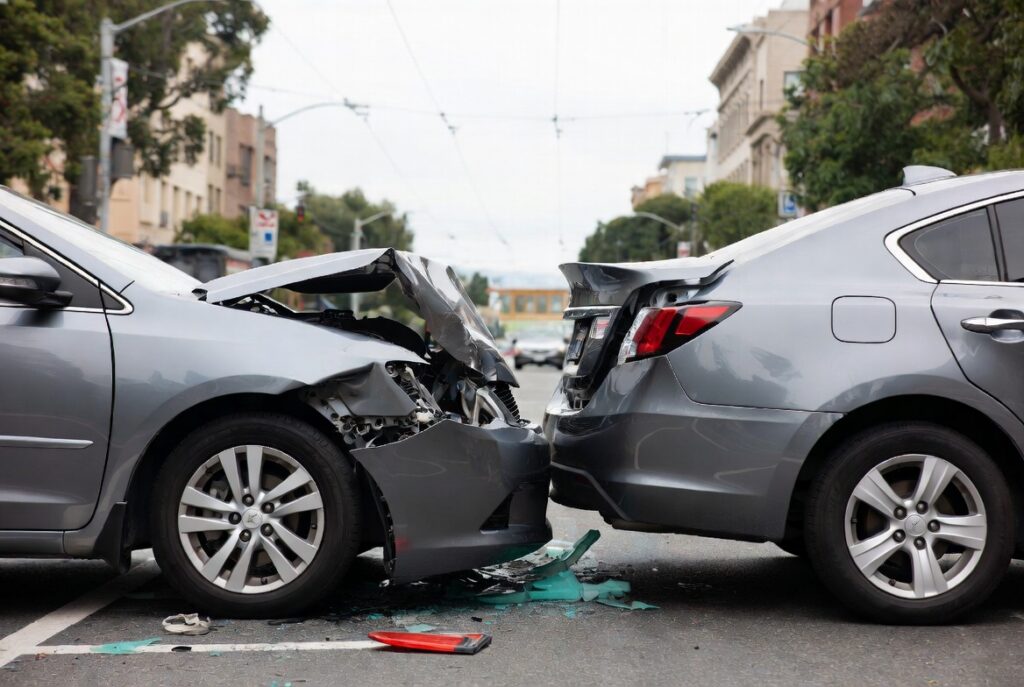
Common Rear-End Collision Injuries a San Francisco Lawyer Sees
Rear-end impacts transfer energy through the seat, the headrest, and the seatbelt in ways that produce a distinct pattern of injuries:
- Cervical strain and whiplash — the most common injury, ranging from mild muscle strain to significant ligament damage
- Cervical disc herniation or bulge — often diagnosed on MRI weeks or months after the crash when conservative treatment fails
- Concussion and mild traumatic brain injury— possible even without striking the head, because the brain moves inside the skull during the acceleration-deceleration cycle
- Lumbar disc injury — common when the seat back fails or when the body is positioned at an angle on impact
- Shoulder and seatbelt injuries — bruising, rotator cuff strain, sometimes thoracic outlet symptoms
- Wrist and hand injuries — drivers gripping the steering wheel at impact can suffer ligament tears
The catastrophic end of the spectrum includes severe traumatic brain injury and spinal cord injury. My practice has reached $6 million for a pedestrian traumatic brain injury settlement and $2.185 million for a separate brain injury matter — and many serious rear-end events produce more harm than the property damage suggests.
Why San Francisco Rear-End Crashes Need a Local Lawyer
Three features of San Francisco driving make rear-end cases here different from cases elsewhere in California.
Stop-and-go traffic. The 101 corridor, I-280, the approach to the Bay Bridge, and lower 19th Avenue all produce constant acceleration and deceleration. When traffic suddenly slows, rear-end risk spikes. These corridors generate a disproportionate share of the rear-end crashes I see.
Rideshare and delivery vehicles. San Francisco has one of the highest densities of Uber, Lyft, DoorDash, Uber Eats, and Amazon Flex drivers in the country. Many of these drivers work long hours, watch navigation apps, and rush to meet quotas. When the at-fault driver is a rideshare or delivery driver acting in the course of work, there is potentially a $1 million commercial policy available — but only if the case is built to access it.
Steep grades. San Francisco’s hills change stopping dynamics. A car following at what looks like a safe distance on flat ground can have dramatically less stopping distance on a downhill. Rear-end crashes on Nob Hill, Russian Hill, and the hills of Pacific Heights frequently involve grade as a contributing factor that drivers underestimated.
How a San Francisco Rear-End Collision Lawyer Builds Your Case
The work of a personal injury attorney in a rear-end collision case is not just paperwork. It is evidence preservation and narrative construction.
Immediate evidence preservation. Surveillance video from nearby businesses, dashcam footage, and 911 audio all have short retention windows. A preservation letter sent within days can mean the difference between solid evidence and a credibility contest.
The medical timeline. Insurance carriers value consistency. An attorney working a rear-end case will help coordinate care with providers who document thoroughly, who order appropriate imaging when conservative treatment fails, and who can articulate the connection between the crash and the diagnoses.
Expert witnesses. Biomechanical engineers, accident reconstructionists, and treating physicians all play roles in cases that do not settle on the first pass. Choosing the right experts and preparing them for cross-examination is where trial experience matters.
The $750,000 UIM example. I handled an underinsured motorist arbitration for a rear-end client where the at-fault driver carried a state-minimum policy. Standard practice in those cases is to settle for policy limits and walk away. We did not. We pursued the UIM claim against the client’s own carrier, built the medical record over the following months, retained the right experts, and ultimately recovered $750,000 in arbitration. Most rear-end cases do not need that level of intervention — but for clients whose injuries exceed the at-fault driver’s coverage, the UIM pathway is often the difference between adequate compensation and being financially stranded.

What to Do After a Rear-End Collision in San Francisco
If you have been hit from behind, the first hours and days matter:
- Call 911 and request a police report, even if the other driver wants to handle things privately
- Photograph the vehicles, the scene, and any visible injuries
- Get the names and phone numbers of any witnesses
- See a doctor the same day, even if you “feel fine” — symptoms commonly emerge over 24 to 72 hours
- Do not give a recorded statement to the at-fault driver’s insurance company
- Do not accept any settlement offer before the full extent of your injuries is understood
- Talk to a personal injury attorney before signing anything
Rear-End Collision Lawyer San Francisco: Frequently Asked Questions
No. California Vehicle Code § 21703 creates a rebuttable presumption that the rear driver was following too closely, but that presumption can be overcome. Common scenarios where the front driver bears some or all of the fault include sudden unjustified stops, brake light failure, and lane-change-then-brake maneuvers. Even when the rear driver is mostly at fault, comparative negligence rules under Li v. Yellow Cab Co. (1975) may reduce a plaintiff’s recovery proportionally.
The general statute of limitations for personal injury in California is two years from the date of the crash under Code of Civil Procedure § 335.1. Claims against government entities — including MUNI buses and city-owned vehicles — require a government tort claim filed within six months. Waiting until the deadline approaches is risky: evidence is harder to obtain, witnesses become harder to find, and insurance carriers know that time pressure favors them.
This is common, especially for soft tissue injuries, disc injuries, and concussions. Adrenaline and shock at the scene can mask symptoms for 24 to 72 hours. The legal claim is still valid, but documenting the delayed onset with medical records is critical. See a doctor as soon as symptoms appear and tell the provider when the symptoms started in relation to the crash.
California’s state-minimum liability coverage is well below what most serious-injury cases are worth. If the at-fault driver’s policy is insufficient, your own underinsured motorist coverage (UIM) can fill the gap. UIM claims are pursued against your own insurance carrier and often require arbitration. I recovered $750,000 in a UIM arbitration for a rear-end client whose at-fault driver carried a state-minimum policy.
No. You are not legally required to give a recorded statement to the at-fault driver’s insurance company. Anything you say in that recording can be used against you later — even casual phrases like “I’m okay” said at the scene. Insurance adjusters are trained to elicit statements that limit the carrier’s exposure. Speak with an attorney before any recorded contact with the other side’s insurance.
Case value depends on factors including the severity and permanence of injuries, the amount of medical treatment required, lost wages, future medical needs, available insurance coverage, and the strength of the liability case. California law does not allow attorneys to predict case values with precision, and any lawyer who quotes a number before reviewing the medical records and the police report is not giving reliable advice. A free consultation is the right starting point.
Most personal injury cases — including rear-end collisions — resolve through settlement, not trial. But the cases that produce the strongest settlement outcomes are usually the ones where the at-fault driver’s insurance company believes the plaintiff’s lawyer is prepared to try the case. I have extensive trial experience and a 9-for-9 verdict record, and I prepare every case for trial from the first intake. Settlement on favorable terms is the typical outcome, but the readiness is what produces it.
Talk to a San Francisco Rear-End Collision Lawyer About Your Case
If you have been injured in a rear-end collision anywhere in San Francisco or the Bay Area, I offer free consultations and handle every case personally — no associate handoffs. Call (415) 851-4557 or email john@representmyinjury.com to discuss what happened and what your options look like.
Si usted ha sido lesionado en un accidente automovilístico en San Francisco o el Área de la Bahía, ofrezco consultas gratuitas en español. Llame al (415) 851-4557 o escriba a john@representmyinjury.com.