
John Roach, Esq. | July 17, 2026 | California Law \ Car Accidents
Left Turn Accident Lawyer in San Francisco: Why the Turning Driver Is (Almost) Always Liable

You had the green. You were going straight through the intersection, doing everything right — and a driver coming the other way turned left directly across your path. In the half-second before impact, there was nowhere to go. If that’s your story, you’re describing the most common serious intersection crash in San Francisco, and you should know something before any insurance adjuster calls: California law was written for exactly this moment, and it is heavily on your side. As a San Francisco car accident lawyer practicing since 2009, left-turn collisions are among the clearest liability cases I handle — with a few exceptions worth understanding honestly.
What California Vehicle Code § 21801 Says About Left Turns
California Vehicle Code section 21801 governs every left turn in the state, and its rule is blunt. A driver intending to turn left must yield the right-of-way to all vehicles approaching from the opposite direction that are close enough to be a hazard — and must keep yielding until the turn can be completed with reasonable safety. The law does not ask the oncoming driver to slow down, anticipate, or make room. The entire legal burden of judging the gap sits on the turning driver. When a left-turning driver misjudges that gap and a collision follows, the violation of section 21801 is itself powerful evidence of negligence — which is why, in the large majority of left-turn crashes, fault lands on the driver who turned.
Why Left Turns Produce So Many Serious Crashes
The left turn is the hardest routine judgment in driving. The turning driver must estimate the speed and distance of oncoming traffic — a task human perception is genuinely bad at, especially with motorcycles and bicycles, whose narrow profiles make them look farther away and slower than they are. Add San Francisco’s ingredients — hills that hide oncoming cars until late, fog and dusk that flatten depth perception, the A-pillar blind spot that can swallow a pedestrian or cyclist entirely, and drivers rushing an unprotected left before the light changes — and you get the crash pattern that fills this city’s injury statistics. It’s why San Francisco’s own Vision Zero safety work has specifically targeted left-turn behavior at high-injury intersections with turn-calming redesigns: the city knows where its most dangerous turns are.
And the geometry is cruel. A left-turn crash is usually a T-bone or near-head-on — the kind of impact that produces traumatic brain injuries, spinal injuries, and fractures rather than fender damage. Even a “moderate” left-turn impact routinely causes a concussion that emergency-room scans miss.
The Physics Problem: Why Good Drivers Make Bad Left Turns
Understanding why these crashes happen matters, because the defense in a left-turn case is almost always some version of “the other vehicle came out of nowhere.” It didn’t — and perception science explains the illusion. Human vision judges the distance of an approaching object partly by how fast its image grows, which means small, narrow vehicles are systematically misjudged: a motorcycle or bicycle at 35 mph genuinely appears farther away and slower than a car at the same speed and distance. Add a driver’s brain juggling the light cycle, cross-traffic, and pedestrians, and the left turn becomes the single decision where ordinary human limits and legal duty collide. The law’s answer is unsentimental: if you cannot judge the gap, you wait. Choosing to turn anyway is the negligence.
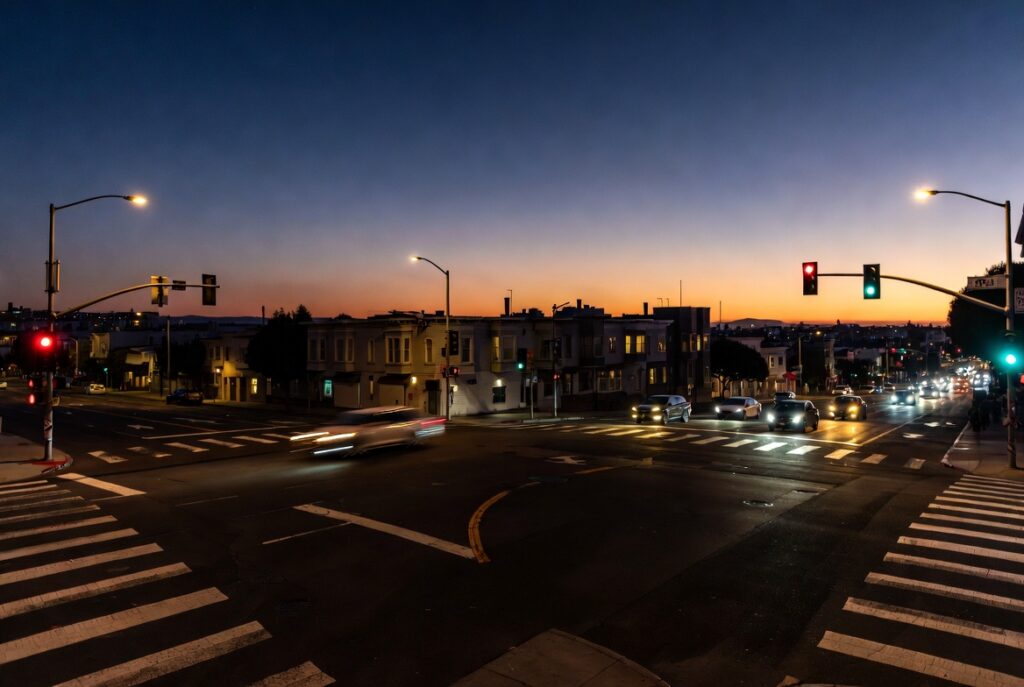
The “unprotected left” deserves its own mention, because San Francisco is full of them: a green ball with no green arrow, at a wide intersection, with a line of impatient drivers behind you. The green light permits the turn — it does not grant the right-of-way. Every driver who commits across oncoming traffic on a stale green, betting the gap will hold, is making a wager section 21801 says they alone are responsible for losing.
The (Almost): When the Turning Driver Is NOT Fully at Fault
Honesty matters here, because “almost always” is not “always.” California follows pure comparative negligence — fault is divided by percentage, and each driver’s recovery is reduced by their share. The turning driver’s presumption of fault can shift, in whole or in part, when:
- The oncoming driver was speeding significantly — a gap that was safe for traffic at the limit closes far faster at 20 over
- The oncoming driver ran a red light or entered the intersection illegally
- The oncoming driver was in a lane they had no right to be in, or passed illegally into the intersection
- A third driver “waved” the turner through and a hidden hazard emerged
Two things follow. First, if you were the driver going straight, expect the insurer to hunt for any of these to shave your recovery — even a manufactured 20% costs you real money on a serious injury. Second, if you were the turning driver and you’re being told the case is hopeless: it may not be. I evaluate both sides of these crashes, because the presumption is a starting point, not a verdict.
San Francisco’s Left-Turn Problem: Unprotected Turns, Crosswalks, and Bike Lanes
The classic Market/Octavia-style scenario — a wide, busy arterial, an unprotected left across multiple lanes, a driver committing on a stale yellow — is only the car-versus-car version. The same failed left turn is one of the deadliest events for everyone outside a car:
- Left turns across crosswalks. A turning driver’s eyes are on oncoming traffic — not on the pedestrians in the crosswalk they’re turning into, who had the walk signal. Under CVC 21950, the pedestrian’s right-of-way doesn’t disappear because the driver was busy judging a gap. These crashes produce some of the worst harm I see, including pedestrian brain injury cases.
- The left cross against cyclists. A driver turns left across the path of cyclists going straight in a bike lane — one of the two classic bike-crash geometries, and the cyclist has the right-of-way.
- Motorcycles. The “I never saw him” left turn is the signature fatal crash for motorcyclists nationwide. Not seeing a rider who was there to be seen is negligence, not an excuse.
- Rideshare left turns. A rideshare driver turning left toward a pickup pin while watching the app is a recurring version of this crash — with commercial insurance layers that change the case entirely.
Hit by a Muni Bus or City Vehicle Turning Left? Six Months, Not Two Years
Muni buses and city vehicles make left turns all day across San Francisco, and when one causes a collision, your claim falls under the California Government Claims Act. Under Government Code section 911.2, you generally must file a written government claim within six months of the injury — far shorter than the two-year deadline in an ordinary case. The same shortened clock can apply where a dangerous public intersection condition contributed to the crash. If any government vehicle or entity is in your left-turn case, talk to an attorney immediately — this deadline forgives nothing.
The Evidence That Decides Left-Turn Cases
Left-turn liability sounds automatic, but the fight is usually over the details — the gap, the speed, the light. The evidence that settles those questions disappears fast:
- Intersection and transit cameras — many SF intersections and every Muni vehicle record video, and retention windows are short
- Vehicle event data recorders — both cars’ “black boxes” capture speed, braking, and throttle in the seconds before impact
- Signal-timing records — city documentation of the light cycle can corroborate or destroy a “I had the arrow” claim
- Witnesses and 911 audio — the first spontaneous accounts, before stories harden
I send preservation demands immediately upon retention. In a left-turn case, the difference between a disputed 50/50 and clean liability is often nothing more than who secured the video first.
How Insurers Fight Left-Turn Claims
You would think insurers concede these cases. They don’t — they manage them. The playbook I see, case after case:
- The manufactured 50/50. The adjuster “finds” speed or inattention on your side and proposes splitting fault down the middle. On a serious injury, a fabricated 30-50% assignment is worth six figures to the carrier — and it evaporates the moment black-box data or video surfaces.
- The early recorded statement. Within days, before you know the extent of your injuries, they want you on tape estimating your own speed and describing the crash. Innocent guesses become impeachment material. Decline until you have counsel.
- The fast, small check. Left-turn impacts cause injuries that declare themselves over weeks — a concussion that seemed minor, a back that stiffens into a disc injury. A quick settlement before your diagnosis is complete is designed to close the claim below its value, permanently.
The counter to all three is the same: evidence secured early, medical treatment followed through completely, and a case prepared as if it will be tried.
What to Do After a Left-Turn Crash in San Francisco
- Call 911 and get a police report — in an intersection crash, the officer’s diagram and initial statements carry real weight
- Photograph both vehicles where they came to rest, the intersection, the signals, and any skid marks before anything moves
- Get every witness’s name and number — intersection crashes have witnesses, and they scatter in minutes
- Note nearby cameras: businesses, residential doorbells, transit vehicles — then tell your attorney immediately so preservation letters go out
- Get medical care the same day, even if you feel only shaken — the gap in treatment is the first thing the insurer will exploit
- Do not give any recorded statement or accept any early offer before speaking with an attorney
What Your Left-Turn Case Is Worth
Because these are angular, high-energy impacts, left-turn cases are frequently serious-injury cases — and their value turns on proving the full harm, not just the property damage. I have recovered $25 million+ for Bay Area clients across the car accident cases I handle, including a $650,000 lumbar-spine recovery, and when the at-fault driver’s policy is too small for the injuries — common with minimum-limits drivers making bad left turns — I pursue your own UIM coverage to close the gap, the way I secured a $750,000 UIM arbitration award. Left-turn crashes also produce the “invisible” injuries insurers fight hardest: if you haven’t felt right since the impact, that pattern is real, documented in the medical literature, and compensable — the same fight I take on in rear-end collisions every week.
Talk to a San Francisco Left Turn Accident Lawyer for Free
If a left-turning driver changed your life — or you were the turning driver and the insurer says you have no case — get an honest evaluation before you accept anyone’s version of fault. As a trial-tested attorney, I prepare every case for trial, which is what makes insurers pay them fairly. For Spanish-speaking clients, I handle everything personally as a direct Spanish-speaking attorney — no interpreter, no handoff. Call (415) 851-4557 or schedule a free consultation. ¿Habla español? Solicite una consulta gratuita aquí.
Frequently Asked Questions
Usually the turning driver. Vehicle Code section 21801 requires a left-turning driver to yield to all oncoming traffic close enough to be a hazard, and to keep yielding until the turn can be made safely. Violating that duty is strong evidence of negligence. Exceptions exist — an oncoming driver who was speeding, ran a red light, or was in an illegal lane can share or shift fault under California’s comparative negligence rule.
No. Even if an insurer assigns you a percentage of fault, California’s pure comparative negligence rule means you still recover — your compensation is reduced by your share, not eliminated. And speed claims are testable: vehicle event data recorders and video frequently disprove them.
Possibly. The presumption against the turning driver is a starting point, not a verdict. If the oncoming driver was speeding significantly, ran the light, or was somewhere they had no legal right to be, fault can shift partially or substantially. These cases turn on evidence — get it evaluated before accepting a denial.
Pedestrians in a crosswalk with the signal have the right-of-way under Vehicle Code section 21950, and a turning driver’s attention on oncoming traffic is not an excuse for failing to see you. These are typically strong liability cases with serious injuries.
Claims against government entities generally require a written government claim within six months of the injury under the California Government Claims Act — far shorter than the usual two-year deadline. Contact an attorney immediately.
Intersection and transit camera video, both vehicles’ event data recorder downloads, the city’s signal-timing records, and early witness statements. Most of it disappears within days or weeks unless formally preserved.
Nothing upfront. This firm works on a contingency fee basis — no attorney fees unless I recover compensation for you. The consultation is free, in English or Spanish.