

john@representmyinjury.com | February 20, 2026 | All Things Trial
Groundbreaking $8.5 Million Jury Verdict Against Uber in Sexual Assault Case: A Beacon of Hope for Victims
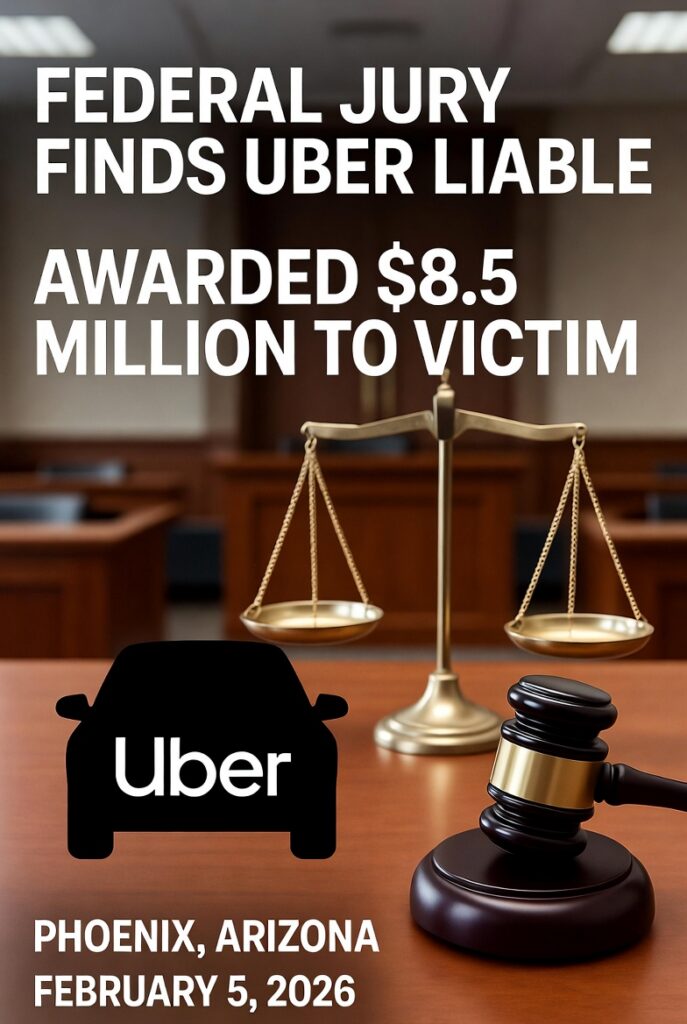
In a landmark decision that has sent shockwaves through the rideshare industry, a federal jury in Phoenix, Arizona, delivered an $8.5 million verdict against Uber in a sexual assault case on February 5, 2026. This ruling not only holds Uber accountable for the actions of one of its drivers but also reinforces the message that rideshare companies cannot hide behind independent contractor classifications to evade responsibility. For sexual assault victims, this jury verdict against Uber represents a significant step forward in the fight for justice. It builds on ongoing discussions about rideshare liability, including California’s Proposition 22. We’re here to break down what this means for you.
Understanding the Context: Proposition 22 and Rideshare Liability in California
To fully appreciate the impact of this jury verdict against Uber, it’s essential to revisit California’s Proposition 22, which was enacted in 2020. Prop 22 classified app-based drivers for companies like Uber and Lyft as independent contractors rather than employees. This provided drivers with some benefits, such as occupational accident insurance and earnings guarantees. However, it also limited traditional employee protections, potentially shielding companies from vicarious liability for drivers’ misconduct.
As we discussed in our previous blog post, “Can Uber or Lyft Be Held Liable for Driver Negligence in California After Prop 22?“, Prop 22 doesn’t offer blanket immunity. Victims of sexual assault or negligence can still pursue claims based on theories like negligent hiring, inadequate supervision, or apparent agency. Apparent agency, in particular, argues that passengers reasonably believe drivers are acting as agents of the company due to branding, app design, and operational controls. Additionally, this recent jury verdict against Uber vividly illustrates how courts are applying these principles, even in states outside California. It shows how courts pierce through corporate defenses in sexual assault cases.
Expounding on the Facts: The Jaylynn Dean v. Uber Technologies, Inc. Case
The case at the center of this jury verdict against Uber is Jaylynn Dean v. Uber Technologies, Inc., which served as the first bellwether trial in a massive multidistrict litigation (MDL No. 3:23-md-03084). This MDL consolidates over 3,000 similar sexual assault lawsuits against Uber. Bellwether trials like this one are designed to test key issues and potentially guide settlements in the broader litigation.
The Incident and Allegations
Jaylynn Dean, who was 19 years old at the time, requested an Uber ride in November 2023 from her boyfriend’s apartment in Tempe, Arizona, to her hotel. According to court documents, during the ride, the driver sexually assaulted her. This led to severe physical and emotional trauma. Dean’s lawsuit alleged that Uber was liable for the assault, citing failures in rider safety protocols and the company’s control over its drivers.
After two days of deliberation, the jury sided with Dean on the key issue of apparent agency. They found that a reasonable passenger could believe the driver was acting on Uber’s behalf, given the app’s seamless integration and branding that promotes safety and reliability. Moreover, Uber’s oversight of rides played a role. This doctrine effectively held Uber vicariously liable for the driver’s conduct.
The Verdict and Damages
The jury awarded Dean $8.5 million in compensatory damages, a substantial amount that acknowledges the profound impact of the assault on her life. However, they rejected claims of direct negligence—such as flaws in Uber’s app design or inadequate safety measures—and declined to award punitive damages. Uber has stated it plans to appeal the decision but also highlighted the jury’s rejection of punitive damages as a partial victory.
This outcome is particularly noteworthy because it’s the first time Uber has been found liable in a federal trial for failing to prevent a passenger’s sexual assault. It follows a mixed result in a California state court trial in September 2025, where a jury found Uber negligent but not liable for damages. This underscores the variability in how juries interpret these cases. The next federal bellwether trial is scheduled for April 2026, which could further shape the trajectory of the MDL.
Why This Jury Verdict Against Uber Matters to Sexual Assault Victims
This $8.5 million jury verdict against Uber is more than just a win for Jaylynn Dean—it’s a pivotal moment for sexual assault victims nationwide, offering renewed hope and stronger legal footing in their pursuit of justice. Here’s why it resonates so deeply:
Breaking Through Corporate Shields
Independent contractor statuses, like those solidified by Prop 22 in California, have long been used by rideshare companies to deflect liability. However, this verdict demonstrates that courts are willing to apply apparent agency to hold companies accountable. For victims, this means that even in states with similar laws, Uber’s branding and control can create a pathway to recovery. This could lead to more successful jury verdicts against Uber in sexual assault cases.
Spotlight on Systemic Safety Failures
The trial exposed Uber’s internal risk-detection tools and their alleged shortcomings in preventing harm. Evidence showed that despite awareness of widespread complaints—Uber has faced thousands of sexual assault reports—this incident still occurred. This verdict puts immense pressure on Uber to enhance driver screening, background checks, real-time monitoring, and response protocols. For victims, it signals a shift toward greater corporate responsibility. It reduces the risk of future assaults and empowers survivors to demand better protections.
Empowering Survivors and Influencing Future Litigation
With over 3,000 pending cases in the MDL, this bellwether verdict validates the experiences of countless survivors who have come forward at great personal risk. It boosts leverage in negotiations, potentially leading to larger settlements or industry-wide reforms. Similar litigation against Lyft is also consolidating, suggesting a broader reckoning for the rideshare sector. For sexual assault victims, this means their stories are being heard. Companies can no longer prioritize profits over passenger safety without consequences.
In essence, this jury verdict against Uber humanizes the statistics, reminding us that behind every case is a person whose life has been irrevocably changed. It fosters a culture of accountability. This encourages more victims to seek justice without fear of dismissal.
Seeking Justice? Let the Law Office of John J. Roach Guide You
If you or a loved one has suffered sexual assault or injury during an Uber or Lyft ride, you don’t have to face the legal maze alone. We fight aggressively against corporate defenses to secure the compensation you deserve for medical bills, emotional distress, and more.
Contact us today for a free, confidential consultation. Call 415-851-4557 or email john@representmyinjury.com. Let’s build on the momentum of this jury verdict against Uber and turn your story into a powerful case for change.