

John Roach, Esq. | March 23, 2026 | California Law \ Car Accidents
Truck Accidents in South San Francisco’s Industrial Zones

South San Francisco’s industrial corridors — the East of 101 area, Airport Boulevard, Produce Avenue, and the biotech and logistics zones along Sister Cities Boulevard — see some of the heaviest commercial truck traffic in the Bay Area. US-101 and I-280 funnel freight traffic through the area constantly, and proximity to SFO adds airport-related commercial vehicles to an already congested network. When serious truck accidents happen in these zones, the injuries are frequently catastrophic and the liability questions are complex.
I’m John J. Roach, a San Francisco personal injury attorney with extensive trial experience representing victims of trucking accidents throughout the Bay Area, including South San Francisco and San Mateo County. This post covers the causes of truck accidents in industrial zones, the liability framework under California and federal law, and what you need to do to protect your claim.
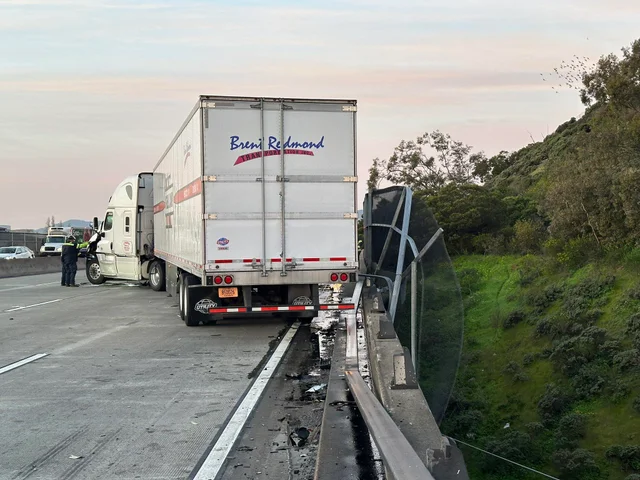
The Truck Accident Problem in South San Francisco’s Industrial Zones
California ranks second nationally for large truck-related fatalities. In 2023, California recorded 392 deaths from large truck crashes. Large trucks represent approximately 2.5% of vehicles on the road but are involved in 9.1% of fatal crashes statewide — a disproportionate death toll that reflects the physics of high-weight, high-speed collisions with passenger vehicles. The San Francisco Bay Area is among the most dangerous regions in California for truck crashes due to dense freight movement, urban congestion, and industrial zone traffic patterns.
South San Francisco’s industrial corridors amplify these risks. Trucks navigate narrow streets shared with workers on foot, forklift operators, and smaller delivery vehicles. Peak-hour congestion on Airport Boulevard and construction near US-101 and SFO access points create lane shifts, uneven surfaces, and reduced sight lines. Loading zones are tight. Truck turns are wide. And the operational pressure on drivers in logistics-heavy environments — tight delivery windows, round-the-clock scheduling — creates conditions where fatigue and shortcuts are common.
Common Causes of Truck Accidents in Industrial Zones
Driver fatigue. Federal Hours of Service regulations exist for exactly this reason — long haul and local delivery drivers operating on tight schedules routinely push against or past legal limits. Fatigue impairs judgment and reaction time as severely as alcohol. In high-pressure logistics hubs like South San Francisco, violations are common and the consequences are serious.
Overloaded or improperly secured cargo. Warehouses and distribution centers in the East of 101 area handle heavy industrial and pharmaceutical loads. An improperly secured load can shift during transit, causing rollovers, jackknifes, or debris spills on roadways. Load securement violations are federally regulated and can support direct liability against the carrier or shipper.
Distracted driving and speeding. Congested industrial routes encourage rushing. Phone use, GPS navigation, and in-cab technology distractions reduce reaction times in environments where workers and pedestrians are frequently present in loading areas and street-level zones.
Mechanical failures and poor maintenance. Brake failures, tire blowouts, and steering defects are disproportionately common in commercial trucking because the vehicles are under constant heavy use. Federal regulations require carriers to maintain inspection records and conduct pre-trip inspections. Failure to do so — or falsifying records — creates both negligence and potential punitive damages exposure.
Blind spots and inadequate training. Large commercial trucks have extensive no-zones on all four sides. Drivers who have not been properly trained to manage these blind spots, or who have been rushed through inadequate orientation by a carrier pushing volume over safety, are a foreseeable hazard in industrial zones where workers move between trucks on foot.
Who Is Liable in a South San Francisco Truck Accident?
Truck accident liability is often more complex than a standard car accident case because multiple parties can be simultaneously responsible — and the evidence required to establish each party’s role is heavily regulated by federal law.
The driver is liable for negligent operation — fatigue, distraction, speeding, or failure to observe safety rules. The trucking company may be vicariously liable for the driver’s conduct under respondeat superior, and directly liable for negligent hiring, inadequate training, or failure to maintain the vehicle. The cargo owner or shipper may be liable if improper loading contributed to the accident. A maintenance company may be liable if faulty repair work caused a mechanical failure. And truck manufacturers may be liable under product liability theories if a defective component caused or contributed to the crash.
Identifying all liable parties requires early and aggressive evidence preservation — electronic logging device data, maintenance records, driver qualification files, trip logs, cargo manifests, and black box data. Trucking companies are required to preserve this evidence after an accident, but spoliation is a real risk. I send litigation hold letters immediately after being retained to protect that evidence before it is overwritten or destroyed.
Federal Trucking Regulations and Why They Matter
Commercial trucking is regulated by the Federal Motor Carrier Safety Administration (FMCSA). FMCSA regulations govern hours of service, driver qualification and licensing, vehicle inspection and maintenance, load securement, and drug and alcohol testing. When a carrier or driver violates these regulations and that violation contributes to an accident, it is evidence of negligence — and in cases of systematic violations or willful disregard of safety rules, it can support a punitive damages claim.
Obtaining the carrier’s FMCSA compliance history, inspection records, and safety rating is one of the first steps in any serious truck accident investigation. A carrier with a pattern of Hours of Service violations or out-of-service brake defects is a very different defendant than a carrier with a clean record — and that difference affects both liability and damages.
What to Do After a Truck Accident in South San Francisco
Call 911 immediately and request medical evaluation even if you feel uninjured. Traumatic brain injuries and spinal injuries from truck collisions frequently produce symptoms that worsen hours after impact. Photograph everything at the scene — truck markings, license plate, company name, DOT number, vehicle damage, road conditions, skid marks, and your injuries. Get witness contact information. Do not give a recorded statement to the trucking company’s insurer before consulting an attorney.
Report the accident to the California Highway Patrol — on US-101 or I-280, CHP has jurisdiction. The police report documents the parties, the scene, and any citations. Notify your own insurer of the accident but do not provide a detailed statement until you have legal representation in place.
California’s statute of limitations for personal injury claims is two years from the date of the accident. But the evidence preservation window is far shorter — electronic logging device data and dashcam footage can be overwritten within days. Contact an attorney as soon as possible after any serious truck accident.
If you were injured in a truck accident in South San Francisco or anywhere in the Bay Area, call me at (415) 851-4557 for a free consultation. I work on a contingency fee basis — you pay nothing unless I recover money for you. I am bilingual in English and Spanish.
Frequently Asked Questions: Truck Accidents in South San Francisco
Multiple parties can be simultaneously liable in a truck accident — the driver for negligent operation, the trucking company for vicarious liability and direct negligence in hiring and maintenance, the cargo owner or shipper if improper loading contributed, a maintenance company if faulty repairs caused a mechanical failure, and the truck manufacturer under product liability if a defective component was involved. Identifying all liable parties requires early evidence preservation — electronic logging device data, maintenance records, driver qualification files, and black box data — which is why retaining an attorney immediately after a serious truck accident is critical.
Commercial trucking is regulated by the Federal Motor Carrier Safety Administration (FMCSA). FMCSA regulations govern hours of service, driver qualification and licensing, vehicle inspection and maintenance, load securement, and drug and alcohol testing. When a carrier or driver violates these regulations and that violation contributes to an accident, it is evidence of negligence — and in cases of systematic violations or willful disregard of safety rules, it can support a punitive damages claim. Obtaining the carrier’s FMCSA compliance history and safety rating is one of the first steps in any serious truck accident investigation.
Two years from the date of the accident under California Code of Civil Procedure Section 335.1 for personal injury claims. However, the evidence preservation window is far shorter — electronic logging device data and dashcam footage can be overwritten within days. Litigation hold letters must be sent immediately to the carrier to prevent spoliation. Contact an attorney as soon as possible after any serious truck accident, regardless of the two-year legal deadline.
A successful truck accident claim can recover medical expenses from the emergency room through the end of treatment, future medical costs including surgery and rehabilitation, lost wages and future lost earning capacity, non-economic damages for pain and suffering and loss of enjoyment of life, and property damage. In cases involving willful violations of FMCSA regulations or systemic carrier safety failures, punitive damages may also be available. California follows pure comparative negligence — you can recover even if you were partially at fault, with your award reduced by your percentage of fault.
Electronic logging device (ELD) data showing the driver’s hours and duty status at the time of the crash; black box data including speed, braking, and throttle inputs in the seconds before impact; driver qualification files including training records and prior violations; maintenance and inspection records; cargo manifests and load securement records; dashcam footage from the truck; FMCSA compliance history and safety rating of the carrier; and witness statements. This evidence must be preserved immediately — send a litigation hold letter to the carrier as soon as possible after a serious accident.
Disclaimer: This blog post is for informational purposes only and does not constitute legal advice. Consult a licensed attorney for advice specific to your situation.




