

John Roach, Esq. | August 21, 2026 | California Law \ Car Accidents
Amazon Flex Driver Injured in San Francisco? A Delivery Accident Lawyer Explains Your Rights When the App Says You’re “Independent”

You accepted a delivery block, loaded your car at the station, and somewhere between a pickup and a doorstep across the city, a crash upended everything — the emergency room, the missed blocks, the income you were counting on. Then you started reading the fine print and hit the wall every Flex driver hits: the word “independent.” Amazon’s position, from the first phone call, is that you run your own business, so the crash is your problem and your small personal auto policy’s problem — not Amazon’s. As a San Francisco attorney who has handled gig-economy and rideshare accident representation since 2009, let me be direct with you: that label is Amazon’s opening move, not the last word on what you can recover.
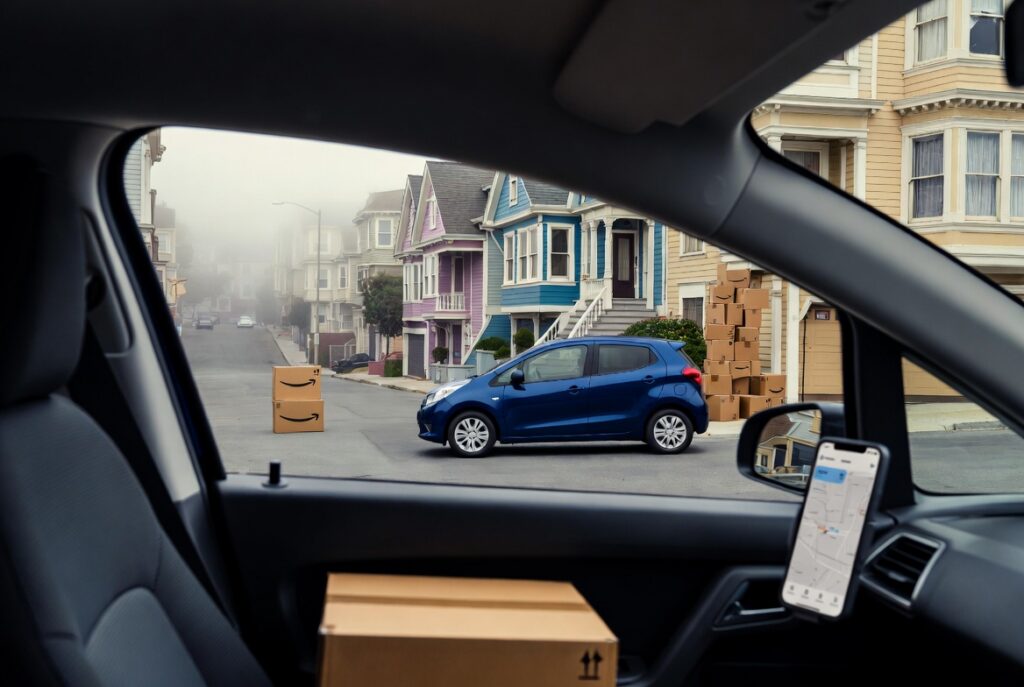
The “independent contractor” designation is a labor classification. It is not a liability shield, and it does not decide who pays for your injuries.
Whether you were hit by another driver, hurt in a single-car crash under the pressure of an impossible route, or injured by a hazard in the road, you likely have more than one source of recovery — and one of them is a seven-figure policy most Flex drivers never learn exists. Here is how it actually works in California, and where the real leverage is.
The One Thing That Decides Everything: What “Phase” You Were In
Amazon carries a commercial auto policy (issued through Zurich, though carriers can change) that turns on and off depending on what you were doing in the app. Which “phase” you were in at the moment of impact often matters more than who was at fault. There are three:
- Phase 1 — logged out, or logged in with no block accepted: You are on your personal policy. Amazon’s coverage generally does not apply.
- Phase 2 — logged in and waiting between deliveries: A gray zone. Amazon frequently argues limited or no coverage, and your personal insurer often denies at the same time for “commercial use.” This is where drivers get squeezed from both sides.
- Phase 3 — actively delivering (packages in your car, the app in use, including the return trip to the station): Amazon’s full commercial policy applies — up to $1 million in third-party liability, up to $1 million in uninsured/underinsured motorist coverage, and contingent comprehensive and collision on your vehicle if your personal policy carries those coverages.
If you had packages in the car and the app open when you were hit, you were almost certainly in Phase 3 — and Amazon’s $1 million policy is in play, no matter what the first adjuster tells you.
If Another Driver Caused Your Crash: Two Big Pockets, Not One
When someone else’s negligence put you in the hospital, the “independent contractor” question barely matters to your recovery. You have a full personal-injury claim against the at-fault driver — medical bills, lost income, future care, and pain and suffering — exactly like any other injured motorist. Delivery crashes are often violent, high-energy impacts that produce severe traumatic brain injury, spinal damage, and the kind of rear-end crashes that leave lasting harm, so full, well-documented recoveries matter.
Here is the part that surprises people. If the driver who hit you had no insurance or not enough of it — and you were in Phase 3 — Amazon’s own $1 million uninsured/underinsured motorist coverage steps in to protect you. That is the moment the “big pocket” quietly becomes yours. Most injured Flex drivers never learn their delivery platform carries a seven-figure UM/UIM policy that covers them personally. I have secured results including the $750,000 UIM arbitration result for an injured client, and that same UM/UIM analysis is the first thing I run in a Flex case.
The Personal-Policy Exclusion Trap
Now the cruel twist. Almost every standard personal auto policy contains a “livery” or commercial-use exclusion. If you were delivering when the crash happened, your own insurer can deny your medical-payments and uninsured-motorist coverage on the ground that you were driving for money. So the exact activity that switches Amazon’s coverage on — making deliveries — is the activity your personal insurer uses to switch yours off.
Two lessons follow. First, do not let a personal-policy denial convince you that you have no coverage; in a delivery crash, Amazon’s policy is frequently the backstop your own insurer just refused to be. Second, going forward, a delivery or rideshare endorsement on your personal policy closes this gap for a few dollars a month — a fix worth making before your next block. If you also drive for Uber or Lyft, the same Prop 22 coverage gaps apply, and the endorsement protects you across every platform.
Prop 22 Benefits: What You’re Owed Regardless of Who Was at Fault
Proposition 22 is the law that classified app-based drivers as independent contractors — and the California Supreme Court upheld it. But Prop 22 also requires the platforms to carry occupational accident insurance for drivers hurt on the job. Amazon Flex is covered. If you were injured while online and available for deliveries, you can generally claim, no matter who caused the crash:
- Up to $1 million in medical expense coverage for the injury.
- Disability payments equal to 66% of your average weekly earnings across all app platforms over the prior 28 days.
- An accidental-death benefit for a driver’s family in the worst cases.
Understand what this is and is not. Occupational accident insurance is a no-fault floor — it pays medical and a slice of lost income without you proving anyone was negligent. It is not workers’ compensation and it is not a full injury claim: it does not pay for pain and suffering, it does not replace your full wages, and it is capped. So you pursue it in parallel with your fault-based claims, not instead of them. The Prop 22 benefit and a third-party claim stack; they are separate buckets, and leaving either on the table costs you money.
The Big-Pocket Question: Making Amazon Answer for the “Independence” It Designed
Amazon engineered the independent-contractor structure precisely to keep its name off your crash, and Prop 22 reinforced the labor classification. But here is the nuance that changes the strategy: Prop 22 says nothing about a company’s liability in tort for what happens on the road. It contains no provision immunizing the platform from responsibility for a driver’s conduct. The label is contestable, and there is more than one route to the deep pocket.
1. Amazon’s own commercial policy — the practical route
Often you do not need to win a control fight at all. You prove Phase 3 and access the $1 million policy directly. For a huge share of these cases, that is the whole ballgame — which is why the evidence question below is the real battle.
2. Agency and respondeat superior — despite the label
The contract label does not control; the reality of control does. Amazon dictates your route, your delivery windows, your scan-and-photo protocols, your customer-contact rules, and your performance metrics — and it can deactivate you at will. That is the fingerprint of an employer directing an operation, and it is the argument that the “independent” business is, in substance, Amazon’s. Where the facts support it, that reality is the lever to reach Amazon beyond the auto policy.
3. Direct corporate negligence — the quota-and-algorithm theory
This is the strongest emerging path, and it is about Amazon’s own conduct, not the driver’s status at all. When a platform sets package quotas and delivery windows so tight that speeding, skipped breaks, and driving fatigued become the predictable cost of hitting them — and a crash results — that is a design choice with foreseeable consequences. A direct-negligence claim built on Amazon’s routing and quota system does not depend on the contractor label, because it targets what Amazon did, not what the driver was called. For an injured Flex driver, this theory can reach Amazon even in a single-vehicle crash where the platform’s demands helped cause the wreck.
4. Negligent hiring, retention, and supervision — and ostensible agency
If Amazon kept a driver on the platform it knew or should have known was dangerous, that is Amazon’s negligence. And because customers summon and trust the Amazon brand — not an anonymous contractor — ostensible-agency and non-delegable-duty arguments give additional routes to the company where the facts fit. These are not automatic, but in the right case they are real leverage.
The strategic point that ties it all together: the same app data that defeats a coverage denial — proving you were actively delivering — is the same evidence that shows Amazon’s control. You build both cases from the same file, starting on day one.
Proving You Were “Actively Delivering”: The App-Data Battle
Everything above turns on one factual question: what were you doing in the app at the instant of impact? The proof lives on Amazon’s servers — block acceptance, login and logout timestamps, package scans, in-transit pings, your assigned itinerary, and delivery-completion records. That data can be overwritten, and a winnable Phase 3 claim gets quietly argued down to Phase 2 when it disappears. So the sequence matters: screenshot everything you can from your phone immediately — the block, the route, the open delivery — and then have a lawyer send a preservation (spoliation) letter fast to lock down Amazon’s records before they cycle. Waiting is how the strongest evidence in your case evaporates.
If You Were Hit BY an Amazon Flex Driver
The analysis runs the same way in reverse. If a Flex driver hit you — whether you were another motorist, a cyclist, or a pedestrian in a crosswalk — the first question is what phase that driver was in. If they were actively delivering, Amazon’s $1 million liability policy covers your injuries; if they were off the clock, you are on the driver’s personal policy and, when that is thin, your own uninsured-motorist coverage. And the big-pocket theories above apply with even more force here: when Amazon’s own routing pressure pushes a driver to speed through a neighborhood and a stranger pays the price, the case against the company is stronger, not weaker. In the worst cases, when a delivery crash causes the loss of a family member, those same deep-pocket questions decide whether a grieving family is made whole.
A Trap for City Streets: The Six-Month Government Deadline
Delivery drivers cover more San Francisco miles than almost anyone, which means public property is often part of the story. If a dangerous road condition — a defective city street, an unmarked hazard, a poorly designed intersection — or a government vehicle contributed to your crash, you may have a claim against a public entity such as the City, the SFMTA, or Caltrans.
A claim against a California public entity carries a hard six-month filing deadline under Government Code §911.2 — far shorter than the two-year deadline for an ordinary injury claim. Miss it, and that claim is gone for good, no matter how strong it was.
This deadline comes up more often than drivers expect, and by the time most people think to ask about it, weeks have already been lost. It is one more reason not to wait to have the crash evaluated.
Why This Case Needs a Lawyer Who Knows the Gig Playbook
Flex cases reward early, aggressive work: locking down the app data, naming every insurance layer — the at-fault driver, Amazon’s commercial policy, Prop 22 benefits, and your own UM/UIM — and developing the control-and-quota record before it fades. This is the same discipline that governs every $1 million commercial policy delivery case I handle. I prepare each matter as if it will be tried, which is what produces full settlements — with a 9-for-9 verdict record, extensive trial experience since 2009, and results including the $6 million pedestrian TBI settlement among more than $25 million recovered for Bay Area clients. Delivery and gig crashes are among the crashes I see most often on city streets, and holding the platform accountable is exactly the kind of fight I take on.
For Spanish-speaking drivers, I handle everything personally as a direct Spanish-speaking attorney — no interpreter in between — with representación bilingüe en San Francisco and full guidance on Prop 22 cobertura for repartidores and rideshare drivers alike. These are exactly the car accident cases I handle across San Francisco.
Talk to a San Francisco Delivery Accident Lawyer for Free
If you were hurt driving for Amazon Flex — or hit by someone who was — do not accept the “you’re independent, it’s your problem” answer at face value. There is almost always more coverage on the table than the first adjuster admits. Call (415) 851-4557 or talk to a personal injury attorney in a free, confidential consultation. Se habla español.
Frequently Asked Questions
During an active delivery block — packages in your car and the app in use — Amazon’s commercial policy applies, including up to $1 million in uninsured/underinsured motorist coverage that can protect you if another driver caused the crash and had too little insurance. Outside active delivery, coverage is limited or falls to your personal policy.
No. “Independent contractor” is a labor classification, not a liability shield. It does not stop you from bringing a claim against an at-fault driver, tapping Amazon’s insurance, or claiming Prop 22 benefits — and in the right case, from pursuing Amazon directly.
It is a no-fault benefit the platforms must provide. It generally pays up to $1 million in medical expenses plus disability equal to 66% of your average weekly earnings across platforms over the prior 28 days, with an accidental-death benefit. It is not workers’ comp and does not pay pain and suffering, so it is a floor, not your full recovery.
If you were actively delivering, Amazon’s $1 million uninsured/underinsured motorist coverage may pay for your injuries. Your own UM/UIM may also apply, though a personal policy can deny for commercial use — which is why Amazon’s coverage is often the key backstop.
Often not. Standard personal policies contain a commercial-use or “livery” exclusion and can deny coverage because you were delivering. A delivery or rideshare endorsement closes that gap going forward and is inexpensive.
Sometimes, yes. Beyond Amazon’s insurance, there are theories to reach the company directly — agency based on the control Amazon exercises, and direct negligence where Amazon’s quotas and routing pressure foreseeably cause dangerous driving. These are fact-specific and require the app and operational records to prove.
Through the app data on Amazon’s servers — block acceptance, login/logout times, package scans, in-transit pings, and delivery records. Screenshot what you can immediately, then have a lawyer send a preservation letter quickly so those records are locked down before they are overwritten.
Generally two years from the injury for a personal-injury claim. But if a public entity contributed — a dangerous road condition or a government vehicle — you may have only six months to file a government claim under Government Code §911.2. Because deadlines vary, it is best to have your case evaluated right away.