

As with most of my case results, I’m telling this story with my client’s identity fully protected — no name, no identifying details, no medical record excerpts beyond what’s needed to explain how the case was actually won.
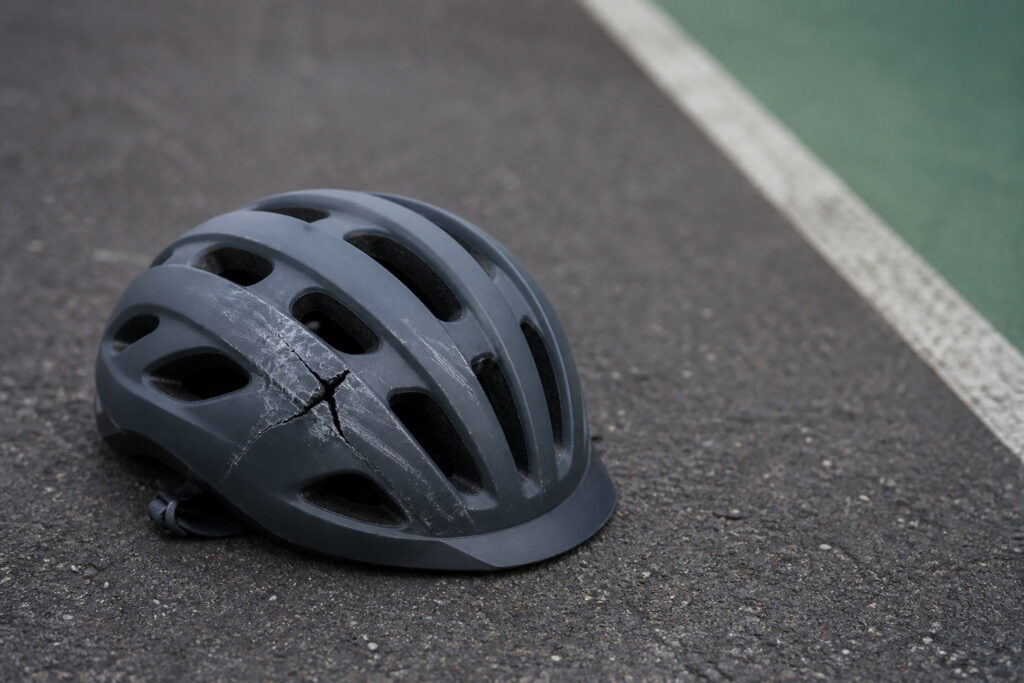
My client had the right of way. He was riding his bike through an intersection, wearing a helmet, doing everything correctly, when a driver making a left turn from the opposite direction cut across his path and hit him. The force of the collision launched him over the hood of the car. He landed on the back of his head hard enough to crack his helmet.
The insurance company never seriously disputed who caused the crash — liability was stipulated outright, on paper, early in the case. What they disputed — for two years, through more than a dozen depositions, all the way to the eve of trial — was whether my client’s brain injury was still real by the time anyone was asking them to pay for it.
The Injury Nobody at the Scene Diagnosed
At the emergency room that day, my client was treated for a cut on his hand. No one ordered a CT scan of his head. No loss of consciousness was documented. On paper, it looked like a bicycle accident with a hand injury.
It wasn’t. Within 48 hours he had a pounding headache, trouble focusing, and a request in to his manager for time off — “not able to really focus, have headaches,” he wrote, adding that he’d cracked his helmet in the fall. His own doctor, whom he saw two days later, diagnosed a concussion and ordered an urgent brain MRI, noting that the ER’s failure to scan him had left an open question that needed answering. That MRI came back clean by the radiologist’s formal read — no bleeding, no visible injury. It’s the kind of result an insurance company loves to see, because to most people, “normal MRI” sounds like “nothing happened.”
It’s also, on its own, close to meaningless in a case like this. My retained neurologist reviewed the same imaging and found something the radiology report’s summary hadn’t flagged: lesions in the frontal lobe white matter consistent with diffuse axonal injury — the microscopic shearing of nerve fibers that happens when the brain moves violently inside the skull, the way it does when a cyclist launches over a car and lands on the back of his head. It doesn’t show up as a lesion you can point to and say “there.” It shows up as a pattern, one you need a specialist looking for it to find.
Symptoms an Insurance Company Would Rather You Didn’t Notice
Over the following weeks, the picture got worse, not better. Nausea and vomiting whenever he tried to ride a bike or play the sports he used to play without thinking about it. Headaches that came with sensitivity to light and noise. A fog that made ordinary thinking feel like it took more effort than it used to. Balance problems his own physical exams documented — measurable unsteadiness standing heel-to-toe with his eyes closed. Sleep disruption. A short temper he’d never had before, confirmed by the people closest to him. Eventually, a formal diagnosis of post-traumatic stress disorder, tied directly to the crash by more than one evaluator.
None of this was invented after a lawyer got involved — which mattered, because that’s always the insurance company’s next move: suggest the symptoms are exaggerated, or coached, or convenient. In this case, the record that undercut that argument had already been written, in my client’s own words, to his own employer, days after the crash and before he’d ever spoken to an attorney: he was struggling to concentrate, he had a doctor’s note, he needed the rest of the week. You can’t coach a Slack message sent to your boss two days after a bike accident. It’s simply what was happening to him in real time — and it’s a small window into how much this injury cost him at work before it ever became a legal case, well before anyone was calculating what that lost time and lost focus were actually worth.
There was something else, too — footage my client happened to take at the scene, the kind of thing people do reflexively after a crash without thinking about why. My expert reviewed it and testified to what it showed: a man walking past his own bicycle, twice, without picking it up; not registering that the car that hit him was the one still sitting there; general, visible disorientation in the minutes after the impact. Nobody had to describe what a concussion looks like. The video already showed one.
What the Insurance Company Argued Instead
The defense built its position around a single early note in the medical record — from about two weeks after the crash — stating that his symptoms had “gradually improved.” They wanted that one line to be the end of the story: a brief concussion, resolving normally, fully behind him within a matter of weeks.
The next eighteen months of records said otherwise. A sports medicine specialist tracking his recovery documented a symptom checklist that, if anything, got worse before it got better — fifteen distinct post-concussion symptoms at one visit, twenty-one at the next, with total severity scores in a range that specialist would only expect to see in an unresolved injury, not a healing one. A neurologist he saw nearly a year out documented ongoing headaches, dizziness on standing, disrupted sleep, and cognitive complaints serious enough to affect his work performance. Formal neuropsychological testing — not just his own expert’s, but testing done through the claims process itself — measured him in the bottom seventh to sixteenth percentile on tests of mental flexibility and reasoning, a result my expert was able to point to directly as consistent with the same diffuse axonal injury he’d already diagnosed from the imaging. When the numbers meant to support the defense’s position instead matched my expert’s diagnosis almost exactly, that was not a coincidence I let go unmentioned.
I put that disagreement in front of a mediator once, formally, well over a year into the case. It didn’t move the insurance company off its position. Mediation failed, and the case kept going exactly as it had been: toward a jury.
A Case Built to Go the Distance
Because liability was never seriously contested — the defendant ultimately stipulated to it outright — this case was always going to be decided on one question: how much was this injury actually worth. That meant the only way to win it was to make the injury impossible to minimize, and that meant treating it, from early on, as a case headed for a jury.
Getting there meant more than a dozen depositions — treating providers, retained experts, and my client himself. Between the two sides, ten retained experts were involved in this case: neurologists, neuropsychologists, and vocational specialists, all ultimately arguing over a single question none of them could fully agree on: how much of this was still real, two years out. I built the medical timeline into a single, coherent chronology spanning more than two years — every visit, every note, every test result, in order, so that the pattern of a real, lasting injury was impossible to obscure behind any one favorable-sounding line the defense wanted to isolate. I had my expert examine the defense’s own evaluators’ data rather than simply contest it, because numbers an insurance company’s own expert generated are far harder for that insurance company to argue around than numbers I generated myself.
And I prepared the case on the assumption that a jury would hear all of it — because an insurance company negotiates very differently once it believes that’s actually going to happen. That preparation wasn’t abstract. Two weeks before trial, I filed 53 trial exhibits, including three custom medical animations built to walk a jury through exactly what diffuse axonal injury is and how it happened in this collision — the same explanation my retained neurologist gave in his deposition, translated into something twelve strangers with no medical background could watch and understand in thirty seconds.
The case went all the way to the eve of trial. The court had already ruled on the pretrial motions that would decide what evidence the jury would and wouldn’t hear. The jury pool hadn’t been called in yet. That is exactly the moment an insurance company’s confidence is most tested — after every procedural advantage it hoped for has already been decided, with nothing left between it and twelve strangers except its own case, the animations it had just seen filed, and two years of documentation it had never been able to explain away. The insurance company settled for $1.7 million rather than find out what that jury would have done with all of it.
Frequently Asked Questions
If the emergency room didn’t diagnose a concussion, does that mean there wasn’t one?
No. Emergency rooms are built to rule out immediately life-threatening injuries, not to diagnose the full extent of a concussion or mild traumatic brain injury, which often develops and worsens over the days that follow. A clean ER visit is not the same thing as a clean bill of health.
Can messages I sent to my employer or friends right after an accident actually help my case?
Often, yes — more than people expect. Contemporaneous records created before any attorney is involved are difficult for an insurance company to dismiss as exaggeration, because there was no incentive to exaggerate at the time they were written. If you’re dealing with a serious injury, save everything: texts, messages, even casual notes describing how you felt in the days after.
What does it mean when a defendant “stipulates to liability”?
It means the defendant formally agrees they were at fault, taking the question of who caused the accident off the table entirely. When that happens, the entire case turns on the extent and value of the injury — which is exactly why the medical and expert evidence has to be built as though it’s the only thing standing between you and a fair result, because it is.
If mediation fails, is the case basically over?
No — for a case being prepared for trial the way this one was, an unsuccessful mediation is a data point, not an ending. It confirms the two sides are still far apart on value, and the response is to keep building the trial record rather than lower the number to chase a settlement. That approach is exactly what eventually moved this case from a contested mediation to a $1.7 million resolution on the eve of trial.
If you or a family member suffered a brain injury or other serious harm as a cyclist, and the insurance company is arguing your symptoms don’t add up to what your doctors say they do, call my office at (415) 851-4557 for a free consultation. I handle every significant case personally. Ofrecemos consultas gratuitas en español.
This case is one example from my broader record of results. For more on how brain injuries are proven when the imaging looks clean, see my guide to mild traumatic brain injuries and my page on bicycle accident claims. Past results do not guarantee a similar outcome in your case — read my full disclaimer.