

john@representmyinjury.com | March 16, 2026 | Car Accidents
Immediate Steps After a Car Accident on Oakland’s I-880
If you’ve just been involved in a car accident on Oakland’s bustling I-880, the moments immediately following can feel overwhelming. This freeway, known for its heavy traffic and frequent collisions, sees thousands of drivers navigating its lanes daily. Knowing the right steps to take can protect your health, your rights, and your potential claim. As a car accident lawyer in Oakland, I’ve helped countless clients recover from incidents on this notorious stretch of highway. In this how-to guide, we’ll walk through the essential actions to prioritize evidence collection and police reports, helping you build a strong foundation for any legal or insurance proceedings.
Oakland’s I-880, also called the Nimitz Freeway, is a vital artery connecting the East Bay to San Francisco and beyond. Unfortunately, it’s also a hotspot for accidents due to congestion, construction zones, and high-speed merges. According to recent data from the California Highway Patrol (CHP), I-880 ranks among the state’s most dangerous freeways, with hundreds of reported crashes annually in Alameda County alone. Whether it’s a rear-end collision near the Oakland Coliseum or a multi-vehicle pileup during rush hour, acting swiftly is crucial. This guide is designed for those searching for “what to do after a car accident in Oakland,” focusing on practical, step-by-step advice to capture post-accident details effectively.
By following these steps, you’ll not only ensure your safety but also gather the evidence needed to support your case. Remember, consulting a car accident lawyer in Oakland early can make all the difference in navigating California’s at-fault insurance system and pursuing compensation for injuries, lost wages, or vehicle damage. In an at-fault state like California, proving the other driver’s responsibility is key to recovering from their insurance.
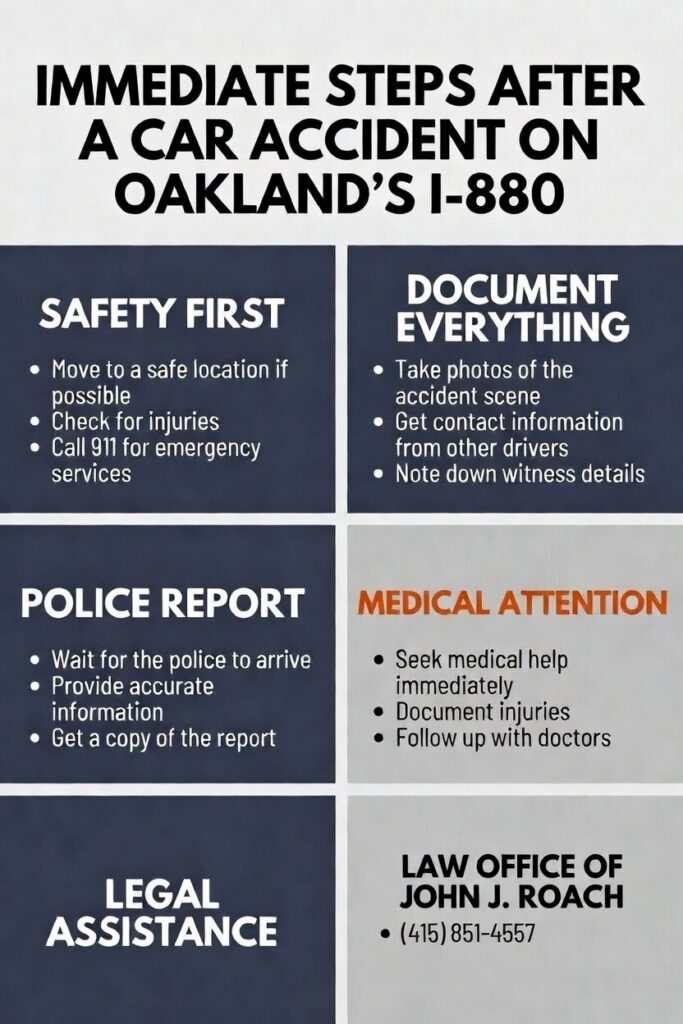
Step 1: Prioritize Safety and Assess the Scene
The first and most critical step after any car accident on I-880 is to ensure everyone’s safety. Adrenaline can mask injuries, and the freeway’s fast-moving traffic poses immediate dangers. Pull over to the shoulder if possible—Oakland’s I-880 has narrow shoulders in some areas, so use hazard lights to alert oncoming vehicles. If your car is disabled in a lane, exit the vehicle carefully and move to a safe spot, like behind a guardrail or off the roadway.
Check yourself and passengers for injuries. Common issues from I-880 accidents include whiplash from sudden stops or more severe trauma from high-impact crashes. If anyone is hurt, call 911 immediately. Even if injuries seem minor, document them as part of your evidence collection—take quick notes on your phone about pain levels or visible bruises.
Why is this step foundational for evidence? Safety first prevents further incidents, which could complicate your police report. In Oakland, where emergency response times can vary due to traffic, staying calm helps you observe details like weather conditions (foggy mornings are common on I-880) or road hazards (potholes or debris) that might contribute to the accident’s cause. Snap preliminary photos of the scene from a safe distance, including vehicle positions and any skid marks. These initial visuals can be invaluable when consulting a car accident lawyer in Oakland, as they provide context for fault determination.
Pro Tip: If you’re near exits like High Street or 66th Avenue, note the mile marker or nearest landmark. This helps CHP locate you faster and accurately logs the accident location in the police report.
Step 2: Contact Authorities and Secure a Police Report
Once safety is addressed, call the police. In California, you’re legally required to report accidents involving injury, death, or property damage over $1,000. For I-880 incidents in Oakland, this typically means contacting the CHP, as they patrol state freeways. Dial 911 or the non-emergency line (510-286-7000 for Oakland PD if needed) and provide details like your location, number of vehicles involved, and any injuries.
Why focus on the police report? It’s a cornerstone of evidence in any car accident claim. The report includes official observations: diagrams of the scene, statements from involved parties, witness accounts, and preliminary fault assessments. In Oakland, where hit-and-runs are unfortunately common on busy routes like I-880, a thorough report can help identify fleeing drivers through traffic cameras or license plate info.
While waiting for officers—response times on I-880 can be 10-30 minutes during peak hours—avoid admitting fault or discussing details with other drivers. Politely exchange basic info (more on this below), but let the police handle investigations. Once they arrive, provide accurate, concise statements. Ask for the report number immediately; you’ll need it to obtain a full copy later.
How to get your police report: In Alameda County, request it from the CHP’s Oakland office or online via the CHP website (chp.ca.gov). It usually takes 10 days to process, but expedited options exist. Fees are around $10-20. As a car accident lawyer in Oakland, I often assist clients in retrieving these documents, as they can reveal discrepancies that strengthen your case.
Evidence Tip: If officers issue citations (e.g., for speeding or distracted driving), note them—they’re key evidence. Also, if tow trucks arrive (common on I-880 to clear lanes quickly), get the company’s details for your records.
Step 3: Gather Comprehensive Evidence at the Scene
Evidence collection is where many accident victims falter, yet it’s essential for proving liability and damages. On Oakland’s I-880, where accidents often involve multiple lanes and witnesses in passing cars, acting fast is key. Your smartphone is your best tool here—use it to document everything before vehicles are moved or the scene is cleared.
Start with photos and videos:
- Capture all angles of the vehicles involved, including damage, license plates, and VIN numbers.
- Document the roadway: Skid marks, debris, traffic signs, and road conditions (e.g., wet pavement from Bay Area rain or glare from afternoon sun).
- Include wider shots showing the accident’s position relative to I-880 landmarks, like the Port of Oakland or the Alameda overpass.
- If safe, video a 360-degree pan of the scene, narrating details like time, weather, and traffic flow.
Why photos matter: In court or insurance disputes, visual evidence trumps memory. For instance, if the other driver claims you merged improperly—a common I-880 issue—photos can show lane configurations and prove otherwise.
Next, collect witness statements. Approach bystanders (safely) and ask for their contact info and brief accounts. Witnesses on I-880 might include truck drivers or commuters; their impartial views can corroborate your version. Use your phone’s voice recorder or notes app to jot down what they saw.
Other evidence to gather:
- Dashcam footage if available (increasingly common in Oakland traffic).
- Roadside surveillance: Note any Caltrans cameras nearby; footage can be requested later.
- Personal items: If belongings were damaged, photograph them.
As a seasoned car accident lawyer in Oakland, I recommend organizing evidence immediately—create a folder on your phone labeled “I-880 Accident [Date].” This streamlines sharing with your attorney, potentially speeding up settlements. Remember, California’s two-year statute of limitations for personal injury claims starts ticking, so strong evidence preserves your options.
Pro Tip: Avoid social media posts about the accident; they could be used against you. Instead, email evidence to yourself for timestamping.
Step 4: Exchange Information with Other Parties
After evidence basics, exchange details with other drivers. California law requires sharing your name, address, phone number, driver’s license, vehicle registration, and insurance info. Do this calmly, even if tensions are high—arguments can lead to incomplete police reports.
For I-880 multi-car accidents, which are frequent due to chain reactions, get info from all involved. If a commercial vehicle (like a port truck) is part, note the company name and DOT number— these cases often involve higher stakes.
Evidence Integration: While exchanging, subtly note the other driver’s behavior (e.g., if they seem distracted or impaired). This can inform the police report without confrontation.
If the other party is uncooperative, let officers handle it. In hit-and-run scenarios, common on busy Oakland freeways, your gathered evidence (photos, witnesses) becomes even more vital.
Step 5: Seek Medical Attention Promptly
Even if you feel fine, get checked out. Adrenaline can hide injuries like concussions or internal bleeding, prevalent in I-880 high-speed crashes. Visit an ER, urgent care, or your doctor soon after—facilities like Highland Hospital in Oakland are equipped for trauma.
Why link to evidence? Medical records serve as proof of injuries, linking them to the accident. Delays can weaken claims, as insurers might argue unrelated causes.
Document everything: Keep receipts, diagnoses, and treatment plans. Share with your car accident lawyer in Oakland to calculate fair compensation, including future medical costs.
Step 6: Notify Your Insurance and Monitor the Claim
Report the accident to your insurer within 24-48 hours. Provide the police report number and your evidence. Be factual; avoid speculating on fault.
In California’s at-fault system, evidence determines liability. The responsible driver (or their insurer) covers damages, but proving fault is essential. If I-880 construction contributed (e.g., unmarked lanes), note it—Caltrans could share liability.
Watch for lowball offers; that’s where a lawyer helps negotiate.
Step 7: Consult a Car Accident Lawyer in Oakland
Don’t navigate this alone. A car accident lawyer in Oakland like those at the Law Office of John J. Roach can review your evidence, police report, and medical docs to build a robust case. We specialize in I-880 accidents, understanding local traffic patterns and CHP procedures.
Benefits:
- Maximize compensation: For pain, suffering, lost income.
- Handle paperwork: From report retrieval to settlement talks.
- Litigate if needed: Against insurers or negligent parties.
Early consultation is free and can prevent costly mistakes.
Conclusion: Empower Yourself Post-Accident
Surviving a car accident on Oakland’s I-880 is stressful, but these steps—focusing on safety, evidence, and police reports—empower you to protect your future. By acting methodically, you capture crucial details that support your recovery.
If you’ve been injured, contact the Law Office of John J. Roach today. As your local car accident lawyer in Oakland, we’re here to fight for you. Visit representmyinjury.com or call for a free consultation. Stay safe on the roads.