

John Roach, Esq. | March 16, 2026 | Car Accidents
Immediate Steps After a Car Accident on Oakland’s I-880

If you were just in a car accident on Oakland’s I-880, the minutes after the crash are more important than most people realize. The evidence you preserve — or fail to preserve — at the scene directly affects the strength of your claim. I-880, also called the Nimitz Freeway, is one of California’s most accident-prone freeways, with high-speed merges, construction zones, and heavy commercial traffic creating conditions for serious collisions every day.
I’m John J. Roach, a San Francisco personal injury attorney with extensive trial experience representing victims of car accidents throughout the Bay Area, including Oakland and Alameda County. This guide walks through exactly what to do after an I-880 accident — step by step — to protect your health, preserve your evidence, and position your claim correctly from the start.
If your accident happened anywhere else in the city, my free guide, The First 10 Days After a Car Accident in San Francisco, covers the same first-days checklist, including the DMV filing deadline.
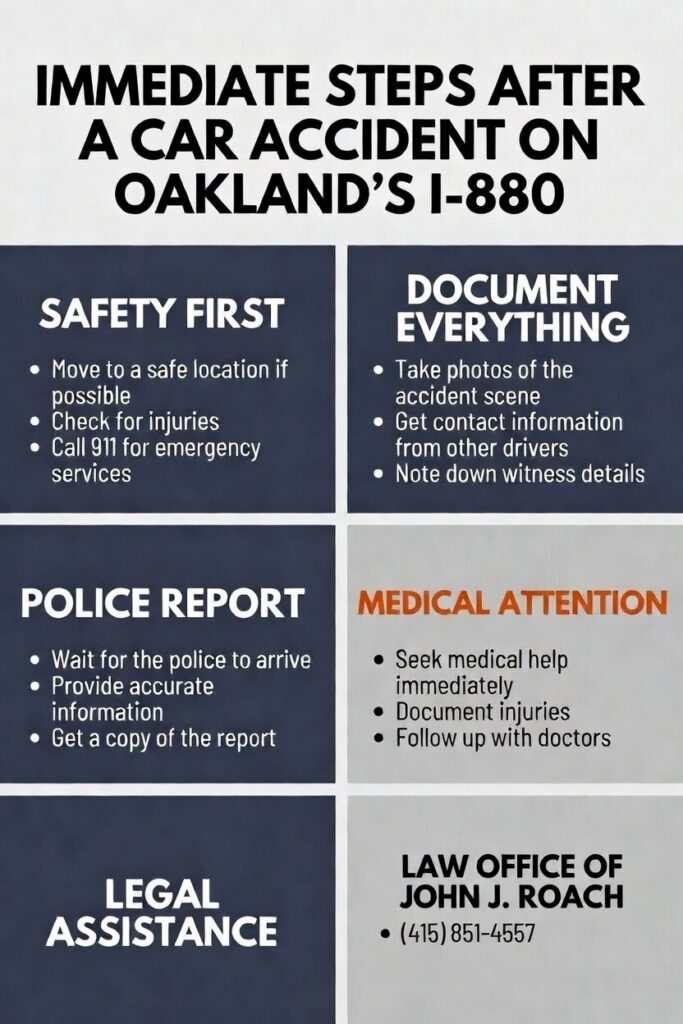
Step 1: Prioritize Safety and Assess the Scene
Pull over to the shoulder if your vehicle can move — I-880 has narrow shoulders in some sections, so activate your hazard lights immediately to alert traffic. If the vehicle is disabled in a lane, exit carefully and move behind a guardrail or off the roadway entirely. Fast-moving freeway traffic is the most immediate danger in the minutes after impact.
Check yourself and passengers for injuries. Adrenaline masks pain — what feels minor immediately after a high-speed crash can be a fracture, concussion, or internal injury. If anyone is hurt, call 911. While you wait, take preliminary photos of the scene from a safe distance: vehicle positions, skid marks, debris field, and any road conditions — wet pavement, debris, construction markings — that may have contributed to the crash. Note your location: the nearest exit, mile marker, or landmark like the Oakland Coliseum or 66th Avenue. This helps CHP locate you accurately and ensures the police report logs the correct accident location.
Step 2: Call Police and Secure the Police Report
California law requires you to report any accident involving injury, death, or property damage over $1,000. On I-880, that means contacting the California Highway Patrol — call 911 or the CHP Oakland office directly. Provide your location, number of vehicles involved, and whether anyone is injured.
While waiting for officers — response times on I-880 can run 10 to 30 minutes during peak hours — do not admit fault or discuss the details of the crash with the other driver. Exchange basic information (covered in Step 4), but let the police conduct the investigation. When officers arrive, give accurate, concise statements. Get the report number before they leave — you will need it to obtain the full report later.
To obtain your CHP report in Alameda County, request it from the CHP Oakland office or online at chp.ca.gov. Processing typically takes about 10 days and costs $10 to $20. If officers issue citations to the other driver — for speeding, distracted driving, or an unsafe lane change — document them. Citations are significant evidence in establishing fault.
Step 3: Gather Comprehensive Evidence at the Scene
Your phone is your most important tool at the scene. Use it before vehicles are moved or the scene is cleared — once CHP clears a lane on I-880, evidence disappears fast.
Photograph and video everything: all angles of every vehicle involved including damage, license plates, and VIN numbers; the roadway including skid marks, debris, traffic signs, and road conditions; wider shots showing vehicle positions relative to lane markings and I-880 landmarks; and a 360-degree video pan of the scene narrating the time, weather, and traffic conditions. If the other driver claims you merged improperly — a common dispute on I-880 — photos showing lane configurations and your vehicle’s position can directly refute that argument.
Approach any bystanders who witnessed the crash and get their name and contact information. Truck drivers, commuters, and construction workers near I-880 often see exactly what happened and are willing to provide a statement. Use your phone’s voice recorder to capture what they saw while it’s fresh. Also note any Caltrans cameras in the area — that footage can be requested later and may show the crash directly.
If you have dashcam footage, preserve it immediately — do not let it be overwritten. Create a folder on your phone labeled with the date and location to organize everything in one place. Do not post anything about the accident on social media — those posts can be used against your claim. Email your photos and videos to yourself to create a timestamped backup.
Step 4: Exchange Information with All Involved Drivers
California law requires you to exchange your name, address, phone number, driver’s license number, vehicle registration, and insurance information with every other driver involved. Do this calmly — arguments at the scene can lead to incomplete police reports and complicate your claim.
I-880 accidents frequently involve multiple vehicles due to chain reactions in stop-and-go traffic. Get information from every driver involved, not just the one you directly collided with. If a commercial vehicle — a port truck, delivery van, or semi — is involved, note the company name and DOT number. Commercial vehicle accidents often involve higher insurance limits and additional liable parties including the employer or cargo owner.
If the other driver is uncooperative or flees the scene, do not chase them. Note every detail you can — make, model, color, partial plate — and give it to CHP. Hit-and-runs are unfortunately common on busy Oakland freeways, and your documented evidence and any witness accounts become the foundation of an uninsured motorist claim under your own policy.
Step 5: Seek Medical Attention the Same Day
Go to the emergency room, urgent care, or your primary care physician the same day — even if you feel fine. Adrenaline masks traumatic brain injuries, spinal injuries, and internal bleeding. High-speed I-880 crashes routinely cause injuries that don’t become apparent until hours or days later. Highland Hospital in Oakland is equipped for trauma and a reasonable option if you need immediate care.
Your medical records are evidence. They establish what injuries you sustained, when they were diagnosed, and how they connect to the accident. A gap between the crash and your first medical visit gives the defense an argument that your injuries were pre-existing or unrelated. Keep every receipt, diagnosis, and treatment plan — they are the foundation of your economic damages claim.
Step 6: Report to Your Insurance Company
Notify your insurer within 24 to 48 hours of the accident. Provide the CHP report number and a factual summary of what happened. Be accurate — do not speculate about fault and do not minimize your injuries. If I-880 construction contributed to the crash — unmarked lane changes, inadequate signage, dangerous transitions — document those conditions because Caltrans may share liability.
California is an at-fault state — the responsible driver’s insurer covers your damages. Insurance adjusters will use everything you say in those early calls to limit their exposure. Do not accept any settlement offer before you understand the full scope of your injuries and have consulted an attorney. Initial offers on serious injury cases are almost always below fair value.
Step 7: Consult a Car Accident Attorney Before Making Any Decisions
Before you sign anything, give a recorded statement to the other driver’s insurer, or accept any settlement offer — consult an attorney. I review your evidence, police report, and medical records, evaluate the full value of your claim including future medical costs and lost earning capacity, and handle all communications with the insurance company so you can focus on recovering.
California’s statute of limitations for personal injury claims is two years from the date of the accident. That clock starts immediately. The longer you wait, the harder it becomes to preserve critical evidence — surveillance footage is overwritten, witnesses become unavailable, and physical evidence disappears. Early consultation costs nothing and protects everything.
If you were injured in an accident on I-880 or anywhere in the Bay Area, call me at (415) 851-4557 for a free consultation. I work on a contingency fee basis — you pay nothing unless I recover money for you. I am bilingual in English and Spanish.
Frequently Asked Questions: Car Accidents on Oakland’s I-880
Yes. California law requires you to report any accident involving injury, death, or property damage over $1,000. On I-880, which is a state freeway, you contact the California Highway Patrol — not the Oakland Police Department. Call 911 or the CHP Oakland office directly. The police report is one of the most important pieces of evidence in any car accident claim, as it documents the scene, parties, witness accounts, and any citations issued.
Photograph all vehicles involved from every angle including damage, license plates, and VIN numbers. Document the roadway — skid marks, debris, traffic signs, lane markings, and road conditions. Take wider shots showing vehicle positions relative to I-880 landmarks. Video a 360-degree pan of the scene narrating time, weather, and traffic conditions. Get names and contact information from any witnesses. Note the location of any Caltrans cameras. Preserve any dashcam footage immediately. Create a timestamped backup by emailing everything to yourself.
Two years from the date of the accident under California Code of Civil Procedure Section 335.1 for personal injury claims. For property damage claims, the limit is three years. However, if the accident involved a government vehicle or occurred on government-maintained property where a public entity may be liable, a government tort claim must be filed within six months. Contact an attorney as soon as possible — evidence preservation is time-sensitive regardless of the legal deadline.
Document everything you can — make, model, color, and any portion of the license plate — and give it to CHP immediately. Hit-and-runs on I-880 are unfortunately common, and CHP will check traffic and freeway cameras for footage. For your civil claim, a hit-and-run is handled as an uninsured motorist claim under your own auto policy. California law allows you to access your UM coverage even when the at-fault driver cannot be identified. Contact an attorney promptly.
Almost never — at least not without consulting an attorney first. Initial settlement offers on serious injury cases are typically well below fair value. Insurance adjusters are trained to close claims quickly and cheaply before you understand the full extent of your injuries or the long-term costs of your treatment. Once you accept and sign a release, that is the end — you cannot go back for more. Have an attorney evaluate the offer before you make any decisions.
Disclaimer: This blog post is for informational purposes only and does not constitute legal advice. Consult a licensed attorney for advice specific to your situation.




