

John Roach, Esq. | January 12, 2026 | California Law \ Car Accidents
Can Undocumented Injury Victims File Personal Injury Claims in California?

If you were injured in an accident in California and you are undocumented, you have the same right to file a personal injury claim and recover full compensation as any U.S. citizen or legal resident. California law explicitly protects you — and explicitly bars the defense from using your immigration status against you in court. Fear of deportation should not prevent you from seeking justice for injuries that were not your fault.
I’m John J. Roach, a San Francisco personal injury attorney with extensive trial experience. I am fluent in Spanish and I have represented undocumented clients in car accident cases, slip and fall cases, workplace injury cases, and pedestrian accident cases throughout the Bay Area. This guide explains your rights, the specific laws that protect you, and how to move forward.

California Evidence Code § 351.2: Your Immigration Status Cannot Be Used Against You
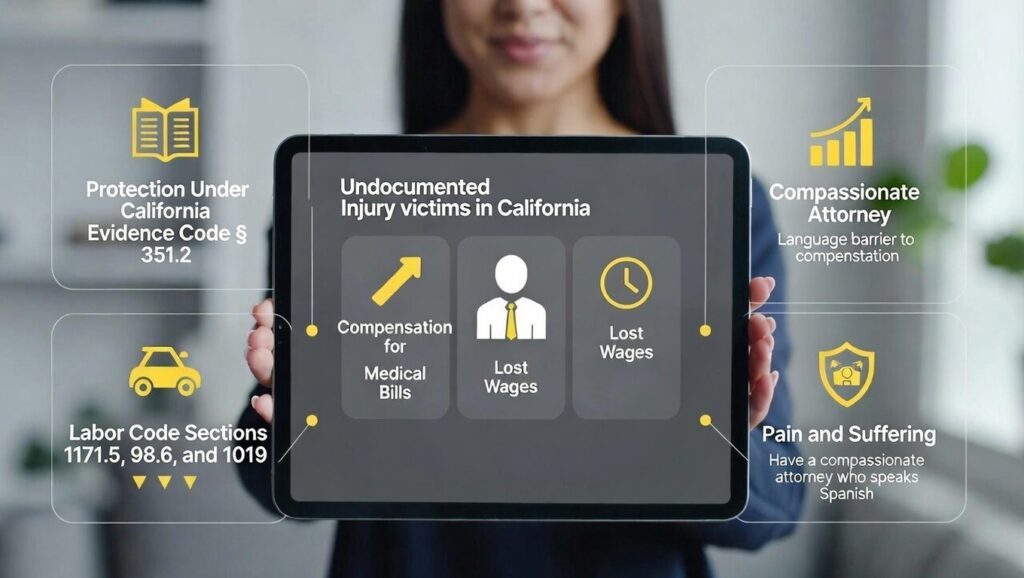
The most important law you need to know is California Evidence Code Section 351.2. Enacted in 2017, this statute bars the admission of a person’s immigration status in civil personal injury and wrongful death cases. This means the defense cannot raise your immigration status in court, in discovery, or in settlement negotiations. They cannot use it to reduce your damages, to intimidate you into accepting a low offer, or to create a chilling effect that discourages you from pursuing your claim.
Before this law, defense attorneys and insurance companies sometimes used the threat of immigration scrutiny as leverage against undocumented plaintiffs. Section 351.2 eliminated that tactic. Your claim is evaluated on the facts of your injury — not on your immigration status.

Lost Wages: You Are Entitled to California Wage Rates
One of the most significant protections for undocumented injury victims is Assembly Bill 2159, also effective 2017, which ensures that lost wage damages are calculated based on California wage rates — not the wage rates of your country of origin. Before this law, some defense experts argued that an undocumented worker’s lost earning capacity should be valued based on wages in their home country, dramatically reducing the economic damages available. That argument is no longer available to the defense in California.
If you have been unable to work because of your injuries, I work with economists and vocational experts to document your employment history and project your lost earning capacity based on California market wages for your occupation and experience level. This applies whether you were working in construction, hospitality, agriculture, domestic work, or any other field.
Workplace Injuries: Additional Protections Under California Labor Code
If your injury occurred at work, California Labor Code Section 1171.5 affirms that all workers — regardless of immigration status — are protected under California labor laws, including the right to workers’ compensation benefits. Your employer cannot deny your claim on the basis of your immigration status.
Employers are also prohibited from retaliating against you for filing a claim or seeking medical care. Under Labor Code Sections 98.6 and 1019, if your employer threatens to report you to immigration authorities in response to a workplace injury claim, that threat is itself an unlawful act — and one I take extremely seriously in litigation. Employer retaliation of this kind can give rise to additional claims and damages beyond the underlying injury.
Many undocumented workers are placed in dangerous conditions precisely because employers assume they will not speak up. California law is designed to remove that assumption and level the playing field.
Will Filing a Claim Put Me at Risk of Deportation?
This is the question I hear most often from undocumented clients, and the answer is no. There is no legal requirement for courts, attorneys, or insurance companies to report your immigration status to federal authorities. Filing a personal injury lawsuit is a civil proceeding — it does not involve any immigration enforcement mechanism. California courts do not report immigration status to ICE or any federal agency as a result of civil litigation.
If the defense attempts to use your immigration status as leverage — threatening to raise it in court or report it to authorities as a way to pressure you into settling for less — that conduct can constitute obstruction and is something I address aggressively. The law is on your side, and I enforce it.
What Damages Can You Recover?
As an undocumented injury victim in California, you are entitled to the same categories of compensation as any other plaintiff:
Medical expenses — All reasonable and necessary past and future medical care related to your injuries, including emergency treatment, hospitalization, surgery, physical therapy, and prescription medications.
Lost wages and earning capacity — Based on California wage rates for your occupation, documented through employment records, pay stubs, witness statements, and expert testimony.
Pain and suffering — Physical pain, emotional distress, anxiety, loss of enjoyment of life, and the full human impact of your injuries. California places no cap on these damages in personal injury cases.
Wrongful death damages — If a family member was killed in an accident, surviving family members — regardless of immigration status — may pursue a wrongful death claim for loss of financial support, companionship, and guidance.
Challenges You May Face — And How I Address Them
Despite the legal protections in place, undocumented injury victims do face real practical challenges. Insurance companies and employers sometimes exploit language barriers or limited knowledge of the legal system to offer inadequate settlements. They may attempt to argue comparative fault — claiming you were partially responsible for the accident — to reduce their payout under California Civil Jury Instruction 405.
The two-year statute of limitations under Code of Civil Procedure Section 335.1 applies to personal injury cases in California. Missing that deadline permanently bars your claim regardless of how strong it is. If a government entity is involved — such as a city bus, Muni, or a public agency vehicle — you may have as little as six months to file a government tort claim. Contact me as soon as possible after any accident to protect your rights.
I handle all communications with insurance adjusters so you never have to speak with them directly. I gather and present evidence of your injuries, employment history, and damages in a way that does not require disclosure of unnecessary personal information. I address any improper inquiries about your immigration status immediately and forcefully. You focus on your recovery — I handle the legal fight.
Why Bilingual Representation Matters
Speaking directly with your attorney — not through an interpreter, not through a family member — makes a significant difference in how your case is built and how you understand what is happening at every stage. I am fluent in Spanish and I conduct client meetings, case strategy discussions, and deposition preparation directly in Spanish when that is the client’s preference. You will always know exactly where your case stands and why.
I have recovered over $25 million for injured clients throughout San Francisco and the Bay Area, including clients who came to me undocumented, uninsured, and uncertain whether they had any rights at all. They did — and so do you.
If you were seriously injured in an accident in California, call me at (415) 851-4557 for a free consultation. I work on a contingency fee basis — you pay nothing unless I recover money for you. Se habla español.
Frequently Asked Questions: Undocumented Injury Victims in California
Yes. California law gives undocumented individuals the same right to file a personal injury claim and recover compensation as any U.S. citizen or legal resident. California Evidence Code Section 351.2 bars the defense from raising immigration status in civil personal injury and wrongful death cases. Your claim is evaluated on the facts of your injury, not your immigration status.
No. Filing a personal injury lawsuit is a civil proceeding. There is no legal requirement for courts, attorneys, or insurance companies to report immigration status to federal authorities. California courts do not report immigration status to ICE as a result of civil litigation. If anyone attempts to use your immigration status as leverage to pressure you into settling, that conduct can constitute obstruction and is something your attorney should address immediately.
Yes. Under Assembly Bill 2159, effective 2017, lost wage damages for undocumented injury victims in California are calculated based on California wage rates — not the wage rates of your country of origin. If you have been unable to work because of your injuries, an attorney can document your employment history and project your lost earning capacity using California market wages for your occupation.
Yes. California Labor Code Section 1171.5 affirms that all workers — regardless of immigration status — are protected under California labor laws, including the right to workers’ compensation benefits. Your employer cannot deny your claim based on your immigration status. Employers are also prohibited from retaliating against you for filing a claim, including threatening to report you to immigration authorities.
Generally two years from the date of the injury under California Code of Civil Procedure Section 335.1. If a government entity is involved — such as a city bus, Muni, or public agency vehicle — you may have as little as six months to file a government tort claim. Missing these deadlines permanently bars your claim. Contact an attorney as soon as possible after any accident.
That is an unlawful act under California Labor Code Sections 98.6 and 1019. Employers are prohibited from retaliating against employees for filing workers’ compensation claims or seeking medical care, including threatening to report immigration status. If your employer has done this, document it immediately and contact an attorney — it can give rise to additional claims and damages beyond the underlying injury.
Disclaimer: This blog post is for informational purposes only and does not constitute legal advice. Consult a licensed attorney for advice specific to your situation.




