
John Roach, Esq. | June 24, 2026 | California Law \ Car Accidents
Multi-Vehicle Accidents in San Francisco: How Fault Is Determined When Three or More Cars Crash

San Francisco traffic is built for chain reactions. Stop-and-go congestion on the 101 and I-280 approaches, fog that swallows brake lights on Sunset and Skyline corridors, steep grades where downhill momentum does the rest, and the Bay Bridge metering lights compressing five lanes of impatience into stop-start waves. When one driver follows too closely or looks down at a phone, a single collision becomes a three-, four-, or five-car pileup in seconds. And unlike a two-car fender bender, what comes next is rarely settled by two adjusters trading phone calls — it becomes a months-long contest over percentages, sequencing, and coverage.
These cases look chaotic at the scene, and the insurance aftermath is worse: multiple drivers, multiple insurers, and everyone’s adjuster pointing at someone else. But multi-vehicle car accident cases aren’t unsolvable — they’re analytical. Fault gets assigned vehicle by vehicle, impact by impact, percentage by percentage. I’ve represented injury victims across the Bay Area since 2009, and this post explains how California law actually sorts out a crash with three or more cars — and why the driver who hit you is rarely the only question that matters.
Why Multi-Vehicle Cases Are Legally Different
A two-car collision usually presents one liability question: who caused it. A multi-vehicle collision presents a web of them. Did the rear driver start the chain, or did they get pushed? Was the middle car stopped safely, or following too closely itself? Did the first vehicle stop suddenly for a reason — or for no reason? Each answer shifts percentages of fault, and each percentage shifts money.
Three features make these cases genuinely different:
- Multiple defendants and policies. More potential sources of recovery — but also more lawyers and adjusters whose job is to move fault onto someone else, including onto you.
- Sequencing disputes. The order and timing of impacts often determines everything, and memories of a three-second event are notoriously unreliable. Physical evidence decides these fights.
- Comparative fault mathematics. California divides fault in percentages across everyone involved, and a special rule — Proposition 51 — changes how each defendant pays. More on that below.
The Chain-Reaction Collision: How Fault Gets Assigned
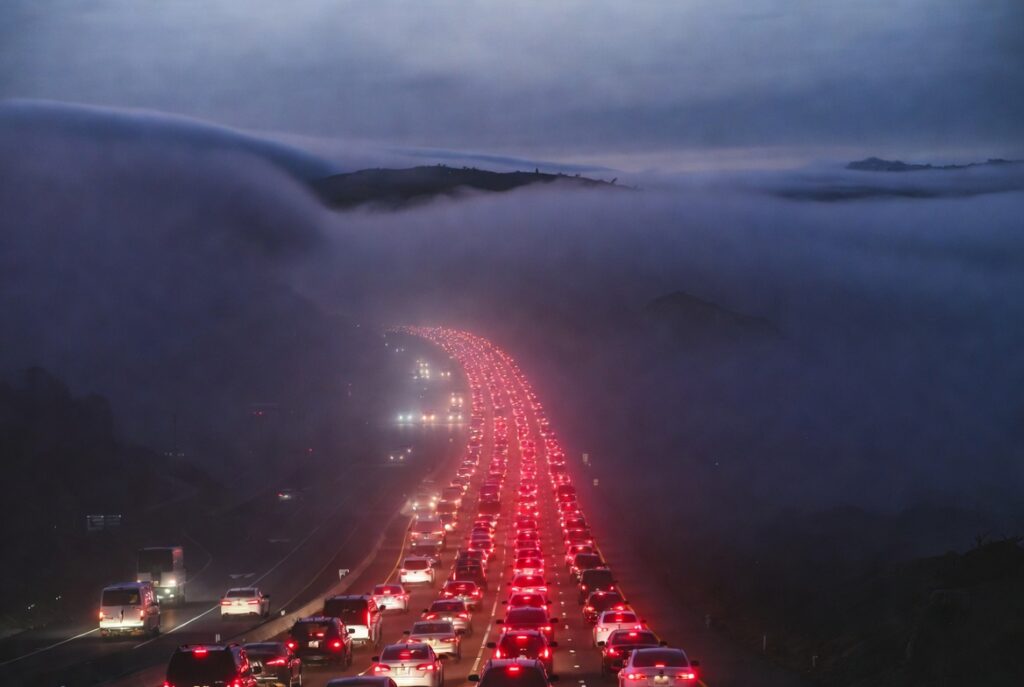
Most San Francisco pileups are stacked rear-end collisions: car D hits car C, which hits car B, which hits car A. California starts from a familiar presumption — a driver who rear-ends another was likely following too closely or driving too fast for conditions, in violation of Vehicle Code section 21703 (following too closely) or the basic speed law, Vehicle Code section 22350. But in a chain reaction, that presumption has to be applied impact by impact:
The rear driver who starts the chain
When the last car in line plows into stopped traffic and shoves everyone forward, that driver typically carries the bulk of the fault — often all of it. The classic defense is that the cars ahead were “already stopped wrong” or stopped suddenly; it rarely holds up when traffic data and damage patterns show ordinary congestion.
The middle car — pushed, or pushing?
This is the most contested seat in the crash. If you were stopped with safe distance and got shoved into the car ahead, you are a victim twice over and generally bear no fault for the forward impact. But if you hit the car ahead first — because you were following too closely — and then got hit from behind, you may share fault for one impact while being a victim of the other. The difference is often tens or hundreds of thousands of dollars, and it turns on physical evidence: damage severity front versus rear, the resting positions of the vehicles, and increasingly, the data inside the cars themselves.
The front car
Lead drivers are usually fault-free, but not always. A driver who slams the brakes for no reason, stops in a live traffic lane after a minor incident instead of moving to the shoulder, or is driving with broken brake lights can pick up a percentage of fault for the chain that forms behind them.
When a commercial vehicle is in the stack
A loaded truck multiplies the physics and the stakes. Commercial vehicles need far more stopping distance, and when a trucking accident starts or amplifies a pileup, federal hours-of-service logs, maintenance records, and the truck’s electronic systems all come into play — along with commercial policies that are typically much larger than personal auto coverage.
California Comparative Fault: Percentages, Not Blame
California is a pure comparative negligence state — since the Supreme Court’s decision in Li v. Yellow Cab Co. (1975), fault is divided among everyone involved in percentages, and an injured person’s recovery is reduced by their own share, whatever it is. Even a driver found 30% at fault still recovers 70% of their damages. There is no cutoff that bars recovery.
Then comes the rule that makes multi-defendant cases genuinely strategic: Civil Code section 1431.2, enacted as Proposition 51. For economic damages — medical bills, lost earnings — defendants remain jointly and severally liable, meaning any defendant can be made to pay the full economic award and sort out contribution later. But for non-economic damages — pain and suffering, which is often the largest component of a serious injury case — each defendant pays only their own percentage. If the driver assigned 60% of fault carries a minimal policy and the driver assigned 15% is well insured, that allocation fight directly controls what you actually collect. This is why fault percentages in multi-vehicle cases are litigated so hard: the percentages are the money.
At the Scene: What Multi-Car Crashes Require That Two-Car Crashes Don’t
The standard post-accident checklist — call 911, get medical care, photograph everything — applies, but pileups add wrinkles that matter later:
- Exchange information with every driver, not just the one who hit you. Fault may ultimately land on a vehicle that never touched yours. If you only collect the rear driver’s information, you may be chasing the wrong policy for months.
- Photograph all vehicles in their resting positions before anyone moves. Resting positions are reconstruction gold. Once cars move to the shoulder, that evidence exists only in your camera roll.
- Capture the road itself. Lane markings, skid marks, debris fields, fog or sun glare, the grade of the hill — conditions are part of the fault analysis and they change within hours.
- Say nothing about fault to anyone at the scene. In a two-car crash, an apology reaches one adjuster. In a five-car crash, it reaches four insurance companies, each of which will use it. Describe what happened to the police accurately and stop there.
- Get checked out even if your impact “wasn’t the big one.” Occupants in moderate impacts routinely turn out to be the most seriously injured — adrenaline and the chaos of a pileup mask symptoms, and a same-day medical record protects both your health and your claim.
One more wrinkle specific to San Francisco: if a government vehicle is part of the stack — a Muni bus, a city truck, a police vehicle — your claim against that entity runs on a dramatically shorter clock. A government tort claim is generally due within six months, not two years. An attorney should evaluate every vehicle in the chain for this issue immediately, because the deadline does not wait for the insurers to finish arguing.
The Evidence That Decides These Cases
Multi-vehicle fault disputes are won with physical and digital evidence, gathered before it disappears:
- Event data recorders (“black boxes”). Most modern vehicles record speed, braking, and impact data for the seconds before a crash. EDR data can prove whether the middle car was moving or stopped at each impact — the single most disputed fact in chain reactions. This data can be overwritten or lost when vehicles are repaired or scrapped, so preservation letters need to go out fast.
- Dashcam and surveillance footage. Other drivers’ dashcams, Muni vehicle cameras, and storefront or garage cameras along dense corridors like SoMa capture impact sequences memories cannot. Most private systems overwrite within days.
- Vehicle damage patterns. Crush depth and damage location tell a reconstruction expert how fast each impact was and in what order they occurred — physics does not misremember.
- The 911 timeline and CAD logs. Multiple calls about the same pileup, time-stamped seconds apart, can corroborate the sequence of impacts.
- Independent witnesses. Drivers two lanes over saw what the people inside the crash could not. Their names get collected at the scene or, often, never.
When Multiple Insurers Point Fingers at Each Other
Expect a pattern: every adjuster in a multi-vehicle case has the same playbook, and it is to delay, deflect, and discount. Each insurer disputes its driver’s percentage, waits for the others to move first, and hopes the injured person gets worn down. Unrepresented victims get squeezed hardest, because the easiest percentage to inflate is the one belonging to the person without a lawyer.
Three practical rules protect you. First, do not give recorded statements to any other driver’s insurer — in a multi-car case, your innocent description of a chaotic three seconds will be mined by several companies at once for anything that shifts fault toward you. Second, do not accept any insurer’s “final” liability determination as if it were a court ruling; adjuster allocations are opening positions, not law. Third, do not settle with one defendant in isolation without understanding how it affects the rest of the case — releases in multi-party cases must be structured carefully.
There’s also a quieter race happening in every pileup with serious injuries: multiple injured people are pursuing the same limited policies. When an at-fault driver carries a $100,000 policy and four people were hurt, that coverage can be exhausted by whoever presents a complete, well-documented claim first — or divided in a way that shortchanges the claimant whose attorney moved slowest. Unrepresented victims in multi-claimant cases routinely discover the policy is gone by the time they’re done treating. Early, organized claim presentation is not aggressive; in these cases it’s simply necessary.
What If the Total Coverage Is Not Enough?
Serious injuries in a pileup can exceed every available policy combined — especially with multiple injured claimants competing for the same limited coverage. This is where case strategy matters: identifying every policy in the stack (each defendant’s liability coverage, employer policies for drivers working at the time, commercial coverage), and then your own underinsured motorist coverage on top. Injuries from multi-impact collisions run severe precisely because the body absorbs forces from more than one direction — traumatic brain injuries and spinal injuries are common even at city speeds. I’ve recovered a $750,000 UIM arbitration award for a brain-injured client whose at-fault driver carried nowhere near enough coverage; building the full coverage map is the difference between a partial recovery and a complete one.
Why Trial Experience Matters When Fault Is Contested
Multi-vehicle cases settle on the strength of the fault analysis — and fault analysis is only credible when the defense believes you can prove it to a jury. I prepare every case as if it will be tried, with a 9-for-9 trial verdict record and more than $25 million recovered for Bay Area clients since 2009. When three insurance companies are pointing at each other, the claimant whose attorney can actually reconstruct the crash — and try the case — is the one whose percentage gets argued down instead of up. I also represent Spanish-speaking clients directly as a bilingual personal injury lawyer, with no interpreter between us.
Injured in a Multi-Car Crash? Talk to a San Francisco Lawyer — Free
If you were hurt in a multi-vehicle accident anywhere in San Francisco or the Bay Area, get the fault analysis done right before any insurer locks in a story. The free consultation costs nothing, and you pay no fee unless I recover for you. Call (415) 851-4557 — you’ll speak with me directly.
¿Prefiere hablar en español? Ofrezco consultas gratuitas en español, directamente conmigo: (415) 851-4557.
Frequently Asked Questions
It depends on the sequence of impacts. The rear driver who starts the chain typically carries most or all of the fault, but each impact is analyzed separately. A middle driver who was pushed into the car ahead generally bears no fault; a middle driver who hit the car ahead first may share a percentage. Physical evidence — vehicle data, damage patterns, footage — usually decides it.
Yes. If you were stopped at a safe distance and were pushed forward, you are a victim of both impacts. Even if you share some percentage of fault for the front impact, California’s pure comparative negligence system still lets you recover the remaining percentage of your damages.
Yes, and in multi-vehicle cases they usually are. California assigns each involved driver a percentage of fault, and your recovery comes from each according to the rules of Civil Code section 1431.2 (Proposition 51).
Under Civil Code section 1431.2, defendants are jointly liable for your economic damages (medical bills, lost wages) but each pays only their own percentage of non-economic damages (pain and suffering). Because fault percentages directly control what you collect — especially when one defendant is underinsured — those percentages are heavily contested in multi-vehicle cases.
Your recovery strategy expands to every other available policy — other at-fault drivers, employer or commercial coverage if a driver was working, and your own uninsured/underinsured motorist coverage. Mapping the full coverage picture early is essential when injuries are serious.
Generally two years from the date of injury under Code of Civil Procedure section 335.1. If a government vehicle (such as a Muni bus) or a dangerous public roadway is involved, an administrative claim may be due within six months. With multiple insurers involved, the earlier evidence is preserved, the better.
Nothing up front. I handle these cases on contingency — no fee unless I recover compensation for you. Consultations are free, in English or Spanish, directly with me: (415) 851-4557.