

John Roach, Esq. | January 5, 2026 | California Law
Videotaped Depositions: Key Tool for Personal Injury and Car Crash Cases

Videotaped depositions are one of the most underutilized tools in California personal injury practice. Most plaintiff attorneys record depositions as a matter of course — but few use them to their full strategic potential. This post covers the statutory framework, the availability rules that most attorneys misunderstand, and the specific joinder tactic I use in UIM arbitrations and trials to lock in favorable expert testimony before the defense has fully prepared its position.
I’m John J. Roach, a San Francisco personal injury trial attorney. I handle catastrophic car accident cases, traumatic brain injury cases, and UIM arbitrations throughout the Bay Area. If you have a case to refer or want to discuss co-counsel, visit my attorney referrals page or reach out through the contact form.
The Statutory Framework: CCP 2025.330, 2025.340, and 2025.620
California Code of Civil Procedure Section 2025.330 authorizes recording depositions by audio or video in addition to stenographic means. The noticing party may designate video recording in the deposition notice. Any other party may also arrange for video recording by providing written notice at least three days before the deposition date. The deposition officer administers the oath, testimony is placed on the record, and objections are preserved for later ruling.
CCP Section 2025.340 governs the technical requirements for video recording. Subsection (m) is the provision plaintiff attorneys should know cold: it allows a party to reserve the right to use the videotaped deposition of an expert witness or treating physician at trial — regardless of whether that witness is available to testify in person. This reservation must be made in the deposition notice or joinder notice. If you fail to include it, you lose the right.
CCP Section 2025.620 governs when deposition testimony may be used at trial. The key provisions:
2025.620(b) — Any part of a deposition may be used against a party to the action who was present, represented, or had reasonable notice of the deposition, for any purpose. This means an adverse party’s deposition can be used at trial regardless of whether they are present and testifying.
2025.620(c) — A deposition of a non-party witness may be used at trial if the witness is unavailable. The statute defines unavailability to include: death, illness or infirmity, residence more than 150 miles from the place of trial, inability to be subpoenaed, and other exceptional circumstances.
2025.620(d) — A videotaped deposition of an expert witness or treating physician may be used at trial even if that witness is available, provided the right was properly reserved in the notice under CCP 2025.340(m). This is the provision that makes video depositions of your experts strategically powerful — availability is simply not an issue.
The Unavailability Misconception
Many attorneys — including experienced ones — operate under the assumption that deposition testimony is only usable at trial if the witness is unavailable. This is incorrect for two important categories of witnesses.
First, adverse party depositions. Under 2025.620(b), you can use the deposition of any party opponent for any purpose at trial, whether or not they are sitting in the courtroom. If the defendant gave damaging testimony at deposition, you can play it in opening statement, during examination, or in closing — even with the defendant present and available to testify. This is a tool many plaintiff attorneys underutilize in opening.
Second, expert and treating physician depositions. Under 2025.620(d), if you properly reserved the right in your notice, the availability of the expert is irrelevant. You can play the video at trial even if the expert is sitting outside the courtroom ready to testify. This has significant cost implications — a treating neurologist or life care planner who charges $500 to $1,000 per hour for trial testimony can be presented via video deposition without any live appearance fees.
Strategic Uses of Video Throughout Trial
Video deposition clips can be used at every phase of trial, not just during the presentation of evidence.
Opening statement. If the defendant made admissions at deposition — acknowledged running a red light, admitted they were looking at their phone, conceded they saw the pedestrian — clip that testimony and play it in opening. It transforms your opening from argument into evidence and sets a tone that is very difficult for the defense to walk back. Most judges will allow this if the clip is admissible evidence the jury will see during trial.
Case in chief. Rather than reading deposition excerpts from a transcript, play the video. Juries retain audiovisual information significantly better than read testimony. Tone of voice, facial expressions, hesitations, and demeanor all become part of the record in a way that transcripts cannot capture.
Impeachment. When a witness testifies inconsistently at trial, video impeachment is far more devastating than transcript impeachment. Reading a question and answer from a transcript is easy for a jury to discount. Playing the witness saying the opposite of what they just said — on video, under oath — is not.
Closing argument. Replay the key moments. If your neurologist explained on video exactly how a traumatic brain injury is caused by acceleration-deceleration forces, play that clip again in closing. If the defendant admitted fault, play it. Repetition of video is powerful.
Notice Requirements: Getting It Right From the Start
The right to use video at trial is only preserved if the notice is properly drafted. CCP 2025.220 sets out the requirements for a valid deposition notice: it must identify the witness, state the date, time, and location, specify any documents to be produced, and — critically — state whether the deposition will be recorded by audio or video means.
For expert witnesses and treating physicians, the notice must also include the reservation of the right to use the video at trial under CCP 2025.340(m). I include this language as a matter of practice in every expert and treating physician deposition notice I serve. Missing it forecloses the 2025.620(d) pathway entirely.
Practice Tip: File a Notice of Joinder for Expert and Treating Physician Depositions
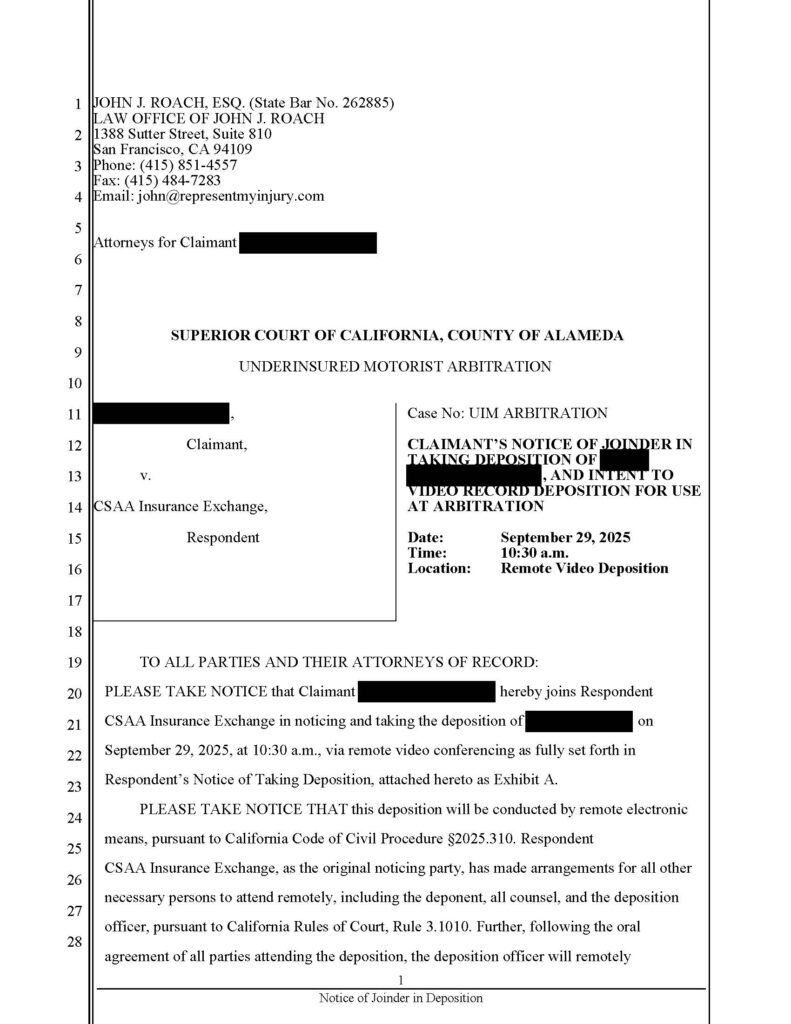
Here is the tactic I use most consistently in UIM arbitrations and complex personal injury cases: when the defense notices the deposition of a treating physician or plaintiff’s retained expert, I file a notice of joinder that cross-notices the deposition and reserves the right to use the video at arbitration or trial.
The strategic rationale is straightforward. Defense attorneys typically notice expert depositions early in discovery, before their own experts are fully retained and before they have completed their review of the medical records. Their examination tends to focus on the basics. As plaintiff’s counsel joining in, I ask my own questions — getting favorable testimony on the record about causation, permanence, and the daily impact of the injury — while the defense has not yet fully developed its attack on the expert’s opinions.
The joinder notice is simple: it identifies the deponent, attaches the defense notice as Exhibit A, states that the plaintiff will record stenographically and by video, reserves the right to use the video at arbitration or trial under CCP 2025.340(m) and 2025.620(d), and notes that if the noticing party cancels, the plaintiff reserves the right to proceed independently.
I used this tactic in the $750,000 UIM arbitration I recently obtained for a client with a traumatic brain injury and post-concussive syndrome from a rear-end collision on I-880. The defense noticed the deposition of the plaintiff’s treating neurologist. I filed a joinder, reserved video use, and used clips from that deposition in the arbitration presentation. The arbitrator awarded $750,000 against an insurer whose opening position was $125,000.
The same approach applies to treating physicians in standard personal injury cases. Treating physicians are typically plaintiff-friendly witnesses — they know the patient, they have treated the injury, and they can speak to causation and permanence from direct clinical experience. Getting their testimony on video early, before the defense has deposed them multiple times and sharpened its cross-examination, preserves the most favorable version of their testimony for use at trial.

Cost Savings: Video Depositions and Expert Fees
Beyond the strategic advantages, video depositions have significant economic benefits for plaintiff attorneys handling cases on contingency. Neurologists, neuropsychologists, life care planners, and vocational rehabilitation experts routinely charge $500 to $1,500 per hour for live trial testimony — including travel, waiting time, and the inherent unpredictability of court scheduling. A retained expert who is paid for a full day of trial availability may end up waiting six hours before being called.
By reserving video use and presenting expert testimony from deposition, you pay for the deposition preparation and the deposition itself — and nothing more. The jury sees the same expert testimony without the premium for live appearance. In catastrophic injury cases where multiple experts are required, the savings can be substantial and directly increase net recovery to the client.
YouTube Examples
I post clips from videotaped depositions on my YouTube channel, including expert testimony from the TBI case referenced above. You can see how video deposition clips are structured and presented in arbitration and trial contexts.
Visit: youtube.com/@Lawofficeofjohnjroach
Referrals and Co-Counsel
If you have a catastrophic car accident case, TBI matter, or complex UIM arbitration in California and want to discuss referral or co-counsel, visit my attorney referrals page for details on how I work with referring counsel. I handle every significant case personally and work on contingency. Call (415) 851-4557 or email john@representmyinjury.com directly — if you want a sample joinder notice or deposition notice with proper video reservation language, I’m happy to send one over.
Frequently Asked Questions: Videotaped Depositions in California
Yes — for two categories of witnesses. Under CCP 2025.620(b), a party opponent’s deposition may be used for any purpose at trial regardless of their availability. Under CCP 2025.620(d), a videotaped deposition of an expert witness or treating physician may be used at trial even if that witness is available, provided the right was properly reserved in the deposition notice under CCP 2025.340(m).
Under CCP 2025.220, the notice must identify the witness, state the date, time, and location, and specify that the deposition will be recorded by video means. For expert witnesses and treating physicians, the notice must also include a reservation of the right to use the video at trial under CCP 2025.340(m). Failure to include this reservation forecloses the CCP 2025.620(d) pathway for using expert video at trial regardless of availability.
A notice of joinder is filed by a party who wants to cross-notice a deposition that has already been noticed by another party. It attaches the original notice as an exhibit and adds the joining party’s own designations — including video recording and the CCP 2025.340(m) reservation for trial use. For plaintiff attorneys, filing a joinder to the defense’s notice of a treating physician allows plaintiff’s counsel to ask their own questions, get favorable testimony on video, and reserve trial use — often before the defense has fully developed its attack on the expert’s opinions.
Yes, provided the clip is admissible evidence that the jury will see during trial. Playing a clip of a defendant’s deposition admission in opening statement is a powerful technique that transforms opening from argument into evidence. Most California judges will allow this when the admissibility of the clip is not in dispute.
Expert witnesses typically charge $500 to $1,500 per hour for live trial testimony including travel and waiting time. By properly reserving video use and presenting expert testimony from deposition, you pay for the deposition preparation and deposition time only. In cases requiring multiple experts, the savings can be substantial and directly increase net recovery to the client.
Disclaimer: This blog post is for informational purposes only and does not constitute legal advice. Consult a licensed attorney for advice specific to your situation.




