

John Roach, Esq. | January 20, 2026 | California Law
What Is a CCP 998 Offer in California Personal Injury Cases? Your Guide to the Statutory Offer to Compromise

One of the most powerful and underutilized tools in California personal injury litigation is the CCP 998 offer to compromise. Whether you are a plaintiff trying to maximize your recovery or an attorney evaluating strategy, understanding how this statute works — and how it affects the financial stakes of going to trial — can be the difference between an optimal outcome and a costly mistake.
I’m John J. Roach, a San Francisco personal injury trial attorney who has practiced since 2009, handling car accident cases, slip and fall cases, traumatic brain injury cases, and wrongful death cases throughout the Bay Area. This is a practical breakdown of CCP 998 — what it is, how it works, and how I use it strategically in serious injury cases.
What Is a CCP 998 Offer?
California Code of Civil Procedure Section 998 allows any party to a civil lawsuit — plaintiff or defendant — to serve a formal written offer to settle the case. The offer must be clearly designated as a “Statutory Offer to Compromise” or “CCP 998 Offer,” must specify the terms of the proposed settlement, and must include a signature line for the offeree to accept. The Judicial Council form CIV-090 can be used to formalize the offer.
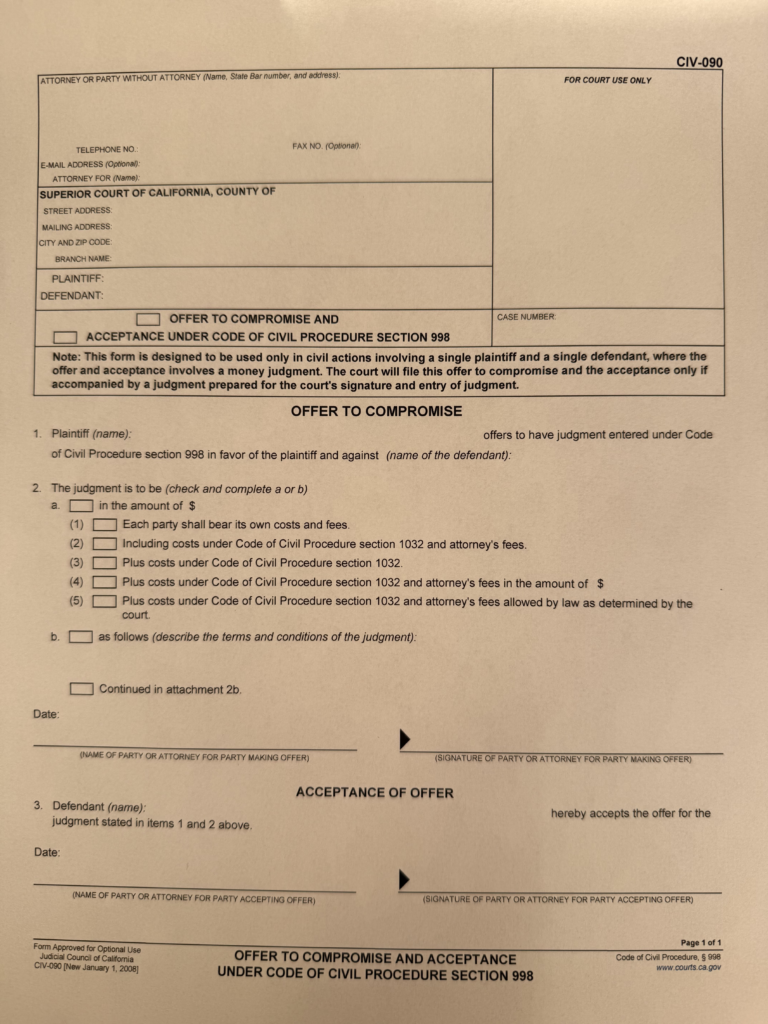
A 998 offer must be served at least 10 days before trial or arbitration begins. The opposing party has 30 days to accept — or until the start of the hearing, whichever comes first. If accepted, the parties execute a settlement agreement and release, and the case is dismissed. If rejected or not answered within the deadline, the offer expires and is kept confidential from the judge or jury during trial.
The purpose of CCP 998 is to encourage reasonable settlements by imposing significant financial consequences on parties who reject a reasonable offer and then fail to do better at trial. It turns the decision whether to settle into a high-stakes financial calculation — and understanding the math is essential to using it effectively.
How CCP 998 Works in Practice
Consider a concrete example. A client sustains serious injuries in a car accident. I estimate total damages at $120,000 — $40,000 in medical expenses and $80,000 for ongoing pain, suffering, and lost earning capacity. I serve a 998 offer for $95,000. The defense reviews the medical records and expert analyses and must decide: accept the offer or risk a worse outcome at trial.
If they accept, the case resolves at $95,000 and both sides avoid the cost and uncertainty of trial. If they reject and we obtain a verdict exceeding $95,000 — say, $110,000 — the consequences for the defense extend well beyond the verdict amount. They must also pay our post-offer expert witness costs and my client receives 10% annual prejudgment interest on the compensatory damages from the date of the offer to the date of payment, under Civil Code Section 3291.

The reverse also applies. If the defense serves a 998 offer of $50,000 and the plaintiff rejects it but only obtains $30,000 at trial, the plaintiff must pay the defense’s post-offer costs — including expert witness fees — which courts deduct from the verdict. If those costs exceed the verdict amount, the plaintiff can end up owing money to the defense. This is one of the most significant financial risks in personal injury litigation and one I make sure every client fully understands before trial.
The Prejudgment Interest Advantage: Civil Code Section 3291
One of the most valuable — and most overlooked — consequences of a rejected plaintiff’s 998 offer is prejudgment interest under Civil Code Section 3291. When a plaintiff serves a 998 offer, the defendant rejects it, and the plaintiff obtains a more favorable judgment at trial, the plaintiff is entitled to 10% annual interest on the compensatory damages from the date the offer was served to the date of payment.
In prolonged litigation, this adds up quickly. The calculation is straightforward: multiply the compensatory damage award by 10%, divide by 365 to get the daily rate, and multiply by the number of days from the offer date to the payment date. In a case that takes two years from offer to payment on a $300,000 verdict, the prejudgment interest alone approaches $60,000.
This is why I serve 998 offers early — after discovery has produced a solid evidentiary record but well before trial. Every additional day between the offer date and the payment date adds to the interest accumulation.
What Costs Are Recoverable Under CCP 998?
When a party serves a 998 offer that is rejected and subsequently obtains a more favorable result at trial, the recoverable costs extend significantly beyond the standard items available under CCP Sections 1031 and 1032.
Post-offer expert witness fees are the most significant enhancement. These include fees paid to treating physicians, accident reconstructionists, neuropsychologists, life care planners, and economists retained after the offer was served. Courts award reasonable and necessary amounts, up to the limits established in Government Code Section 68092.5. In catastrophic injury cases with multiple experts, post-offer expert fees can easily reach $20,000 to $50,000 or more.
Prejudgment interest at 10% annually on compensatory damages from the offer date runs concurrently.
Other post-offer costs include court reporter fees, deposition transcripts, exhibit preparation, and subpoena costs incurred after the offer was served.
Attorney fees are not recoverable directly under CCP 998 — they require a separate statutory or contractual basis. Pre-offer expert fees and mediation costs are also generally excluded from the 998 cost-shifting framework unless separately authorized.
How to Calculate Whether You Beat a 998 Offer
The determination of whether a party obtained a “more favorable judgment” than a rejected 998 offer is not simply a comparison of the offer to the verdict. Courts add the offeree’s pre-offer costs to the verdict before making the comparison.
From the plaintiff’s perspective: Add pre-offer costs to the verdict. If the total exceeds the defendant’s rejected offer, the plaintiff has beaten the offer and the cost-shifting consequences are triggered. Example: Defendant’s rejected offer was $50,000. Verdict is $45,000. Pre-offer costs are $7,000. Total: $52,000. That exceeds $50,000, so the plaintiff has beaten the offer despite the verdict being lower than the offer.
From the defendant’s perspective: If the plaintiff’s rejected offer was $95,000, the verdict is $110,000, and the plaintiff’s pre-offer costs are $8,000, the total is $118,000 — well above $95,000. The defendant must pay all post-offer cost enhancements.

From an actual case I handled: the plaintiff served a 998 offer of $300,000 on December 1, 2022. The verdict was $300,000 on April 28, 2025. Pre-offer costs were $6,699.78, bringing the total to $306,699.78 — above the offer. Prejudgment interest accrued at approximately $82.19 per day (10% of $300,000 / 365) over 880 days: $72,328.77. Post-offer expert fees were $14,225. The total recovery significantly exceeded the verdict alone.
Real Case Examples

Scenario 1 — Plaintiff’s offer rejected, plaintiff wins more: Plaintiff offers $95,000. Defense rejects. Jury awards $110,000. Plaintiff adds post-offer expert fees ($12,000) and prejudgment interest at 10% over 18 months (approximately $14,000). Total cost to defense: over $136,000 — significantly more than the $95,000 they rejected.
Scenario 2 — Defendant’s offer rejected, plaintiff wins less: Defense offers $50,000. Plaintiff rejects. Jury awards $30,000. Plaintiff must pay defense post-offer costs ($18,000) and expert fees ($12,000). Net recovery to plaintiff: minimal or negative. This is the scenario I am most careful to help clients avoid — rejecting a reasonable defense offer and then underperforming at trial is a significant financial risk that every plaintiff must understand before proceeding.
Scenario 3 — Close call: Plaintiff offers $12,500 inclusive of costs. Verdict is $3,150. Adding post-offer transcript and expert costs may push the total above the offer, triggering interest and additional fees. In smaller cases, the arithmetic can be surprisingly consequential.
The Good Faith Requirement
California courts require that 998 offers be made in good faith — meaning they must fall within a reasonable range of the potential verdict and be served at a time when the opposing party has sufficient information to evaluate them. An offer that is unreasonably low in a clear liability case, or served before meaningful discovery has occurred, may be found invalid by the court after trial and the cost-shifting consequences will not apply.
I serve 998 offers after discovery has produced a solid record — medical records, expert opinions, and a clear damages picture — so the offer is both strategically positioned and legally defensible as a good faith offer. Timing is as important as the amount.
Strategic Considerations
For plaintiffs, the optimal time to serve a 998 offer is after discovery has revealed the full strength of the liability and damages case but well before trial — maximizing the period during which prejudgment interest accrues if the offer is rejected. The amount should be calibrated to be genuinely reasonable relative to the expected verdict range: high enough to reflect the real value of the case, but not so high that the defense can easily argue it was made in bad faith.
For defense counsel and their clients, a 998 offer is a tool to cap exposure. A reasonable early offer that addresses the verified economic damages — while limiting exposure on contested non-economic damages — shifts the financial risk of trial to the plaintiff. If the plaintiff rejects and underperforms, the defense recovers its post-offer expert costs.
In settlement negotiations, I reference the 998 tool directly when it serves my client’s interests: making clear that a formal statutory offer is forthcoming and that rejection will trigger interest accrual and cost-shifting. This changes the calculus for the insurance adjuster in ways that a standard settlement demand does not.

If you were seriously injured in an accident in San Francisco or the Bay Area and want to understand how the 998 tool fits into the strategy for your case, call me at (415) 851-4557 for a free consultation. I work on a contingency fee basis — you pay nothing unless I recover money for you. I am bilingual in English and Spanish.
Frequently Asked Questions: CCP 998 Offers in California
A CCP 998 offer is a formal written settlement offer served under California Code of Civil Procedure Section 998. Either party — plaintiff or defendant — can serve one at any time at least 10 days before trial. If the offer is rejected and the offering party obtains a more favorable result at trial, the rejecting party faces significant financial consequences including payment of post-offer expert witness fees and, for plaintiffs, 10% annual prejudgment interest on compensatory damages under Civil Code Section 3291.
If you are the plaintiff and you reject the defendant’s 998 offer but obtain a lesser verdict at trial, you forfeit your right to recover post-offer costs and must pay the defendant’s post-offer costs — including expert witness fees. These are deducted from your verdict. If the costs exceed your verdict, you may owe money to the defendant. This is one of the most significant financial risks in personal injury litigation and must be carefully evaluated before rejecting any 998 offer.
When a plaintiff serves a 998 offer, the defendant rejects it, and the plaintiff obtains a more favorable result at trial, the plaintiff is entitled to 10% annual interest on the compensatory damages from the date the offer was served to the date of payment. This is calculated daily: damage amount × 10% ÷ 365 = daily rate. In cases that take years from offer to resolution, this can add tens of thousands of dollars to the total recovery.
Post-offer expert witness fees are the most significant cost enhancement under CCP 998. These include fees paid to treating physicians, accident reconstructionists, neuropsychologists, life care planners, vocational rehabilitation experts, and economists retained after the offer was served. Courts award reasonable and necessary amounts up to the limits in Government Code Section 68092.5. Attorney fees and pre-offer expert fees are not recoverable under CCP 998.
The determination is not simply a comparison of the offer to the verdict. Courts add the offeree’s pre-offer costs to the verdict before making the comparison. For example, if the defendant’s rejected offer was $50,000 and the verdict is $45,000, but the plaintiff’s pre-offer costs are $7,000, the total is $52,000 — which exceeds $50,000, meaning the plaintiff has beaten the offer despite the verdict being lower than the offer amount.
Yes. California courts require 998 offers to fall within a reasonable range of the potential verdict and to be served at a time when the opposing party has sufficient information to evaluate them. An offer that is unreasonably low in a clear liability case, or served before meaningful discovery, may be found invalid by the court after trial — and the cost-shifting consequences will not apply.
Disclaimer: This blog post is for informational purposes only and does not constitute legal advice. Consult a licensed attorney for advice specific to your situation.




