

John Roach, Esq. | February 9, 2026 | California Law \ Car Accidents
Understanding Contingency Fees in Personal Injury Cases: A Guide for Victims

One of the first questions every seriously injured person asks when they call my office is: “How do you get paid?” The answer is a contingency fee — and understanding how it works is important before you sign any retainer agreement with any attorney. This post explains what contingency fees are, why the percentage structure is justified, how the tiered fee structure in my retainer agreement works, and what happens to the costs advanced during your case.
I’m John J. Roach, a San Francisco personal injury attorney with extensive trial experience representing victims of car accidents, slip and fall accidents, traumatic brain injuries, wrongful death cases, and other serious personal injury matters throughout the Bay Area. I work exclusively on contingency — and here is exactly what that means for you.
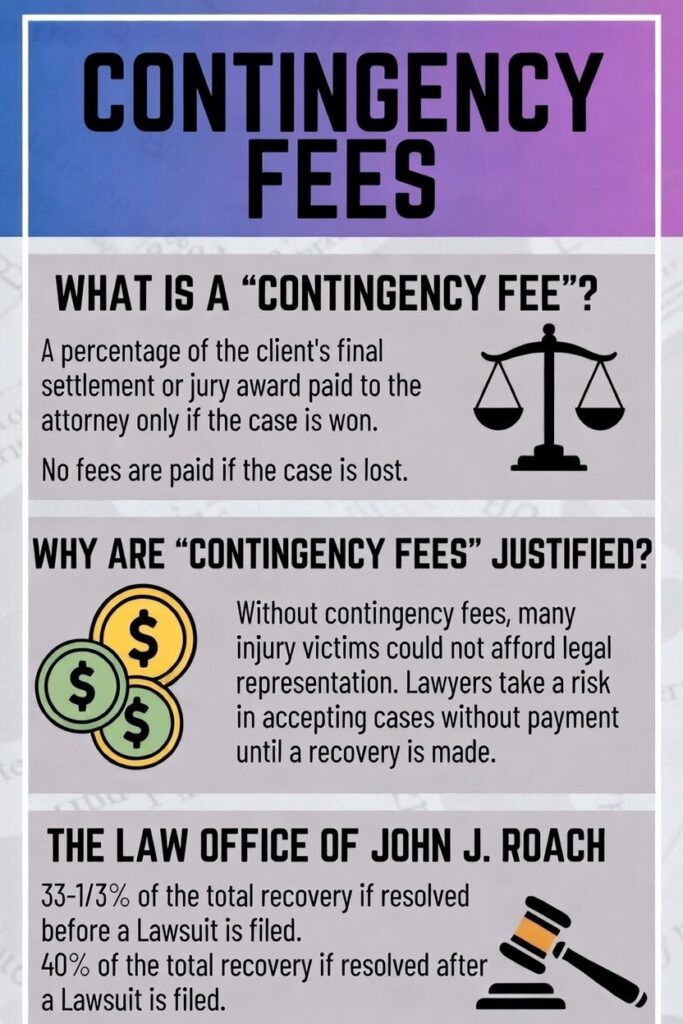
What Is a Contingency Fee?
A contingency fee is a payment arrangement in which the attorney only gets paid if the case results in a recovery — through settlement, arbitration award, or jury verdict. If there is no recovery, there is no attorney fee. You pay nothing out of pocket regardless of how much work is done on your case.
Instead of an hourly rate or a flat fee, the attorney receives a percentage of the total recovery. That percentage is agreed upon in writing at the start of the representation, before any work begins. In California, attorneys are required by the Rules of Professional Conduct to obtain informed written consent from clients and to disclose explicitly that the fee is not set by law — it is negotiable between attorney and client.
This structure means that an injured person with no money, no ability to pay hourly legal fees, and no familiarity with the legal system can hire an experienced trial attorney and have that attorney fully committed to their case — because the attorney’s compensation depends entirely on the outcome.
Why the Percentage Structure Is Justified
Critics sometimes ask why attorneys charge a percentage of the recovery rather than an hourly fee. The answer is risk. When I take on a serious injury case, I front all the costs — medical record retrieval, police reports, expert witness retention, deposition costs, court filing fees, investigation, and more. In a complex case with multiple experts, those costs can reach $50,000 or more before the case resolves. I receive none of that money back and receive no payment for my time if the case does not result in a recovery.
The outcome is uncertain in every case I accept. Evidence that looked strong can be challenged at trial. A sympathetic client can make a poor impression on a jury. An insurer with deep resources can drag a case out for years. A jury can find against a legitimate plaintiff. The percentage-based fee compensates for the cases that do not succeed — it is not pure profit on the cases that do.
Beyond risk, the contingency structure aligns incentives. My fee is a percentage of what you recover, so my financial interest and yours are identical: maximum recovery. An attorney billing hourly has no particular financial stake in the outcome. The contingency model ensures I am fighting for the same result you are.

Is There a Standard Contingency Fee in California?
No. California law does not set a standard contingency fee for personal injury cases. Fees are negotiable and vary based on the complexity of the case, the anticipated cost of litigation, the strength of the liability evidence, and the attorney’s experience and track record. Common ranges in California personal injury cases are 33⅓% for pre-litigation settlements and 40% for cases that require filing a lawsuit and proceeding through litigation.
Higher fees in litigated cases reflect the substantially greater time and expense involved. Once a lawsuit is filed, the workload expands dramatically — depositions, motions practice, expert witness retention and preparation, court appearances, trial preparation, and potentially trial itself. The attorney’s investment of time and money in a litigated case is far greater than in a case that resolves pre-litigation, and the fee structure reflects that difference.
How I Handle Contingency Fees at the Law Office of John J. Roach
My retainer agreement uses a tiered contingency structure that I explain to every client before they sign anything:
33⅓% if the case resolves before a lawsuit is filed. Pre-litigation resolution — through direct negotiation or demand — involves less cost and complexity than full litigation. When I can achieve a fair result without filing suit, the client keeps a larger share of the recovery.
40% if a lawsuit is filed. This applies once a complaint is filed in Superior or District Court, or once a demand for arbitration is made in an uninsured or underinsured motorist case. The higher percentage reflects the substantially greater investment of time, cost, and risk that litigation requires.
My goal in every case is to achieve the best possible result with the least possible cost — because costs reduce your net recovery. I pursue pre-litigation resolution aggressively when the liability is clear and the damages are fully documented, and I litigate without hesitation when the insurer will not offer fair value. The decision to file suit is always made together with the client, with a clear explanation of what it will cost and what it is expected to achieve.
What Happens to Costs Advanced During the Case?
In addition to the attorney fee, my retainer agreement provides for reimbursement of costs advanced during the case — items like subpoena fees, court filing fees, medical record charges, deposition transcript costs, expert witness fees, and investigation costs. These are paid out of the recovery after the attorney fee is calculated.
This means the sequence is: gross recovery minus attorney fee, minus advanced costs, equals your net recovery. I review the cost itemization with every client before any settlement is finalized so there are no surprises. In my practice, I keep case costs as lean as possible while retaining the experts the case actually requires — because every dollar in unnecessary costs is a dollar out of your recovery.
If there is no recovery, you owe nothing — not for attorney fees and not for the costs advanced. That is the core promise of the contingency model.
Why Contingency Fees Make Legal Representation Accessible
The practical impact of the contingency fee model is that anyone seriously injured by someone else’s negligence — regardless of their financial situation — can access experienced legal representation. An uninsured construction worker, an undocumented immigrant, a retiree on a fixed income — none of them can afford to pay $400 per hour to litigate a personal injury case for two years. Contingency fees eliminate that barrier entirely.
Research consistently shows that represented plaintiffs recover significantly more than unrepresented ones — even after the attorney fee is deducted. Insurance companies know which attorneys litigate and which ones settle for whatever is offered. Having an experienced trial attorney on your side changes the insurer’s calculus from the first phone call.
If you were seriously injured in an accident in San Francisco or the Bay Area, call me at (415) 851-4557 for a free consultation. I will explain exactly how my fee structure works, what your case may be worth, and what the litigation process looks like — before you make any decision. I am bilingual in English and Spanish and available evenings and weekends.
Frequently Asked Questions: Contingency Fees in California Personal Injury Cases
A contingency fee is a payment arrangement in which the attorney only receives a fee if the case results in a recovery — through settlement, arbitration award, or jury verdict. The fee is a percentage of the total recovery, agreed upon in writing before representation begins. If there is no recovery, there is no attorney fee and no cost to the client. In California, attorneys are required to obtain informed written consent and to disclose that the fee is negotiable.
California does not set a standard contingency fee for personal injury cases — fees are negotiable. Common ranges are 33⅓% for cases that resolve through pre-litigation settlement and 40% for cases that require filing a lawsuit and proceeding through litigation. Higher fees in litigated cases reflect the substantially greater investment of attorney time and case costs that litigation requires.
Case costs advanced by the attorney — medical record charges, court filing fees, deposition transcripts, subpoena fees, expert witness fees, and investigation costs — are reimbursed from the recovery after the attorney fee is calculated. The sequence is: gross recovery minus attorney fee, minus advanced costs, equals your net recovery. If there is no recovery, you owe nothing for either fees or costs.
Filing a lawsuit dramatically increases the attorney’s investment of time and cost — depositions, motions practice, court appearances, expert witness retention and preparation, trial preparation, and potentially trial itself. The higher percentage in litigated cases reflects the greater risk and investment, not additional profit. Pre-litigation resolution is less expensive for both the client and the attorney, which is why the fee is lower when a case settles before suit is filed.
Yes. The contingency fee model requires no upfront payment. The attorney fronts all case costs and receives a fee only if the case results in a recovery. This means an uninsured worker, a retiree on a fixed income, or anyone without resources to pay hourly legal fees can hire an experienced trial attorney and have that attorney fully committed to their case — because the attorney’s compensation depends entirely on the outcome.
Disclaimer: This blog post is for informational purposes only and does not constitute legal advice. Consult a licensed attorney for advice specific to your situation.




