

My client wasn’t hurt by a stranger’s negligence and left to fight a stranger’s insurance company. He was hurt by a stranger’s negligence — and then had to fight his own insurance company to get paid for it. His own insurer disputed the injury was even real. The arbitrator ruled in his favor and ordered full payment of his underinsured motorist coverage: $225,000.
A leisurely bike ride, a U-turn, and no visible injury at all

My client was 43, a software engineer with no history of back pain, riding his bike through a tunnel on what he’d planned as a relaxed ride to the beach. As he came out of the tunnel, a driver made a U-turn directly in front of him. He couldn’t stop in time. His left hip struck the car, he went over the hood, and he hit the ground.
He got up. He could walk. He wasn’t bleeding. No bruises, no scratches, no broken skin anywhere. By every visible measure, he looked like a man who’d had a scare and nothing more.
That’s exactly what made this case hard — and exactly why I took it.
The injury that didn’t look like an injury
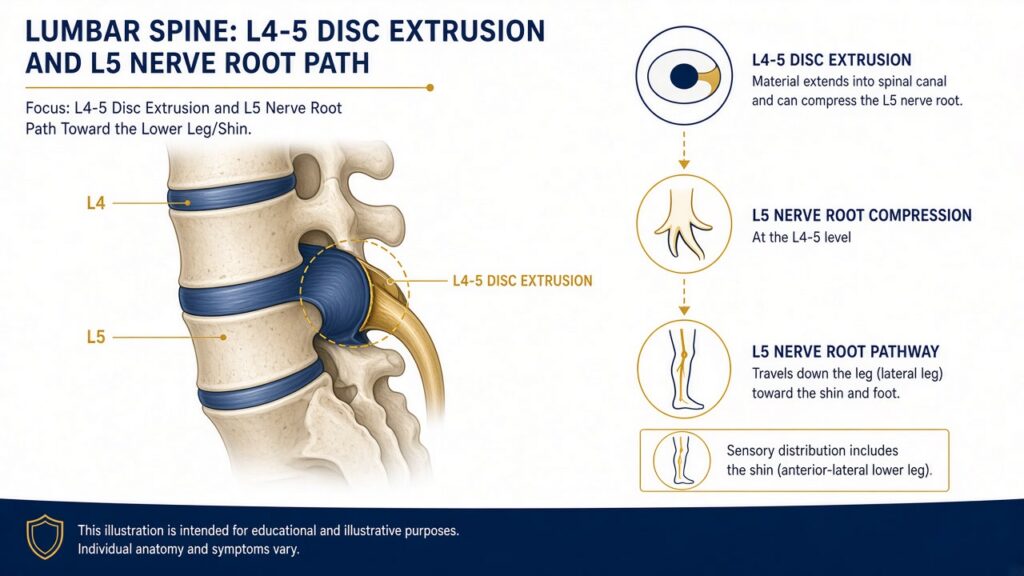
What he actually felt was strange: a numb, plastic-sheet sensation in his left shin. He saw a general practitioner, not a spine doctor, who ordered an X-ray of his leg, found no fracture, and sent him home with a diagnosis of soft tissue strain — three to four months to resolve. No back exam. No neurological testing. No straight-leg-raise test.
Over the following months, alone and working from home, he got worse. He stopped riding his bike. He stopped tending the wall of plants that climbed to the second floor of his house — something he genuinely took pride in. His mother visited and found him crawling through his own house, using his hands to get down the stairs because he couldn’t stand upright. She’s the one who told him to get it looked at again.
An MRI finally showed why: a large disc extrusion at L4-5, severely compressing the nerve root. One treating doctor’s chart note reads simply, “herniation is huge.” By then my client needed a wheelchair just to get from the car to his own medical appointments. He had spine surgery — a decompression and microdiscectomy at L4-5. It worked, for a while. Months later the pain came back. A second MRI showed the disc had herniated again in the same spot. He had a second surgery.
Then his own insurer told him to prove it wasn’t something else

The driver who hit him was underinsured — his coverage didn’t come close to covering two spine surgeries and months of collapsing health. So we turned to the underinsured motorist coverage my client had paid for on his own policy, for exactly this situation. That’s when the case stopped being about who caused the crash — nobody ever disputed that — and became entirely about whether the crash caused the injury.
The insurance company’s retained expert, a self-described “conservative” neurosurgeon, testified that my client’s disc herniation had nothing to do with the bike accident — that it happened months later, from some unreported, undocumented injury nobody could name. Under oath, he couldn’t point to a single medical record, a single witness, or a single fact supporting that theory. He admitted he had no information about my client’s activity level during the relevant period. He admitted there was nothing in six years of medical records showing any prior back complaint. He admitted that trauma like falling off a bike absolutely can tear a spinal disc. He simply didn’t believe, in this instance, that it had.
How I took apart their defense expert
The insurance company’s entire causation defense rested on that one retained witness. Before I asked him a single medical question, I got him to put his incentives on the record: 90% of his medical-legal work is for the defense, he bills $600 an hour to review records, and he charges $5,000 for a half-day of arbitration testimony. He’d spent 27 minutes examining my client — about half of that the actual physical exam — and roughly two and a half hours reviewing somewhere between 500 and 1,000 pages of medical records before writing his report.
His opinion rested on a theory that required an injury nobody had ever documented — an “undisclosed” trauma sometime in August or October of 2016. I asked him directly whether there was any reference anywhere in the records to an injury on that date. “That’s why I said undisclosed,” he told me. There wasn’t. There never had been.
I walked him back through the reasoning underneath that theory, one admission at a time. His opinion that my client’s initial shin pain was a soft-tissue injury — not nerve pain — rested entirely on the fact that a general practitioner’s chart note called it “focal tenderness” instead of “radiculopathy.” I asked whether he knew that doctor had any spinal training. He didn’t. I asked whether that doctor had performed any back exam, neurological testing, or straight-leg-raise test. He hadn’t — nothing in the chart showed one had been done. I asked whether concluding the doctor had quietly examined the back and found nothing worth noting, versus simply never examining it, was anything more than a guess. “It’s an educated guess,” he admitted.
Then I asked him, plainly, whether the collision contributed to the disc injury that required two surgeries. He wouldn’t say no. He wouldn’t say yes. Across several pages of transcript he moved from “I don’t know if there’s a contribution — it may have” to “possible, but not probable” to “I’m not prepared to say it had no role” — without ever landing on a position he could actually defend. When I pushed him to say what role he thought the accident did play, he told me that question itself called for speculation.
The closest thing he had to a real theory was two separate injuries: an initial, resolved bout of leg tenderness from the accident, followed by a second, unrelated disc herniation months later. I asked him when the first episode ended and the second began. He couldn’t say. “The focal tenderness could have stopped much earlier. I simply can’t reconstruct that from the records I have,” he told me — describing, in his own words, the exact gap his whole theory depended on and couldn’t produce.
He’d also never opened the CD containing my client’s second MRI — the one showing the recurrent herniation that led to the second surgery. He was giving causation opinions about a surgery he’d never seen the imaging for.
Occam’s razor, not speculation
I built the affirmative case around what nobody disputed: no prior back problems, ever. No accident, injury, or incident of any kind in the six years before the collision, or in the months afterward. A driver’s U-turn. A body thrown over a hood. A hip that dented sheet metal. Immediate numbness in the exact nerve distribution — the L5 root — that runs to the shin, right where my client first felt something wrong. And my client’s own retained physician testified plainly that getting hit by a car while riding a bike, flying over the hood, and landing on the ground is “a very common way — or a very easy way — for patients to hurt their back.”
Every defense theory required inventing an event that nobody witnessed, nobody documented, and nobody — including the insurance company’s own expert, once pressed — could actually defend. My client’s explanation required inventing nothing. It matched the timeline, the anatomy, and the medical record exactly.
At arbitration, I built the damages case around what those months actually cost him in ways a medical chart can’t capture: nearly six months between the collision and his first surgery, valued at $1,000 a day for pain no one believed was real; roughly five months between his first and second surgery, valued at $750 a day; and every day forward, for the rest of his life expectancy, that a man who used to ride his bike for recreation has been told not to get back on one.
The award
The arbitrator’s ruling didn’t leave much room for argument. He found the collision caused my client’s L4-5 disc herniation, with severe compression of the dural sac, and the recurrent herniation with severe displacement on top of it. He found the accident was a substantial factor in my client’s pain, suffering, and medical expenses — past and future — at a value “reasonably in excess of the remaining limits” of his own UIM coverage. Because the insurance company had already conceded that if causation were found, the injury was worth more than the policy anyway, the arbitrator didn’t need to land on a specific damages number at all. He simply ordered the insurance company to pay what it owed: the full $225,000 in underinsured motorist benefits, on its own policyholder’s claim, for an injury it had spent the entire arbitration insisting wasn’t real.
My client didn’t have a dramatic, visible injury. He had numbness in his shin, a story nobody witnessed, and an insurance company betting that would be enough to make his claim disappear. It wasn’t.
If your own insurance company is disputing a UIM or UM claim after a bicycle, motorcycle, or car accident, I’d be glad to review it. Free consultation: (415) 851-4557.