

John Roach, Esq. | February 16, 2026 | Attorney Tips \ California Law \ Car Accidents
Can Uber or Lyft Be Held Liable for Driver Negligence in California After Prop 22?

California rideshare accident cases raise legal questions that go well beyond a standard car accident claim. When you are injured by an Uber or Lyft driver, you are not just dealing with that driver’s personal auto insurance — you are dealing with a corporate entity, a layered insurance structure, and a specific body of California law that governs when and how that company can be held responsible. Proposition 22, which voters passed in 2020, has added another layer of complexity that injured victims and their attorneys need to understand.
I’m John J. Roach, a San Francisco personal injury attorney with extensive trial experience handling car accident cases, including rideshare collision cases, throughout the Bay Area. This post breaks down the current California framework for rideshare liability — the Diaz rule, what Prop 22 does and does not change, and what the insurance coverage looks like in serious injury cases.
Vicarious Liability and the Diaz Rule
The starting point for any rideshare liability analysis is the California Supreme Court’s decision in Diaz v. Carcamo (2011) 51 Cal.4th 1148. The rule established there is straightforward: when an employer admits vicarious liability for a driver’s negligent conduct, claims for negligent hiring, retention, or entrustment are typically barred.
The Court’s reasoning was that these direct negligence theories are functionally duplicative of vicarious liability in driving cases — both ultimately attribute the driver’s conduct to the employer. Allowing both claims to proceed simultaneously could produce unfair double liability under California’s comparative fault system, because the employer could be assigned additional fault percentage beyond what it has already accepted through the vicarious liability admission.
Uber and Lyft frequently admit vicarious liability as a litigation strategy. By doing so, they eliminate the negligent hiring and retention claims that would otherwise allow a plaintiff to probe the company’s background check processes, driver screening failures, and internal safety decisions — and potentially open the door to punitive damages. Understanding why they make this admission, and what it costs the plaintiff, is essential to evaluating any rideshare injury case.
What Negligent Hiring and Retention Claims Require
Before the Diaz rule bars them, negligent hiring and retention claims are potentially significant in rideshare cases. These are direct liability theories — meaning they hold the company responsible for its own conduct in screening and retaining drivers, independent of the driver’s conduct behind the wheel.
Under California Civil Code Section 1714, every person has a duty of ordinary care to prevent harm to others. Applied to an employer, this means a rideshare company that knew — or should have known — that a driver presented an unreasonable risk of harm may be directly liable for injuries that driver causes. Rideshare companies are required to conduct background checks under California Public Utilities Code Section 5445.2. A failure to conduct an adequate check, or a decision to retain a driver whose record revealed known risks, could support a direct negligence claim.

Negligent hiring claims also have the potential to support punitive damages under Civil Code Section 3294 — if the company’s conduct showed conscious disregard for the safety of the public. This is a significant distinction from a vicarious liability claim, which is limited to compensatory damages based on the driver’s conduct. When the Diaz rule bars the negligent hiring claim, it typically closes the punitive damages door as well, which is one of the most important strategic consequences of the company’s vicarious liability admission.
What Proposition 22 Does — and Does Not — Change
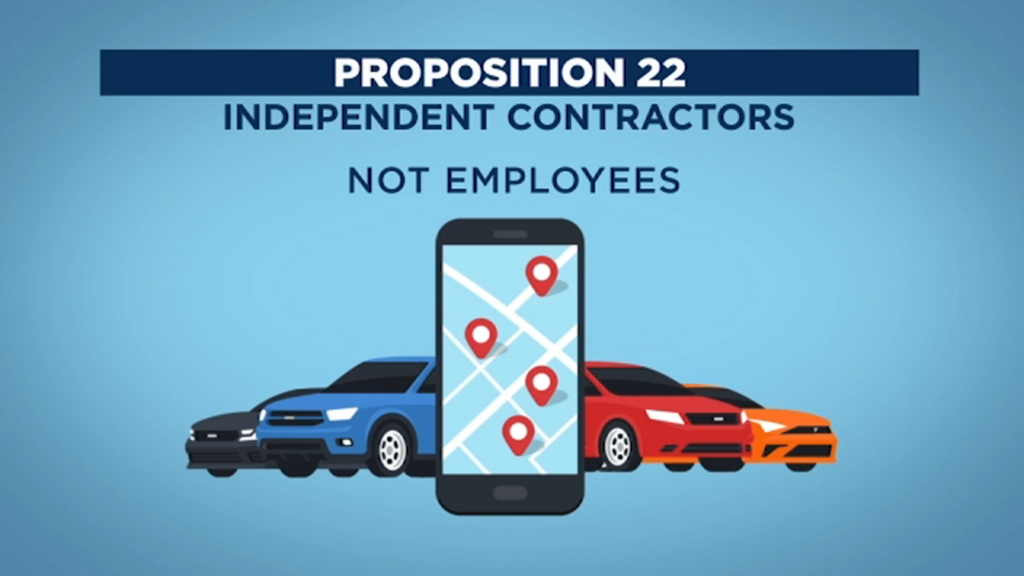
In November 2020, California voters passed Proposition 22, which classifies app-based rideshare drivers as independent contractors rather than employees — provided the rideshare companies satisfy specified conditions including avoiding mandated schedules or minimum ride acceptance requirements. The California Supreme Court affirmed Prop 22’s constitutionality in Castellanos v. State of California (2024) 16 Cal.5th 588.
The critical point for injured victims is this: Proposition 22 was designed to address labor classification and driver benefits — it does not modify tort liability for third-party injury victims. The initiative’s text, ballot arguments, and the judicial analysis in Castellanos all confirm that Prop 22 was not intended to restrict the ability of passengers, pedestrians, or other road users to recover from rideshare companies for driver negligence.
Several specific statutory provisions preserve liability regardless of Prop 22’s independent contractor classification. California Public Utilities Code Section 5354 attributes the actions of rideshare drivers to the company as a transportation network company. Civil Code Section 2100 imposes the highest duty of care on common carriers — including rideshare companies — for their passengers. These frameworks remain intact under Prop 22.
The independent contractor designation does provide an additional layer of protection for claims brought by drivers themselves against the company — under Camargo v. Tjaarda Dairy (2001) 25 Cal.4th 1235, hirers generally avoid negligent hiring liability regarding independent contractors’ own employees. But courts have consistently clarified that Camargo does not preclude third-party negligent hiring actions by passengers or other members of the public.
The Insurance Framework: What Coverage Actually Applies
Understanding the layered insurance structure in rideshare cases is essential — particularly in traumatic brain injury, spinal cord injury, and wrongful death cases where damages can exceed a million dollars. California law, including Prop 22 and Senate Bill 371 (effective January 1, 2026), mandates layered coverage that varies by the driver’s activity status at the time of the crash.
Period 1 — App on, waiting for a ride request. The driver is logged into the platform but has not yet accepted a ride. Coverage is limited: typically $50,000 per person for bodily injury, $100,000 per accident, and $30,000 for property damage. Companies also maintain $200,000 in excess liability for severe incidents during this period.
Periods 2 and 3 — Ride accepted through passenger drop-off. Once a ride is accepted through the completion of the trip, the full company insurance applies: $1,000,000 in third-party liability coverage for injuries or property damage caused by the driver. Under SB 371, UM/UIM coverage has been restructured to $60,000 per person and $300,000 per accident.
The $1 million liability policy available in Periods 2 and 3 is the most important number in any serious rideshare injury case. It dramatically exceeds the coverage available from a typical personal auto policy — and when vicarious liability applies, this corporate insurance is accessible even if the Diaz rule has eliminated the direct negligent hiring claims.
When Negligent Hiring Claims Remain Viable
The Diaz rule only applies when the company admits vicarious liability. If Uber or Lyft contests whether the driver was operating through the app at the time of the crash — or disputes that any employment or agency relationship existed — vicarious liability is not conceded and the negligent hiring claims remain live. In those situations, proving standalone company negligence through deficient background checks or overlooked prior violations becomes both possible and potentially very valuable.
Even when vicarious liability is admitted, the specific facts of the case may support alternative theories. If the evidence reveals distinct company misconduct beyond the driver’s conduct — systematic failures in screening, patterns of retaining drivers with known safety records, or deliberate indifference to risk — those arguments deserve analysis as independent claims even if Diaz limits their availability in their traditional form.
What This Means If You Were Injured in a Rideshare Accident
The practical takeaway for injured victims: rideshare companies continue to bear liability for driver negligence in most scenarios, they carry substantial insurance, and Prop 22 did not change that. The strategic complexity lies in understanding the interplay between the Diaz rule, the vicarious liability admission, and the punitive damages question — and in ensuring the demand and litigation strategy are structured to maximize recovery from available sources.
In cases where damages exceed the $1 million policy limit — as they frequently do in catastrophic brain injury and spinal cord injury cases — accessing the company’s assets beyond the stated policy limits requires aggressive litigation posture and, in some cases, a viable negligent hiring or punitive damages theory that survives the Diaz analysis.
If you were seriously injured in a rideshare accident in San Francisco or the Bay Area, call me at (415) 851-4557 for a free consultation. I work on a contingency fee basis — you pay nothing unless I recover money for you. I am bilingual in English and Spanish and available evenings and weekends.
Frequently Asked Questions: California Rideshare Accident Liability
Yes. Rideshare companies bear liability for driver negligence under vicarious liability principles — California Public Utilities Code Section 5354 attributes driver actions to the transportation network company. This means you can pursue the company’s $1 million liability policy (available when a ride is accepted through completion) in addition to any claim against the driver individually. Proposition 22’s independent contractor classification does not change this framework for third-party victims.
Diaz v. Carcamo (2011) established that when an employer admits vicarious liability for a driver’s negligence, claims for negligent hiring, retention, or entrustment are typically barred as duplicative. Uber and Lyft frequently admit vicarious liability as a litigation strategy, which eliminates the ability to probe their background check processes and typically closes the door to punitive damages. Understanding this dynamic is essential to evaluating the full value of a rideshare injury case.
No. Proposition 22 was designed to address labor classification and driver benefits — it does not modify tort liability for third-party injury victims. The California Supreme Court confirmed in Castellanos v. State of California (2024) that Prop 22 was not intended to restrict passengers’, pedestrians’, or other road users’ ability to recover from rideshare companies for driver negligence.
Coverage depends on the driver’s activity status at the time of the crash. During Period 1 (app on, waiting for a ride), coverage is limited to $50,000 per person and $100,000 per accident. During Periods 2 and 3 (ride accepted through passenger drop-off), the company provides $1 million in third-party liability coverage. This $1 million policy is the primary source of recovery in serious injury cases and far exceeds typical personal auto policy limits.
In catastrophic injury cases — traumatic brain injury, spinal cord injury, wrongful death — damages frequently exceed $1 million. Accessing the company’s assets beyond the stated policy limit requires aggressive litigation strategy. If a viable negligent hiring or punitive damages theory survives the Diaz analysis, it can be the basis for recovery beyond policy limits. Rideshare companies hold substantial assets and may carry additional excess insurance layers. These cases require experienced catastrophic injury counsel from the outset.
Call 911 and request a police report. Photograph the scene, the vehicles, any visible injuries, and the driver’s information. Screenshot the rideshare app showing the trip in progress — this documents the period of coverage and confirms the employment relationship. Seek medical attention the same day. Do not give a recorded statement to any insurance company before consulting an attorney. The period of coverage significantly affects which insurance applies, so preserving the app evidence immediately is critical.
Disclaimer: This blog post is for informational purposes only and does not constitute legal advice. Consult a licensed attorney for advice specific to your situation.