

John Roach, Esq. | January 16, 2026 | California Law
What Happens After Filing a Lawsuit?

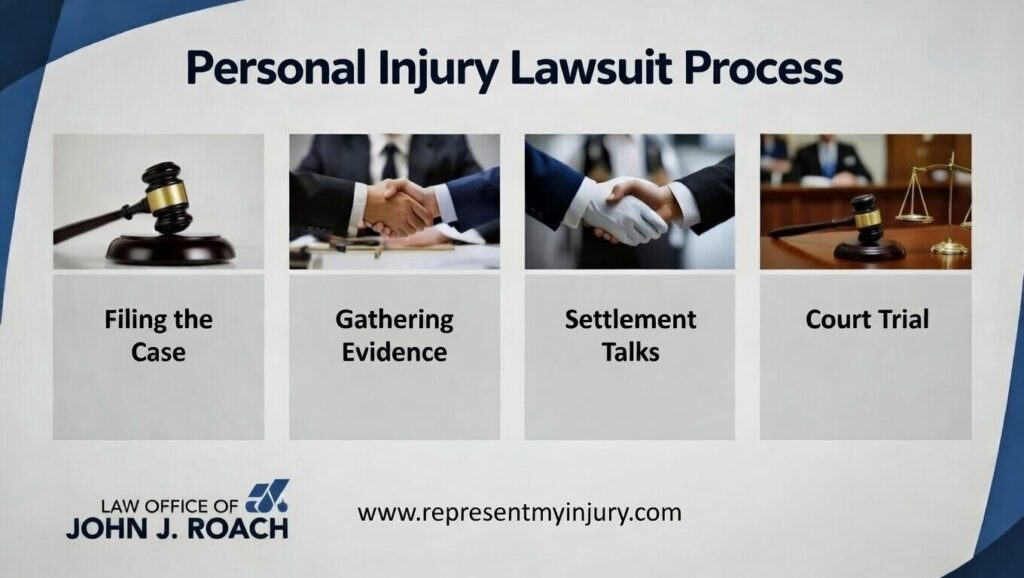
Filing a personal injury lawsuit in California is not the end of the process — it is the beginning. Once the complaint is filed, the case moves into formal litigation that typically unfolds over 12 to 24 months before reaching resolution. Understanding what to expect at each stage helps you make informed decisions about your case and your recovery.
I’m John J. Roach, a San Francisco personal injury trial attorney who has practiced since 2009, handling car accident cases, traumatic brain injury cases, wrongful death cases, and other serious personal injury matters throughout the Bay Area. This is a practical overview of the litigation process in California — what happens, when it happens, and what your role is at each stage.
Stage 1: Service of Process and Defendant’s Response
After the complaint is filed, it must be formally served on each defendant. Under California Rules of Court Rule 3.110, the complaint must be served within 60 days of filing, and proof of service must be filed with the court within that same period.
Once served, the defendant has 30 days to respond. They may file an answer — admitting or denying each allegation — or file a demurrer or motion to strike challenging the legal sufficiency of the complaint. In most car accident and premises liability cases, the defendant files an answer and the case proceeds to discovery. From your initial consultation with an attorney to completed service typically takes at least three months.
Stage 2: Discovery — The Longest Phase
Discovery is the formal process by which both sides gather evidence, exchange information, and evaluate the strengths and weaknesses of the case. It is typically the longest phase of litigation and the one that most directly shapes the outcome at trial or in settlement negotiations.
Written discovery includes interrogatories (written questions that must be answered under oath), requests for production of documents, and requests for admissions. Plaintiffs may serve written discovery 10 days after service of the complaint. Defendants may serve it at any time. Responses are due within 30 days, or 35 days if served by mail.
Depositions are sworn oral examinations of witnesses conducted outside of court. Plaintiffs may notice depositions 20 days after service of the complaint. Depositions must be scheduled at least 10 days out from the notice (15 days if by mail). In serious injury cases, depositions of the plaintiff, defendant, treating physicians, and expert witnesses are all standard components of discovery.

Medical examinations — The defense has the right to have you examined by a physician of their choosing under California Code of Civil Procedure Section 2032. This is called an Independent Medical Examination, though as I explain to every client, there is nothing truly independent about it — the examining physician is hired and paid by the defense.
Subpoenas for records — Both sides subpoena medical records, employment records, and other relevant documents. For employment records, the records custodian must be served 15 days before the production date and the employee must be served at least 5 days before.
In traumatic brain injury, spinal injury, and wrongful death cases, discovery routinely takes 12 months or more given the volume of medical records, the number of experts involved, and the complexity of the damages picture.
Stage 3: Pre-Trial Motions and Mandatory Settlement Conference
California courts require parties to participate in a Mandatory Settlement Conference (MSC) before trial. This is a formal settlement discussion conducted before a judge or court-appointed mediator, aimed at resolving the case without the need for trial.
In addition to the MSC, parties often participate in private mediation — typically a one to two day session with a neutral mediator, usually a retired judge or experienced attorney. Mediation in California personal injury cases typically occurs 9 to 18 months after the accident, after discovery has produced a clear picture of the evidence and damages on both sides.
Approximately 95% of California personal injury lawsuits resolve before trial — either at mediation, during the MSC, or through direct negotiation between counsel in the weeks leading up to trial. I prepare every case as though it will go to trial precisely because that preparation is what produces strong settlement outcomes.
Stage 4: Trial
If the case does not settle, it proceeds to trial. California requires cases to go to trial within five years of filing, though most courts aim to set trial dates within 24 months. Trial length varies from a few days to several weeks depending on the complexity of the case.
Key pre-trial deadlines include: discovery cutoff 30 days before trial, expert witness exchange 50 days before trial (demands for expert disclosure must be served 70 days before trial), and summary judgment motions must be heard no later than 30 days before trial with 75 days notice required.
At trial, a judge or jury hears opening statements, witness testimony, expert opinions, and closing arguments before reaching a verdict on both liability and damages. I have tried cases in San Francisco Superior Court and courts throughout the Bay Area and am fully prepared to take every case I file through verdict if that is what it takes to achieve a just result.
Stage 5: Post-Trial and Appeals
After a verdict, the losing party may file post-trial motions — including a motion for new trial or a motion for judgment notwithstanding the verdict — and may ultimately appeal. Appeals add months to years to the resolution timeline. Many cases settle during the appeals process once both sides have had time to assess the verdict and the risks of continued litigation.
Once a final judgment is entered and all appeals are exhausted, the winning party enforces the judgment and collects payment. In cases where the defendant has insurance — which is the case in virtually all car accident and premises liability matters — payment is made by the insurer.
Key Deadlines and Motion Practice in California
California civil procedure has specific timing requirements that govern every phase of litigation. Missing a deadline can waive a right or result in sanctions. Here are the key deadlines my clients most frequently ask about:
Statute of limitations — Two years from the date of injury for most personal injury cases under CCP Section 335.1. Six months from the incident for claims against government entities. Missing either deadline permanently bars the claim.
Noticed motions — Must be filed and served at least 16 court days before the hearing, with additional days added for service by mail or electronic service.
Ex parte applications — The opposing party must be notified by 10:00 AM the day before the hearing.
CCP 998 offers to compromise — May be served any time up to 10 days before trial. A 998 offer that is not accepted has significant cost consequences if the offeror obtains a more favorable judgment at trial — the other party may be required to pay expert witness fees incurred after the offer was made.
Trial subpoenas — Notice to appear at trial without documents requires 10 days notice; with documents, 20 days.
What Is Your Role as the Client?
Litigation is a collaborative process. Your role as the client is to provide complete and accurate information about your injuries, medical treatment, employment history, and the impact the injury has had on your daily life. You will be asked to participate in your own deposition, attend mediation, and — if the case goes to trial — testify in court.
I keep every client fully informed at every stage and involved in every significant decision. You will always know where your case stands, what the next steps are, and what your options are. The legal decisions are mine — whether to file a particular motion, how to approach settlement negotiations, how to structure the trial presentation. But the major choices — whether to accept a settlement offer, whether to proceed to trial — are always yours.
If you or a family member was seriously injured in a car accident, pedestrian accident, or any other incident caused by someone else’s negligence in San Francisco or the Bay Area, call me at (415) 851-4557 for a free consultation. I work on a contingency fee basis — you pay nothing unless I recover money for you. I am bilingual in English and Spanish and available evenings and weekends.
Frequently Asked Questions: California Personal Injury Lawsuits
Most California personal injury cases resolve within 12 to 24 months of filing, though complex cases involving catastrophic injuries, multiple defendants, or disputed liability can take longer. The discovery phase alone typically takes 6 to 12 months. Approximately 95% of cases settle before trial — either at mediation, during the Mandatory Settlement Conference, or through direct negotiation in the weeks before trial.
Generally two years from the date of injury under California Code of Civil Procedure Section 335.1. If a government entity is involved — such as the City of San Francisco, Muni, or BART — you must file a government tort claim within six months of the incident. Missing either deadline permanently bars your claim. Contact an attorney as soon as possible after any serious accident.
Discovery is the formal evidence-gathering phase where both sides exchange information. It includes written interrogatories, requests for document production, depositions of parties and witnesses, defense medical examinations, and subpoenas for medical and employment records. Discovery shapes the settlement value of the case and typically takes 6 to 12 months in serious injury cases.
Most California personal injury cases do not go to trial — approximately 95% resolve through settlement at mediation, the Mandatory Settlement Conference, or direct negotiation. However, the willingness and ability to go to trial is the most important factor in achieving a fair settlement. Insurance companies offer better results to attorneys they know will try cases. I prepare every case for trial from day one.
A CCP 998 offer to compromise is a formal settlement offer that carries significant cost consequences if rejected. If the offering party ultimately obtains a more favorable result at trial than the 998 offer, the rejecting party may be required to pay the offering party’s expert witness fees incurred after the offer was made. In personal injury cases, these fees can be substantial.
Under California Code of Civil Procedure Section 2032, the defense has the right to have you examined by a physician of their choosing once your physical condition is at issue in the case. Despite being called an Independent Medical Examination, the doctor is hired and paid by the defense insurer and their report is designed to minimize your injuries. Your attorney should prepare you thoroughly for this examination and review the resulting report carefully for inaccuracies.
Disclaimer: This blog post is for informational purposes only and does not constitute legal advice. Consult a licensed attorney for advice specific to your situation.




