

john@representmyinjury.com | January 5, 2026 | California Law
Videotaped Depositions: Key Tool for Personal Injury and Car Crash Cases
Hi, I’m John J. Roach. I run the Law Office of John J. Roach in San Francisco. As a trial lawyer, I help people hurt in accidents. This includes car crashes and other personal injury cases. Today, I want to talk about videotaped depositions. They are a big help in court.
Depositions let lawyers ask questions before trial. Witnesses answer under oath. In California, we can record them on video. This changes how we win cases.
What the Law Says: CCP on Videotaped Depositions
California has rules for depositions. They come from the Code of Civil Procedure, or CCP.
CCP Section 2025.330 lets us record depositions. The main way is with a court reporter. They type everything. But you can also use audio or video.
The party who sets up the deposition can record it on video. They must say so in the notice. Other parties can record too. They need to give notice three days before.
The deposition officer swears in the witness. Testimony goes on record. Objections get noted. But no rulings happen then.
This law allows video in all depositions. It’s not just for special cases.
CCP Section 2025.620 says when you can use depositions at trial. Any part can go against a party who was there or had notice. It must follow evidence rules.
For video, there are extra rules. Especially for doctors and experts.
Does the Witness Need to Be Unavailable?
Many think depositions only get used if the witness can’t come to trial. That’s not always true.
For regular witnesses, yes. CCP 2025.620(c) lists reasons. Like if they live over 150 miles away. Or if they are dead or sick. Or if the court finds special reasons.
But for parties to the case, it’s different. An adverse party can use your deposition for any reason. Even if you are at trial. See CCP 2025.620(b).
For doctors and experts, video can play even if they are available. CCP 2025.620(d) says this. You must reserve the right in the notice. And follow other steps.
So, no. The deponent does not always have to be unavailable. It depends on who they are.
This helps in personal injury cases. Like car crashes. We can show the jury video of the other driver. Or our experts.
Using Video Clips in Any Part of Trial
Video depositions are powerful. You can use clips anywhere in trial.
This includes opening statements. Opening statements tell the jury what to expect. Show a clip of the defendant admitting fault. It grabs attention. It helps win early.
Judges allow this if the clip is admissible. It’s evidence the jury will see later.In the case, use videos to show testimony. Instead of reading transcripts.
In closing arguments, play key moments again. Remind the jury.
For car crash cases, show a witness describe the accident. Or a doctor explain injuries.
Video makes it real. Juries remember faces and tones.
Requirements in the Deposition Notice
To use video, start right. The notice must say so.
CCP 2025.220 lists what the notice needs.It must have the address, date, and time.Name the witness.If documents needed, say what.
Key: Say if you plan to record audio or video.
For doctors or experts, say if you reserve the right to use video at trial.
Give the notice in writing. Serve it on all parties. If you forget, you might not use the video later.
As a trial lawyer, I always include this. It keeps options open.
Benefits of Videotaped Depositions
Videotaped depositions have many upsides. Especially in personal injury and car crash cases.
First, they lock in testimony. Witnesses say things under oath. On camera. They can’t change stories at trial.
If they try, play the video. It impeaches them. Shows they lie.
You can edit clips. Cut to the best parts. For maximum effect. But follow rules. No misleading edits.
Second, save money on experts. Doctors and pros charge high fees to come to court.
With video, record once. Play at trial. No need to pay for live time.
This cuts costs. Helps clients get more money.
Third, backup for surprises. Life is unpredictable. Witnesses might be late. Or sick. Or can’t come.
Have the video ready. Play it instead. Keep the trial going.
In car crashes, eyewitnesses might move away. Video keeps their story alive.
Also, video shows emotion. Tone of voice. Body language. Better than reading words.Juries connect more. They see the pain in a victim’s face.
Or the defendant’s lack of remorse. As a trial lawyer, I use video to build strong cases.
Practice Tip: File a Notice of Joinder for Experts and Treating Doctors
Here’s a key tip for plaintiff lawyers. File a notice of joinder in the defense’s deposition notice. Do this for expert witnesses and treating doctors.
What is a joinder? It means you join their deposition. You add your own notice to theirs.
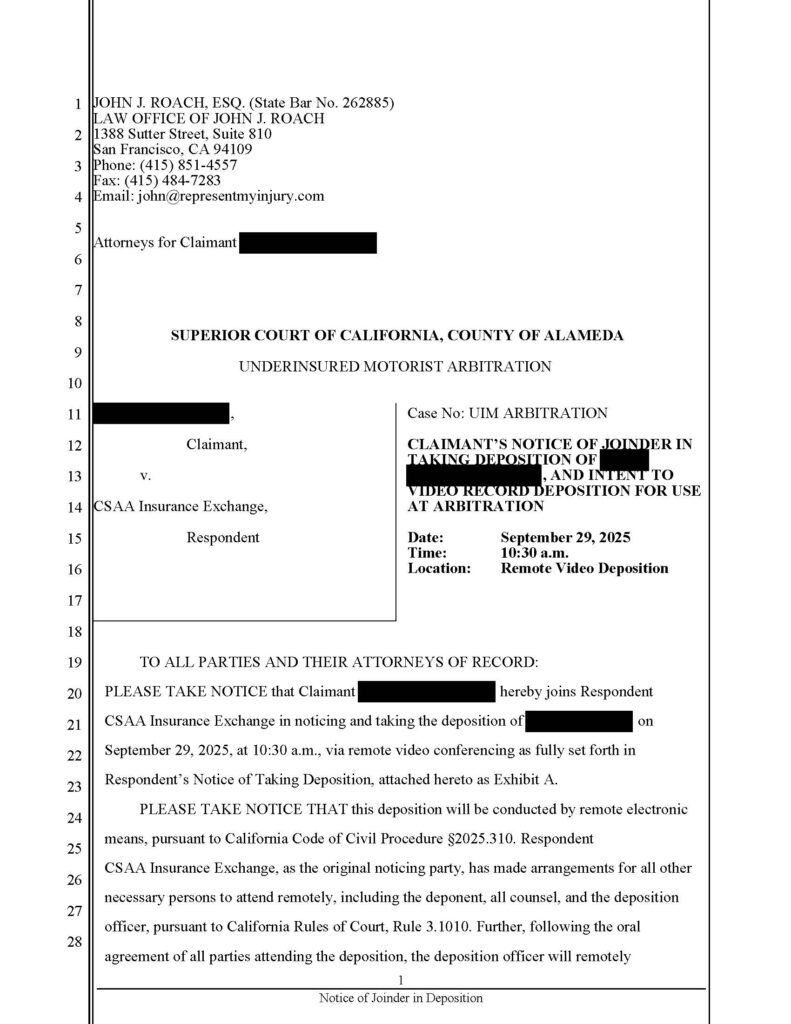
See the example in a real case. In a recenty case, I joined the respondent’s deposition of claimant’s neurologiust. This was an underinsured motorist arbitration.
The joinder notice said the claimant joins the depo. It attached the original notice as Exhibit A.
It noted the depo is remote per CCP 2025.310. And the officer swears in remotely.
Key part: It says the claimant will record stenographically and by video.
It reserves the right to use the video at arbitration. This includes opening, exam, closing.
If the defense cancels, the claimant proceeds.
Why do this? It lets you take a “trial deposition” after the discovery deposition. Defense lawyers notice expert depositions first. Often early in discovery.
They may not be fully prepared. They focus on basics. As plaintiff, join in. Ask your questions. Get favorable answers on video. Lock in good testimony. Before defense preps more.
For treating doctors, same idea. They are your witnesses. But the defense deposes them. Join to control the narrative. Get details on injuries from car crashes.This tactic wins personal injury cases. It surprises the other side.

More on CCP 2025.340 and 2025.620
Let’s dive deeper into the law. CCP 2025.340 covers video recording rules. Subsection (m) is key for experts. It lets you reserve video use at trial.
You must say so in the notice. Or joinder. This applies even if the expert is available.
CCP 2025.620(d) allows video of experts at trial. No need for unavailability. If you reserved it. For any depo, 2025.620 lets you use parts against parties who had notice.
Video adds impact in car crash trials. Show the doctor explaining a brain injury. Or pain from whiplash. These sections empower trial lawyers. Use them wisely.
In the joinder example, I cited these. It made the video usable at arbitration. The same can be done for trial.
Examples on My YouTube Channel
Want to see real examples? Check my YouTube channel. I post clips from videotaped depositions. They show how it works in court.
Visit: https://www.youtube.com/@johnroachesq.5506
See how video wins cases.
Need a Deposition Notice?
Contact Me. If you need a sample deposition notice, reach out. I can send a valid one. It includes video language.
Call my office at (415) 851-4557. Or email me at john@representmyinjury.com.
I help with personal injury. Car crashes.
Why Choose a Trial Lawyer Like Me
In San Francisco, many lawyers settle fast. I prepare for trial to maximize the settlement value. Use tools like video depositions.
This gets better results. Insurance companies know I fight.
If hurt in a car crash, don’t wait. Call now. Statutes of limitations apply.
Let me help you get justice.
If you’ve suffered serious injuries in a San Francisco auto accident, contact me today. Visit https://representmyinjury.com/ for a free consultation and let’s fight for your justice.
Complete our intake form: https://lawofficeofjohnjroach.cliogrow.com/intake/5d22773fd05d3aa4c6bc3d4ff3c7de0a
Disclaimer: This blog post is for informational purposes only and does not constitute legal advice. Consult a licensed attorney for advice specific to your situation.